Legal Spend Management Software
Discover the intuitive, AI-powered legal spend management solution that enables complete visibility and control over spend.
Legal Spend Management: A Guide for In-House Teams
While even the most well-prepared in-house teams can’t predict every M&A deal, regulatory shift, or litigation matter that’s on the horizon, there are proactive measures they can take to ensure that their legal budget is optimized to handle whatever comes their way.
Here we’ll explore what legal spend management is, why it’s important for legal departments to perfect, and how it can be accomplished efficiently and effectively.
What Is Legal Spend Management?
Legal spend management is the practices, strategies, and tools used by organizations to control and efficiently manage their legal expenses. This typically includes overseeing costs related to outside counsel, alternative legal service providers, and other associated legal fees and expenses.
What are the Main Objectives of Legal Spend Management?
Transparency
Organizations need to be able to track and monitor legal costs to understand how funds are allocated and used. Transparency allows for better decision-making and ensures no hidden or unexpected costs.
Cost control
Controlling costs effectively ensures that legal expenditures are in line with budgets and expectations.
Value optimization
Every engagement with outside counsel must deliver business value. Legal spend management gives you the data to make sure firms pair high-quality advice with cost-effective staffing.
Efficiency
Legal spend management helps legal departments streamline operations, automate repetitive tasks like invoice review and spend reporting, and make optimal use of both in-house and outside counsel resources. Efficiency gains enable in-house teams to get more high-impact work done every day, ultimately leading to cost savings by reducing time spent on administrative work.
By focusing on these core objectives, organizations will develop a comprehensive legal spend management strategy that controls costs and prioritizes business value. This approach allows for better alignment with broader organizational goals, leading to more effective and accountable legal operations.
Establishing clear communication and expectations also helps build better relationships with legal service providers.
Legal Spend Management vs. Matter Management
These two disciplines are closely linked, and understanding spend without matter context gives you an incomplete picture.
Matter management tracks the work—who is handling what tasks, how the matter is progressing, and what updates have occurred. Legal spend management tracks the cost of that work—invoices submitted, rates charged, guideline compliance, budget-to-actual, etc.
Together they answer the full question: what work is being done, by whom, for how much, and with what business impact. A strong enterprise legal management platform unifies both in one system rather than forcing you to reconcile two.
Legal Spend Management vs. Legal Invoice Review
Invoice review is a task. Legal spend management is a program.
Invoice review asks whether this invoice complies with your guidelines. Legal spend management asks whether your total legal spend is aligned with business risk, whether your firms are resourcing work efficiently, whether your budgets are realistic, and where next quarter’s costs are heading. Invoice review is one input into that. It isn’t the whole discipline.
How Legal Spend Management Fits Into Enterprise Legal Management
Legal spend management is a foundational element of enterprise legal management (ELM).
ELM covers the full range of legal operations functions—matter management, vendor management, spend management, workflows, reporting, and analytics. Spend management sits at the intersection of e-billing and analytics within that framework.
Legal spend management is also the most common starting point for in-house teams building their ELM tech stack, for one simple reason: outside counsel is typically the largest and least predictable line item in the legal budget, which makes it the fastest place to demonstrate return.
Why Legal Spend Management Matters Now More Than Ever
Three pressures are converging on in-house teams at once.
1. Outside counsel rates keep climbing
Brightflag’s annual analysis of hourly rates in Am Law 100 firms shows continued upward movement, and because roughly half of most legal budgets flow to law firms, even modest rate increases translate into meaningful budget impact.
2. Spend is concentrated
Brightflag’s Outside Counsel Benchmarking Report found that in-house teams direct 64.4% of legal spend to their top 10 firms on average.
Concentration means a small number of relationships drive most of your cost, so improvements in those relationships compound quickly. It also means a rate increase from a single firm can move your whole budget.
3. Workload is growing faster than headcount.
More matters, more regulatory complexity, and more business demand, with flat or shrinking teams. That makes manual invoice review not just expensive but genuinely impossible to do well at scale.
None of this is cyclical. It’s the operating environment. Legal spend management is one of the few levers in-house teams control directly.
7 Signs Your Legal Department Needs Legal Spend Management Software
If several of these sound familiar, you’re likely leaving money on the table.
- You don’t have real-time insight into how legal spend is trending. If basic questions from Finance about your current legal spend require your legal team to collect invoices from inboxes and manually assemble a spreadsheet, you don’t have visibility — you have a scavenger hunt.
- Matters routinely run over budget, and you only find out when the invoice arrives. Cost overruns are normal. Discovering them after the fact is not.
- Your department has a reputation for missing its budget. Consistent variance usually isn’t a forecasting problem. It’s a data problem.
- You’re processing more invoices than anyone can meaningfully review. Once volume outpaces review capacity, spot-checking becomes the de facto process and errors become inevitable.
- Attorneys are spending hours reviewing invoice line items. Every hour a lawyer spends reviewing invoices is an hour of expert judgment spent on clerical work.
- Firms raise rates and you notice later. Unapproved rate increases are one of the most common and most avoidable sources of overspend.
- Finance is frustrated by legal invoices. If accruals are late, invoices arrive in the wrong format, or payment chasing is routine, the friction is costing both teams time.
The Common Challenges of Managing Legal Spend
Understanding what makes legal spend management difficult is the first step towards fixing it.
Limited visibility into matter-level costs
When spend data lives across spreadsheets, inboxes, and PDFs, you can see totals but not drivers. You know what you paid, but you don’t know why.
Non-standardized invoices and complex billing practices
Block billing, inconsistent task descriptions, and varying invoice formats can all obscure what you’re actually buying.
Reactive budgeting and surprise overruns
Without real-time tracking, budgets are set once and revisited when it’s too late to change course.
Difficulty evaluating vendor value
Assessing quality and value without established metrics is guesswork, which makes it hard to justify spend or renegotiate with confidence.
Unenforced billing guidelines
Most departments have outside counsel billing guidelines. Far fewer apply them consistently, because manually checking a hundred-line invoice against a ten-page policy isn’t realistic.
Unreliable forecasting
Without consistent historical data, forecasts default to “finger-in-the-wind” guesses, which satisfies nobody in finance.
Siloed data and internal coordination.
Legal often reports and budgets differently from the rest of the business, which limits insight into total impact.
Key Features of a Successful Legal Spend Management Program
Legal spend management software should be more than just somewhere you go to approve invoices. It should have a robust suite of features that help you optimize your legal spending.
A System of Record for Legal Spend
A legal spend system of record keeps all of your invoices, budgets, and accruals in one place, making it easier to see where your money is going. Your legal service providers can submit invoices and other spend information through the tool’s vendor portal.
Using this spend data, this repository should provide real-time updates on spend and allow users to track spend against budgets. Secure cloud-based storage solutions offer both accessibility and a backup option for this critical data, so you can access it anytime and always know it’s safe. And new AI solutions like Ask Brightflag ensure you don’t need to spend time creating reports to gain insights about your spend data. Instead, simply request the information from the conversational AI tool and get the insights you need in seconds.
The repository should also feature role-based access controls to maintain data integrity, ensuring that only authorized personnel can modify legal spend data.
AI-Powered Invoice Review
Poring over legal invoices to verify that each line item aligns with the work you requested and complies with your outside counsel guidelines is a painstaking process. AI is well suited to handle it.
Brightflag’s patented AI analyzes every line item within a legal invoice, categorizes the legal work performed, and checks it against your billing guidelines without your in-house team having to lift a finger. Non-compliant entries — block billing, excessive research time, disallowed activities — are automatically flagged, and invoices are routed to the appropriate reviewers for approval or escalation.
This matters because line-item interpretation is fundamentally different from keyword matching. Reading and understanding what was actually billed is what produces reliable flags, and reliable flags are what make the review trustworthy enough to act on.
The legal team at SMBC saved $2.7 million by consistently applying their outside counsel guidelines with the help of Brightflag’s AI-assisted invoice review.
Automated Application of Outside Counsel Guidelines
A top-tier legal spend management system should come equipped with functionalities that make it easy to enforce outside counsel guidelines. If any non-compliant charges appear, the tool should flag them for immediate review, eliminating the need for manual oversight.
In addition to acting as the first reviewer on each legal invoice so you don’t have to, the system should make it as easy as possible for your attorneys to review and approve invoices.
Brightflag, for example, sends regular emails to reviewers highlighting invoices awaiting their review, and provides all the context they need to review the invoice directly from their email, such as the details of potential billing issues found by Brightflag AI, and an AI-generated summary of the work performed by outside counsel.
Because the legal landscape and your company’s needs are always changing, the tool should allow for easy updates to billing guidelines. This ensures that the system remains aligned with any changes in legal services, rate adjustments, or regulatory shifts.
Last, the tool should offer training resources or materials to vendors, ensuring that everyone involved in the billing process understands and complies with the guidelines. This simplifies the invoicing process and enhances the relationship with legal service providers by fostering transparency and collaboration.
The Three Billing Guideline Violations Brightflag’s AI Flags Most Often
- Excessive internal communications. Intra-firm conferencing above roughly 15% of billed time warrants a look.
- Unapproved research. You’re paying for expertise, not for a firm getting up to speed.
- Multiple fee earners in the same meeting. One attendee is usually sufficient, with internal updates shared afterward.
Budgeting At Every Level Of Legal Spend
The best practice for legal operations teams is to track budgets at the matter level, the practice area level, and the overall department.
In practice, most legal teams don’t do this. It’s simply too hard to track when your information is locked up in a mishmash of emails and spreadsheets. Or, if your legacy software is too clunky and unsophisticated to track each level.
A good legal spend management tool lets you set and track budgets at each of the three levels. That way, you always have the information you need to see if you’re trending over or under budget. When you’re on top of your budget, it’s also easier to spot spending anomalies and unexpected charges and take corrective action.
Budgeting at all three levels allows legal teams to:
- Stay aligned on strategy and cost. Budgets tied to specific practice areas or matters let teams plan intentionally and ensure external spend aligns with business priorities.
- Spot issues early. Granular budgeting surfaces variances before they become problems. Your overall spend-to-budget might look healthy while litigation sits at 180% of plan.
- Enable accountability without micromanagement. Leaders get oversight; matter leads manage within clear guardrails.
Improve forecasting accuracy. Historical budget data at every level feeds sharper predictions.
Finally, your LSM software should empower you to build the reports you need to be well-equipped for regular and annual budgeting meetings with your finance team.
Getting started: If you’re new to setting matter budgets, focus first on the 20% of matters that drive 80% of your spend—or simply your top 10 highest-spending matters. Across Brightflag customers, teams currently set budgets on 55.5% of matters on average.
Automated Accruals Collection
Accruals, or work-in-progress, are where the legal-finance relationship is either built or strained. Chasing firms by email every month is thankless and slow.
A good legal spend management platform automates the reminders, gives vendors a secure portal to submit through, and feeds the results into your reporting without manual assembly. Dropbox now sees a higher proportion of vendors submitting accruals while spending two days less on accruals each month.
Legal Spend Reporting
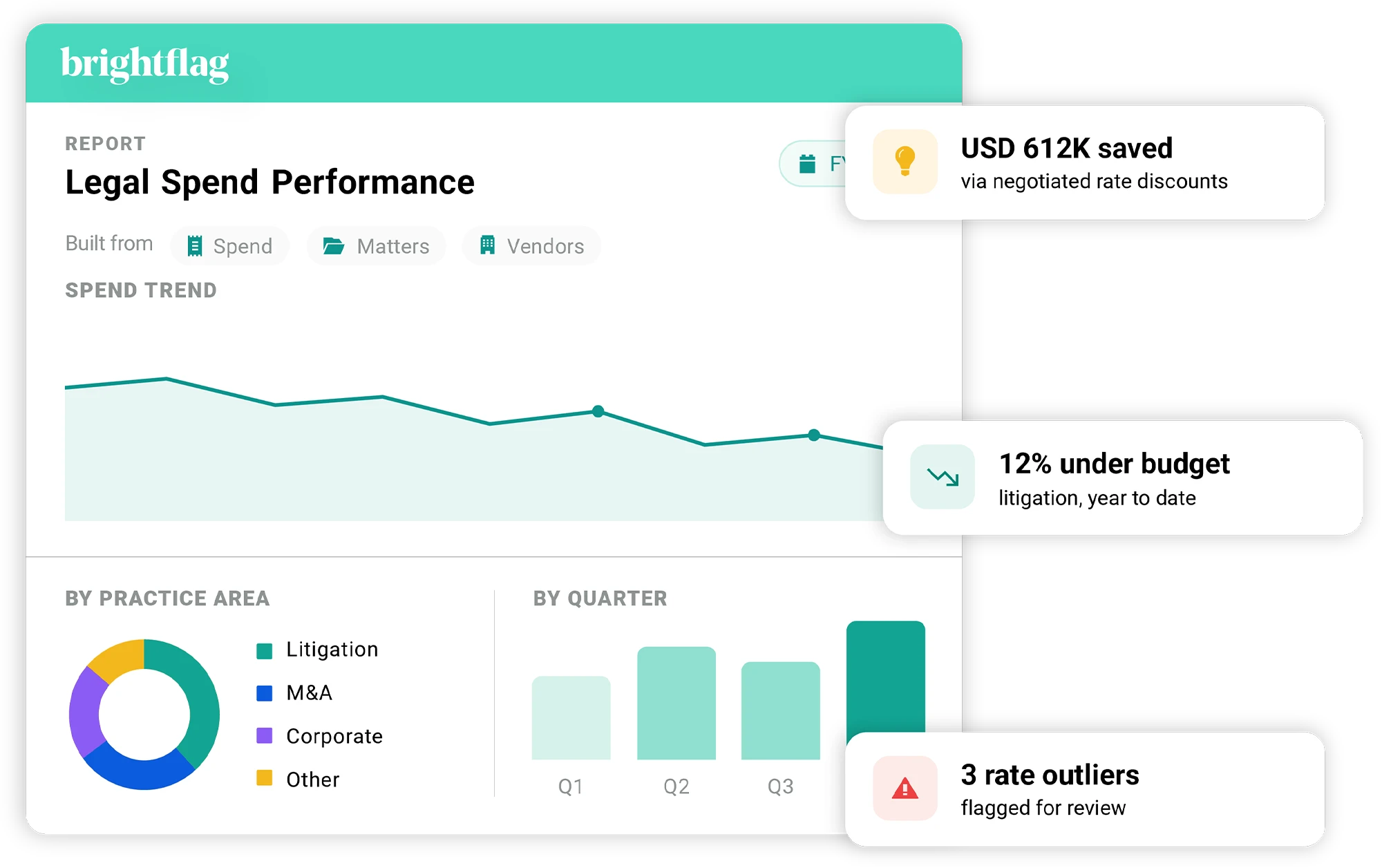
Legal spend reporting helps you transform data into actionable insights. A well-designed legal spend management tool should offer robust tracking and analytics capabilities to facilitate better decision-making.
Your software should have customizable dashboards that provide at-a-glance insights into your legal spending. These dashboards can be tailored to show the most relevant metrics, whether you’re interested in spend by vendor, case type, or geographical region. This enables you to quickly grasp the state of your legal expenditures without having to sift through endless spreadsheets.
In addition, it should leverage generative AI to provide immediate data insights to you and your team, without the need to create reports.
The tool should also offer detailed reporting options that break down legal spend in various ways. Want to know how much you’ve spent on a particular vendor or what matters are driving high spend? The reporting feature should be able to answer those questions and more.
The tool should also offer comparison metrics that allow you to assess your spend against your own historical data and industry benchmarks. This comparative analysis provides a clearer picture of how well your legal spend management efforts are faring.
Of course, all the powerful analysis and fancy reports in the world are useless if you don’t have time to dig into them. That’s why all good LSM tools should include a customer success manager to support you. CSMs operate like an extension of your team, tracking down the trends and offering advice so you can focus on the rest of your work.
Outside Counsel Selection and Management
The most durable savings come from how work is assigned, not just how invoices are reviewed.
Your platform should give you the data to run RFPs, conduct panel reviews, benchmark firms against one another, evaluate resourcing mix, and decide which work genuinely needs a top-tier firm versus a regional firm or alternative legal service provider. It should also flag timekeeper rate increase requests for approval rather than letting them through silently.
Brightflag’s Advanced Vendor Management functionality enables all of this and more.
The Benefits of Legal Spend Management Software
Complete visibility into legal spend
You can’t control what you can’t see. Centralized data means real-time answers about where money is going, by vendor, practice area, matter, business unit, and geography.
Measurable cost reduction
Savings come from several directions at once: recovered guideline violations, negotiated discounts applied automatically, avoided off-rate timekeeper charges, and budget overages caught while there’s still time to act.
A Forrester Total Economic Impact™ study commissioned by Brightflag quantified this across two buyer profiles:
| First-time Buyer | Replacement Buyer | |
| Annual Legal Spend (Composite) | $5M | $10M |
| Three-year ROI | 387% | 335% |
| Payback Period | <6 months | <6 months |
Ocado’s own results with Brightflag landed in similar territory: an overall invoice reduction above 5%, against a CFO target of 3.3%.
Time returned to your team
Brightflag customers have reported invoice review dropping from around 30 minutes per invoice to under three, and attorneys getting back one to five hours a week.
Toll now produces precise divisional spend reports in 15 minutes with Brightflag, and those reports feed group-wide and C-suite reporting.
Better forecasting and a stronger finance partnership
Accurate accruals, real-time budget tracking, and historical run-rate data change how finance sees legal. You stop being the department that surprises them at quarter close.
More objective law firm relationships
Data replaces impressions. Rate benchmarking, resourcing analysis, and compliance history give you an evidence base for panel reviews and rate negotiations, and give firms something concrete to respond to.
A legal department seen as a strategic partner
When you can quantify cost avoidance, efficiency, and resourcing decisions in the same language as every other function, legal’s standing inside the organization changes. That’s the benefit that’s hardest to put on a spreadsheet and the one legal leaders value most.
The Metrics to Track in Legal Spend Management
Less is more. A handful of well-chosen metrics beats a wall of dashboards. These are the ones that consistently drive decisions.
- Spend-to-budget. Track at the overall and practice area level. Overall spend can look on-plan while one practice area is running far over, and practice-area visibility is what lets you act early.
- Spending trends over time. Month-over-month and year-over-year movement by practice area or business unit surfaces shifts you didn’t plan for, like a steady rise in employment litigation, while there’s still time to adjust.
- Blended hourly rate by firm. Total cost divided by total hours gives you a single number reflecting both rates and staffing seniority. It’s the fastest way to spot a firm resourcing work more expensively than its peers.
- Billing guideline compliance rate. The percentage of invoices and line items adhering to your guidelines, by firm. Signals both vendor discipline and internal enforcement.
- Realized savings. Reductions from flags, rejections, and negotiated discounts, tracked as a running total. This is your program’s headline number for finance.
- Percentage of matters with a budget. A direct measure of program maturity.
- Percentage of spend resourced at partner level. Leverage is one of the biggest determinants of matter cost.
- Timely invoice submission. The share of invoices submitted within 30 days of work being completed. Late invoices wreck accruals and forecasts.
- Discounts achieved. Both negotiated rate discounts and volume discounts, measured as realized value rather than agreed terms.
For a fuller framework covering workload, outside counsel, budget, and stakeholder satisfaction metrics, see our Legal Department Metrics Guide.
How AI Is Changing Legal Spend Management
Legal departments are no longer wondering whether to incorporate AI into their spend management. They’re evaluating which AI capabilities actually move the needle.
Three are worth prioritizing.
AI enrichment of invoice data.
Before anything can be analyzed, unstructured invoice text has to become structured data. AI reads each line item and classifies the work performed against a standard taxonomy, which is what makes everything downstream — flagging, benchmarking, reporting — reliable.
Generative AI for instant answers.
Every day, in-house teams field questions like “what’s our legal spend this year by department?”, “how much has Firm X invoiced us?”, and “what are our top open matters by spend?”
Ask Brightflag lets you ask these in plain language and get answers in seconds, with no report-building or menu navigation. It was the first generative AI assistant built specifically for legal spend and matters.
AI agents for first-pass review.
The next step is agents that conduct first-pass invoice review within defined authority, proposing adjustments and escalating anything above a set threshold.
The architectural point underneath all three: AI is only as trustworthy as the system governing it. AI is inherently non-deterministic — ask it the same question twice and you may get two answers. That’s useful for research and drafting and precisely wrong for approval logic, permissions, and audit trails. The right design puts AI inside the governance layer of a system of record, so every flag, adjustment, and approval is consistent and auditable. That’s why your spend data belongs in a governed platform rather than a general-purpose AI tool.
There’s also a rate-sensitivity angle worth watching. If firms adopt AI and reduce hours but raise rates disproportionately, your savings evaporate. Tracking hours and rate trends together is now essential, and it’s a core reason to have both in one system. Our Outside Counsel AI Strategy guide covers how to set expectations with firms on AI use and billing.
Why Brightflag is the Choice for Legal Spend Management
Brightflag’s AI-powered legal spend management software enables you to take control of your legal expenses in multiple ways. This includes automated application of your outside counsel guidelines, AI-enabled data insights, and effective budget enforcement.
With the power of Brightflag’s data analytics, you can gain valuable insights into your spending patterns, helping you make data-driven decisions to control or reduce spend. Here’s what sets it apart:
Patented AI that reads every line item.
Brightflag pioneered end-to-end AI invoice review for legal spend. The AI interprets the work described rather than matching keywords, which is why teams trust the flags enough to act on them.
As one director of outside counsel management told us, there’s a high confidence level in the review — they trust it to flag issues properly.
Proven, independently validated ROI.
A Forrester Total Economic Impact™ study commissioned by Brightflag found 387% three-year ROI for first-time buyers and 335% for replacement buyers, both with payback in under six months.
Ask Brightflag.
The first generative AI assistant built for legal spend and matters, so reporting bottlenecks disappear.
Speed to value.
Implementations measured in weeks. Toll went live in four weeks with minimal friction, helped by the fact that many of its firms already used Brightflag for other clients.
Highly rated customer support.
Brightflag holds a 4.6 average rating on G2 with 30+ five-star reviews. Forrester’s interviewees repeatedly raised support as an unquantified benefit: tickets closed within 24 to 48 hours, and in one case a request resolved within 10 minutes.
Results across industries.
SMBC saved $2.7 million through consistent guideline enforcement. Ocado cut invoices by more than 5% and saved 1,470 hours. Dropbox reclaimed 12 weeks annually on invoice rejections and payment. Sonnedix halved its panel with data-led conversations.
Schedule a demo with Brightflag to take the first step towards proactive spend management.
Legal Spend Management FAQs
What is legal spend management?
Legal spend management is the practices, strategies, and tools organizations use to control and efficiently manage their legal expenses, primarily outside counsel costs. It covers invoice review, billing guideline enforcement, budgeting, accruals, vendor management, and spend analytics.
What is legal spend management software?
Legal spend management software is a platform that centralizes legal invoices, budgets, and vendor data, automatically checks invoices against billing guidelines, tracks spend against budget in real time, and provides reporting and analytics on legal costs.
How can I improve legal cost control for my legal department?
Start by centralizing all legal spend in one system so you can see where money goes. Then document and automate enforcement of your outside counsel guidelines, set budgets at the matter and practice area level, require approval for timekeeper rate increases, and hold regular data-backed reviews with your top firms.
How do I reduce outside counsel legal spend without hurting case outcomes?
Focus on efficiency rather than blunt cost cutting. Enforce billing guidelines consistently, match work to the right level of firm and seniority, set matter budgets with early-warning alerts, use benchmarking data in rate negotiations, and consider alternative fee arrangements for predictable work. Reserve top-tier firms for your highest-risk, most complex matters.
How much can legal spend management software reduce legal costs?
Independent and industry figures cluster in a similar range. In a Forrester Total Economic Impact™ study commissioned by Brightflag, a composite organization based on real customers realized a 2-4% reduction in costs through billing compliance alone, plus additional savings from discounts, rate enforcement, and budget visibility. Ocado achieved an overall invoice reduction above 5%, and SMBC saved $2.7 million through consistent guideline enforcement.
What’s the ROI of legal spend management software?
A Forrester Total Economic Impact™ study commissioned by Brightflag found a 387% three-year ROI for first-time buyers and 335% for teams replacing a legacy platform. These figures were based on composite organizations created from real Brightflag customers.
How long does it take to implement legal spend management software?
Brightflag’s average implementation time is six weeks. Configuration typically takes a single workshop, AP and SSO integration follows, and law firm onboarding runs in parallel. Toll went live in four weeks.
What metrics should I track for legal spend management?
The highest-value metrics are spend-to-budget at the overall and practice area level, spending trends over time, blended hourly rate by firm, billing guideline compliance rate, realized savings, percentage of matters with a budget, percentage of spend at partner level, and timely invoice submission.
What’s the difference between legal spend management and matter management?
Matter management tracks the work: who is handling what, at what stage, under what budget. Legal spend management tracks the cost of that work: invoices, rates, guideline compliance, and budget-to-actual. They’re most powerful integrated in a single platform.
What’s the difference between legal spend management and e-billing?
E-billing is the technology layer for submitting and processing invoices electronically. Legal spend management is the broader discipline that uses that data for budgeting, analytics, vendor management, and forecasting. E-billing is a component; spend management is the program.
Do you need a dedicated system to manage legal spend effectively?
Spreadsheets and manual workflows can suffice early on. Once a department manages significant budgets or processes more invoices than staff can meaningfully review, a dedicated platform becomes necessary for consistent guideline enforcement, real-time budget tracking, accurate reporting, and collaboration with finance.
Is legal spend management software secure?
Enterprise-grade platforms use encryption, role-based access controls, SSO, and compliance with data protection regulations including GDPR. Ask any vendor for their security certifications and trust documentation.
How do I communicate legal spend performance to the business?
Use data to tell a business-focused story, and tailor it to the audience. CFOs generally want ROI, forecast accuracy, and savings realized. Business units care more about resourcing and matter outcomes. Your spend platform’s dashboards should support both without manual assembly.