Legal Department Metrics: A Guide to Measuring and Improving What Matters
 8 chapters
•
8 chapters
•
 12 min read
In This Guide

The 8 metrics every in-house team should track to optimize their work

The keys to effectively tracking legal department metrics

Expert metrics insights from legal operations leader Ashley Adams
Table of Contents
Introduction
Nowadays, in-house legal teams can track a wide variety of metrics and pull data from countless sources. While that might sound like a good problem to have, it can quickly become overwhelming to try to sift through it all in search of insights that actually improve legal work management.
Fortunately, there is a collection of tried and true metrics that legal departments have turned to in order to better understand how well they’re serving the business—and what steps they need to take in order to improve.
In this guide, we’ll cover what those core metrics are—broken down into the four metric categories that matter most—to help your legal department answer key questions about how they are performing. We’ll also hone in on why each metric is important, and how you can go about tracking them.
Creating an Effective Metrics Program
The metrics you focus on should serve as both a map and a compass—showcasing both where your legal team is today, and providing guidance on which direction to progress in the future.
In other words, you want to track data that tells you how effectively you are delivering legal services to your business, and where you can improve going forward. To do so, you’ll want to ensure your metrics address these four key questions, which will give you a holistic view of your legal department’s impact on the business:
• How effectively are we managing our workload?
• How well are we leveraging outside counsel?
• How efficiently are we managing our budget?
• How satisfied are our stakeholders in the business with legal service delivery?
Less is more when it comes to metric tracking. Developing multiple overly complex dashboards is a surefire way to overwhelm yourself and your stakeholders, and makes deriving actionable insights from your data that much harder.
The Key Metrics to Track and Why They Matter
Now that we understand how to set the stage for effective metrics tracking, let’s take a deeper look at the key metrics legal teams should track. Below we’ve broken down each set of metrics into the four categories that are most impactful.
1. Metrics That Improve Workload Management
The best way to maximize the value legal delivers to the business is by ensuring the legal team can focus their time on the highest-impact work.
In order to do that, it’s vital to measure your legal team’s workload, as well as where legal work is originating from within the business—and how that’s changing over time.
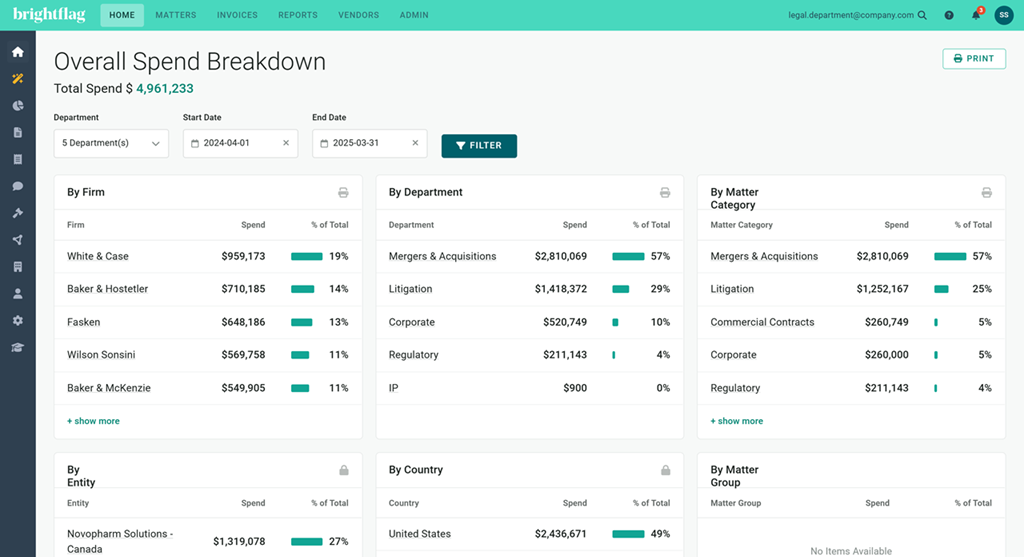
Metric: Matters by Region/Practice Area
Sorting matters based on the regions and practice areas they pertain to is a great way to understand, at a glance, which areas of the business are driving the most legal work.
Why It’s Important
Having this information can be useful for sparking strategic conversations with the business areas driving the most legal work and outside counsel spend.
If large tranches of your work pertain to intellectual property, for example, you can sit down with your product team to better plan for similar work that may be coming down the pipeline in the future. This way your team can be better prepared to handle that workload when it arrives.
This metric can also be useful for ensuring your team is adequately staffed to handle workload increases in certain practice areas and/or jurisdictions.
How to Track It
The best way to track this metric is to use your e-billing and matter management system to report on the number of matters opened by region and practice area.
Metric: Matter Risk and Complexity
It likely goes without saying, but not all matters are created equal.
That’s why having insight into a matter’s level of risk and complexity is important—because it allows you to have a more comprehensive understanding of how much time and attention each matter will require.
Why It’s Important
If you’re not tracking this aspect of your matters, you may find yourself in a situation where an individual or team appears to be working on fewer matters, when in reality the demand placed on them is actually increasing due to the high complexity of the matters coming in.
How to Track It
To track risk and complexity, require that your team classifies matters as either low-, medium-, or high-risk and complexity when opening a matter in your e-billing and matter management system.
This, of course, requires a bit of work up-front in order to make those designations. However, this can really pay dividends down the road by painting a fuller picture of the level of work your legal team is engaged with.

Metric: Matters-per-Attorney
Your legal team’s bandwidth will almost always be in flux based on the volume and nature of the work coming in. That’s why it can be very difficult to tell where the bottlenecks of capacity are within the department, and how workloads are increasing or decreasing over time.
The only way to strategically allocate new work—or make the case for additional headcount to manage rising workloads—is to know how much capacity the members of your team have.
Why It’s Important
When measured at the level of individual teams and attorneys, this metric helps to balance workload across teams and team members, ensuring that individuals aren’t over-burdened at peak times. When measured in aggregate, this metric is also great at highlighting increases to the volume of legal work coming across the desk of your in-house team over time.
If it’s a sizable increase, you can use the data to build a business case for additional resources—like a new hire, ALSP, or piece of legal technology—to help lighten the load.
How to Track It
Use your e-billing and matter management system to track how many matters have been opened and assigned to each attorney within a given time period. This will help you determine how many matters each legal professional is handling, and provide you with a clearer sense of how much bandwidth your team has for more work.
2. Metrics That Facilitate Better Outside Counsel Management
Outside counsel spend typically comprises ~50% of the legal budget, and outside counsel firms perform about the same percentage of all work delivered by the in-house legal team. With so much work falling on outside counsel’s shoulders—and so many financial resources devoted to them—it’s critical to be able to track their performance and ensure your business is receiving as much value as possible from them.
Metric: Blended Rate
A law firm’s blended rate represents the average price they charged for one hour of legal work. It is useful for comparing the cost of engaging different firms for the same work.
Why It’s Important
The blended rate charged by a law firm gives you a high-level overview of how efficient your firms have been in resourcing their work.
Because it can be influenced by both the rates of individual timekeepers and the seniority of fee earners that are assigned to work (e.g. partners vs. junior attorneys), it is a useful metric for signaling instances where it would be beneficial to dig a bit deeper into the rates and resourcing of a particular law firm.
When leveraged effectively, this metric can drive meaningful conversations around rates and resourcing with your outside counsel firms which can ultimately result in cost savings.
How to Track It
Divide the total hours billed by a firm within a certain period by the total cost of services during that period. Your e-billing and matter management system may also provide out-of-the-box reporting on law firm blended rates.


Metric: Outside Counsel Guideline Compliance
Outside counsel guidelines are used by in-house teams to outline their expectations regarding how outside counsel should manage matters, billing practices, budgets, and other aspects of their work.
However, it doesn’t matter how exhaustive your outside counsel guidelines are if they’re not being complied with.
Why It’s Important
Ultimately, you want to do business with outside counsel firms that strive to meet the standards you set for the legal work you send their way. By tracking guideline compliance, you can identify which firms have adhered closely to your guidelines, and build a case for a deeper conversation around compliance with the firms who haven’t.
How to Track It
With Brightflag, you can easily pull data on the percentage of spend billed in breach of your outside counsel guidelines for each firm. That’s because the platform leverages its patented AI to automatically review every invoice line item against your outside counsel guidelines and flag any work that was not in compliance. This will give you a clear sense of how effectively each firm addresses your billing requirements.
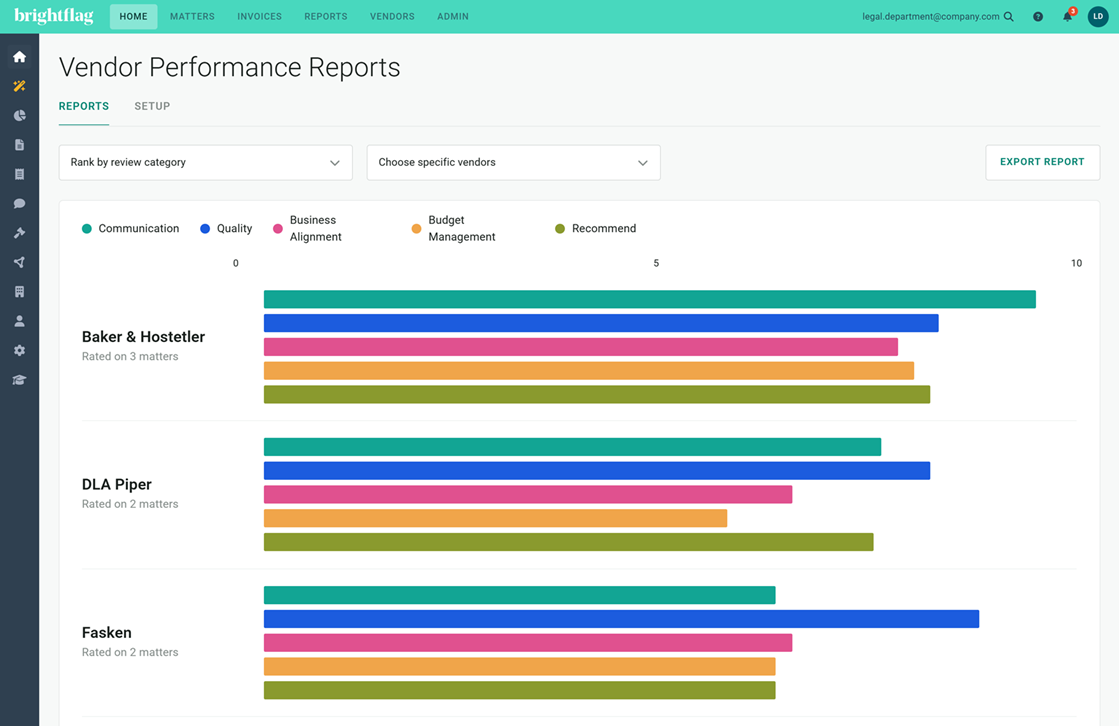
Metric: Qualitative Performance
It goes without saying that your legal department, and by extension your business, benefits from working more closely with their best-performing law firms. Effective evaluation of outside counsel performance should involve assessments of overall work quality, as well as communication and responsiveness.
Why It’s Important
Knowing which outside counsel firms perform the best, most efficient work can help your legal department make strategic resourcing decisions.
One example would be consolidating the number of firms that your in-house team sends work to, and ensuring your best-performing law firms get the lion’s share of your instructed work. You can then work to negotiate volume-based discounts with those firms to reflect the increased amount of work your team sends their way going forward. In this instance, your legal team would receive higher-quality work while also reducing costs.
How to Track It
Set up a short outside counsel performance assessment that internal matter leads must complete every time a matter is closed. Or, for larger matters, matter leads can provide performance reviews periodically during the course of the matter in order to gauge the quality of work at each stage. These assessments can then be automatically submitted and stored within your matter management platform for easy tracking and reference.

3. Metrics That Demonstrate Effective Budget Management
The legal department’s number one priority is to protect the organization from risk. In order to do that effectively, it needs to build trust with internal stakeholders. Oftentimes that requires demonstrating that delivering value to the organization is also top-of-mind for the legal team.
This can be a difficult task though—especially if your legal department doesn’t have the data they need to illustrate their commitment to being reliable financial stewards.
By harnessing the metrics below, your legal department can showcase its ability to speak the language of business (i.e. money) while simultaneously shielding the organization from risk. This, in turn, positions legal as a strategic partner to the business, and strengthens the relationship between legal and internal stakeholders like finance.
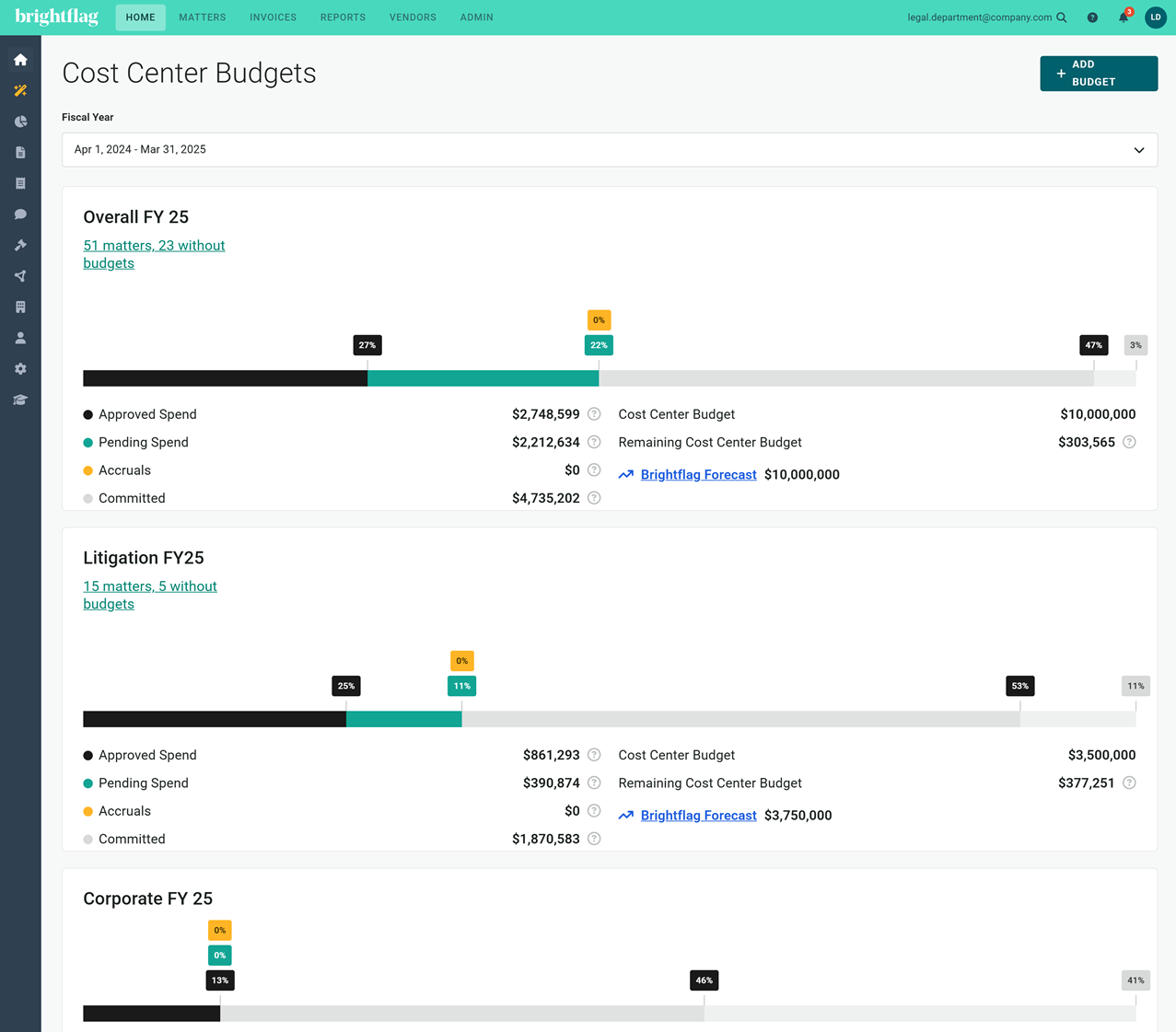
Metric: Spend-to-budget
Legal’s reputation as a reliable financial steward within the organization is contingent on its ability to effectively manage its budget. Tracking spend-to-budget at the overall and practice area level gives your in-house team the visibility they need to make budget management possible.
Why It’s Important
At the overall level, this metric shows how your spend is tracking against legal’s budget for the year.
However, this metric becomes more meaningful for proactive financial management if you also track spend-to-budget at the practice area level, because it’s at this level that it can be used to address potential issues before they become significant problems.
For example, there may be instances where your overall spend-to-budget is on-track, but diving deeper into practice area spend-to-budget reveals that litigation is already at 180% of budget. Knowing this could spur your legal team to reassess resourcing in order to mitigate any future issues this particular budget overrun might cause further down the line.
How to Track It
Create your overall and practice area budgets for the year in your e-billing and matter management system. The system can then automatically track spend to each of these budgets in real time.
Metric: Spending Trends
In addition to tracking spend-to-budget, it is useful to track how spend is changing over time to identify meaningful trends or patterns. As with spend-to-budget, you can track this at the overall level, and by practice area or business unit.
Why It’s Important
This is a great metric for highlighting areas where spend is trending differently than expected—allowing you to readjust your resourcing going forward.
For instance, you may notice a steady rise in your employment litigation spend that you didn’t account for in your annual plan. Noticing this early may prompt you to dig into the cause and identify that it’s the result of an increase in wrongful termination claims. This would help you readjust your expectations for spend in that area going forward—as opposed to looking up at the end of the year and being surprised to find you shot by your annual employment litigation budget.
How to Track It
Your e-billing and matter management tool should provide out-of-the-box reporting on spending trends over time.

4. Metrics that Illustrate Business Value
Ultimately, the legal department exists to deliver legal services to the business.
The metrics outlined above can help your legal team better serve that goal. But an additional layer of metrics can also be rolled out to measure the effectiveness of the above programs, and the overall satisfaction of the business with the in-house team’s legal service delivery.
Metric: Satisfaction Scores
This metric will shine a light on how effectively your organization feels your legal team has handled their requests for legal services.
Why It’s Important
Getting an outside perspective on how well your in-house team is managing their work can illuminate areas of strength, as well as where their work is ripe for improvement.
How to Track It
Set up a simple survey in a tool like Google Forms or Sharepoint that asks these two questions:
• How satisfied are you with the legal services provided to you by the legal department? Rate on a scale of 1-5, from very dissatisfied to very satisfied.
• What’s the reason for your score?
Keeping it short and sweet will increase your chances of receiving feedback from those being surveyed. To track progress, you can send this survey out quarterly to everyone in your organization that requests legal services.
Conclusion
An effective metrics program tells you where you are today and provides indications of how you can improve in the future.
With this streamlined set of metrics, your legal department can answer key questions about the value legal provides to the business, chart a clear path forward, and improve the perception of legal within the business along the way.
Brightflag’s intuitive e-billing and matter management platform has helped hundreds of in-house teams track and leverage metrics to improve legal service delivery, reduce costs, and be more strategic with their work. For a personalized look at how Brightflag can help you track and act on the metrics that matter, schedule a demo with us today.
Related Resources



See Brightflag in action
Put this playbook to work. See how legal teams use Brightflag to manage outside counsel, control spend, and prove their value — in a 30-minute walkthrough.