Enterprise Legal Management Software
See how Brightflag's AI-powered enterprise legal management solution helps legal teams manage matters, vendors, and spend.
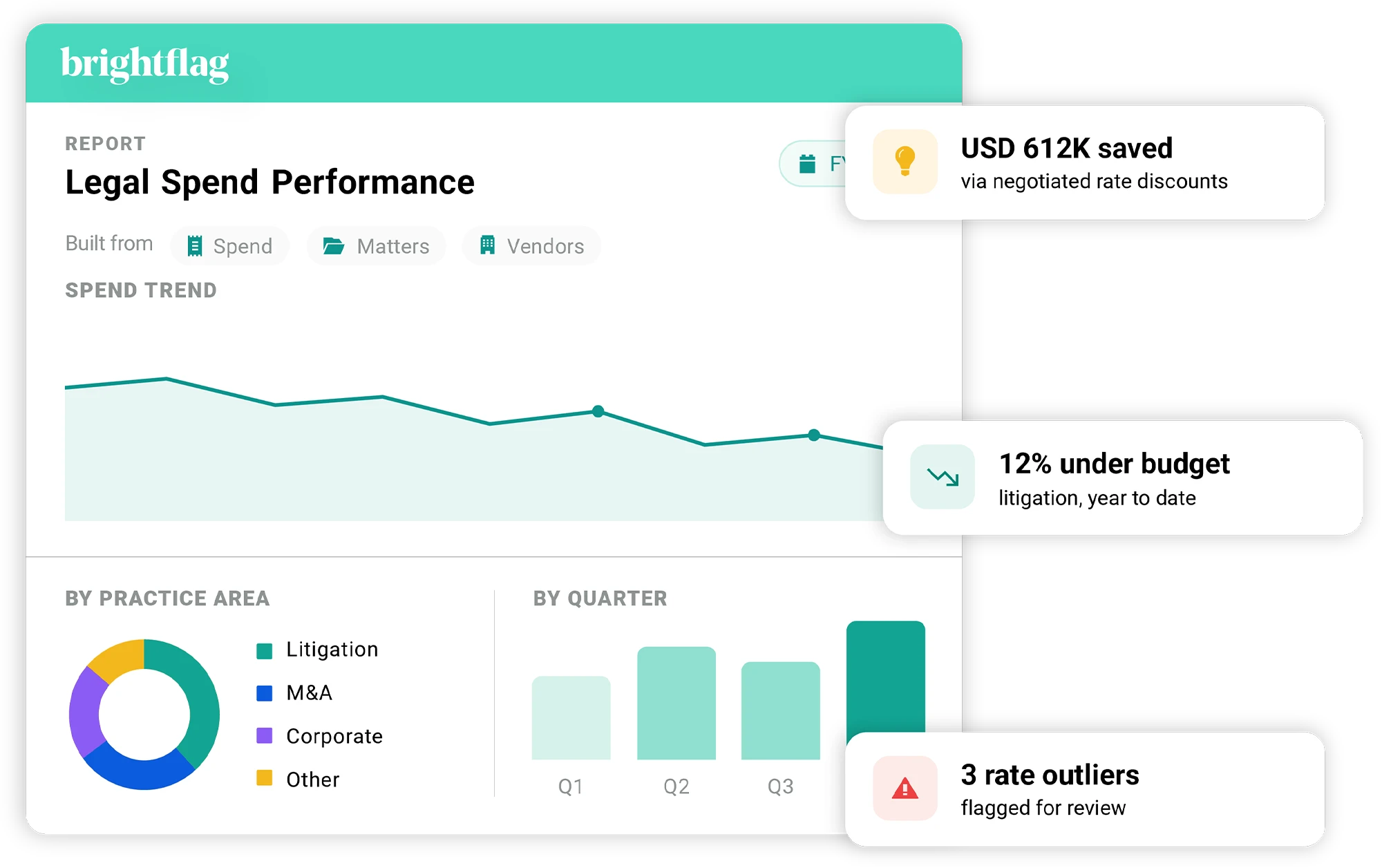
Over the past ten years, we’ve seen a seismic shift in how in-house counsel gets work done—driven in large part by the adoption of AI-powered enterprise legal management software.
These days, legal teams need a robust enterprise legal management solution to unlock new efficiencies, reveal crucial insights, and provide proactive, data-driven strategies for their organizations.
This guide covers what enterprise legal management is, the tasks it handles, the benefits it delivers, what separates AI-native platforms from legacy systems, and how to choose the right one.
What Is Enterprise Legal Management Software?
Enterprise legal management (ELM) software is the digital platform in-house legal teams use to manage matters, outside counsel, and legal spend in one place. It replaces the mix of email, spreadsheets, and disconnected tools that legal departments without an ELM solution typically rely on.
Enterprise legal management software streamlines administrative tasks like legal invoice review and tracking matter updates so your in-house team can focus on high-impact legal work.
With in-depth, real-time reporting, ELM tools also provide a 360-degree view of all legal department activities. This allows legal departments to easily track and analyze their legal spend and identify potential cost savings.
Adoption is now the norm rather than the exception. A recent CLOC State of the Industry report found that 85% of legal departments use electronic billing and 78% use matter management technology—the two foundational ELM capabilities—making it the most established system-of-record category in the legal tech stack.
Enterprise Legal Management vs. Contract Lifecycle Management
These two categories are frequently confused, and the distinction matters when you’re deciding where to invest first.
- ELM governs the operating infrastructure of the legal department—matters, intake, outside counsel relationships, budgets, invoices, and reporting.
- CLM governs the contract lifecycle—templates, clause libraries, negotiation, execution, and renewal.
They’re complementary rather than competing, and most mature departments run both, integrated. For most in-house teams, ELM comes first—outside counsel spend is typically the single largest line item in the legal budget, and it’s an area where an ELM can deliver the clearest, fastest potential return-on-investment.
Who Uses Enterprise Legal Management Software?
- Legal operations professionals administer the platform and own reporting, billing guidelines, and vendor management.
- General Counsel and CLOs use it to see the full picture of legal work and spend, and to report that picture to the board and the executive team.
- In-house attorneys use it to open matters, track progress, and approve invoices.
- Finance teams rely on it for accruals, forecasts, and AP integration.
The Components of an Enterprise Legal Management System
The core components of an ELM system include matter management, legal spend management, vendor management, and reporting.
Legal Matter Management
For legal matter management, an ELM acts as the centralized system for tracking and organizing all legal matters. It allows legal teams to keep tabs on all the updates and deliverables assigned to each matter, and collaborate with outside counsel partners on work.
The system also allows the analysis of matters based on various criteria like a matter complexity, the practice area, and who is involved. This helps with prioritizing work and allocating resources.
Legal Spend Management
A key aspect of legal spend management is e-billing. E-billing simplifies the process of receiving, reviewing, and paying legal invoices, all while ensuring compliance with outside counsel guidelines.
Legal spend management provides tools to analyze legal spending, identify trends, and uncover cost-saving opportunities. This analysis includes tracking spend by law firms and matter types.
Legal spend management also assists in setting and tracking budgets for different legal matters and automatically collecting monthly accruals, which helps legal ops teams maintain financial discipline and predictability.
Vendor & Outside Counsel Management
Your ELM serves as the system of record for all your vendor data, capturing historical insights into rates, staffing mixes, spend, performance, and more.
In an ELM system like Brightflag, this data can be used to streamline RFPs, firm selection, panel reviews, and rate negotiations, transforming them from conversations based on impressions into conversations based on numbers.
Reporting Tools
Enterprise legal management systems offer dynamic reporting and dashboards that provide real-time insights into legal operations, including spend analysis, matter progress, and outside counsel compliance rates. They enable the creation of customizable reports tailored to the legal department’s specific needs.
Integrations
A modern ELM connects to the systems the rest of your business already runs on—AP and ERP for payment, SSO for access, and business intelligence tools for cross-functional analysis.
Brightflag supports AP integration via email, batch file, or API, and most customers add deeper integration in a second phase after go-live.
What Legal Department Tasks Can Enterprise Legal Management Software Help With?
This is where ELM stops being abstract. Here’s the everyday work it absorbs.
|
Task |
What ELM changes |
| Opening and categorizing matters | One-step matter opening replaces email-and-spreadsheet intake |
| Reviewing outside counsel invoices | AI checks every line item against your guidelines; humans can opt to review flags in more detail |
| Enforcing outside counsel guidelines | Applied consistently to every invoice |
| Setting and tracking matter budgets | Historical data informs the budget; the system alerts you before you breach it |
| Collecting monthly accruals | Automated reminders and a vendor portal replace manual chasing |
| Managing timekeeper rates | Approved rates enforced automatically at submission |
| Benchmarking law firm performance | Rate, resourcing, and efficiency data across your whole panel |
| Running panel reviews and RFPs | An evidence base for consolidation and renegotiation |
| Reporting to finance and the C-suite | Reports in minutes instead of days |
| Forecasting the legal budget | Run-rate data by matter type turns guesswork into calculation |
| Allocating work across the in-house team | Visibility into who has bandwidth for new matters |
The Benefits of Enterprise Legal Management Tools
Most corporate legal teams are getting hit with more legal work than ever. At the same time, headcounts remain stagnant, and in-house budgets are flat or decreasing.
All that adds up to legal departments that increasingly need to find ways to maximize their resources.
That’s where enterprise legal management software can help. Enterprise legal management solutions transform legal departments’ operations, enhancing efficiency, visibility, and strategic decision-making.
Improve Visibility
Enterprise legal management tools help legal teams understand the work being done across the legal function, and track spend across vendors by matter, practice area, and more.
Armed with this end-to-end visibility, legal teams can transition from reactive to proactive management. They can spot inefficiencies, streamline operations, and ensure that all team members are on the same page and working cohesively towards aligned goals.
Streamline Administrative Work
Every moment in-house attorneys spend on administrative tasks is time taken away from addressing core legal matters.
Thanks to ELM software automation, an attorney no longer loses hours each weekday consumed by poring over invoices line by line. Neither are legal ops managers wasting time searching through a maze of disconnected emails and spreadsheets to piece together legal spend.
Instead, this software centralizes all the disparate pieces of information into a coherent, easy-to-access, single source of truth.
Taking work like invoice review off the plate of your in-house attorneys frees their time to focus on solving legal problems for your business. Reducing time spent on repetitive tasks like reporting and searching for information about ongoing matters also affords legal ops teams the space and time to focus on strategic initiatives with a deeper impact and a higher value for the legal team.
In a Forrester Total Economic Impact study commissioned by Brightflag, one head of legal operations described going from 30 minutes per invoice review to under three by using Brightflag. Another organization’s attorneys got back between one and five hours a week.
Enforce Outside Counsel Guidelines
AI-powered ELM tools make it easy to check invoice line items against outside counsel guidelines.
Manually checking every part of a 100-line-item invoice against your outside counsel guidelines is painstaking. In practice, in-house attorneys eyeball the invoice’s bottom line, spot-check the big-ticket items, and then approve the invoice.
The result? A company potentially paying more for legal services due to issues like double billing, inadvertently paying for basic research, or inefficient staffing, like several fee earners billing time for attending the same meeting or call.
Brightflag’s enterprise legal management solution uses AI to automatically compare line items against outside counsel guidelines and flag discrepancies, overcharges, and violations.
This not only ensures transparency in billing but actively contributes to substantial cost savings over time. Across billions of dollars in invoices, the three most common issues Brightflag AI surfaces are consistent year over year:
- Excessive internal communications. Intra-firm conferencing above roughly 15% of billed time on an invoice is worth a second look.
- Unapproved research. You’re paying for expertise, not for a firm getting up to speed.
- Multiple fee earners in the same meeting. In most cases one attendee is sufficient, with internal updates shared afterward.
Increase Value Received From Outside Counsel
Enterprise legal management tools help you benchmark your vendors, negotiate more cost-effective pricing, and move work to lower-cost vendors.
You can use your enterprise legal management’s reporting features to understand which law firms offer the best blend of rates, staffing, efficiency, and expertise to handle your legal matters.
You can also monitor and assess vendor performance against pre-determined benchmarks. For example, you might discover a particular firm is the best for your IP disputes based on metrics like their hourly rates and how quickly and efficiently they settle matters. With that information, you can approach the firm about taking on all of your intellectual property litigation and negotiate a volume discount.
Brightflag’s Outside Counsel Benchmarking Report found that in-house teams direct 64.4% of legal spend to their top 10 firms on average. A small number of relationships account for most of your budget, which means small improvements in those relationships compound quickly.
Set Realistic Budgets
ELM software makes it easy to track legal spend against your budget in real time.
Forecasting legal spend is difficult. Setting budgets at a matter, practice area, or department level without the data from a modern ELM is throwing darts blindfolded.
Using an ELM, you can immediately tap into your historical data to understand your run rate of spend within a specific matter type or practice area. You can use this to make data-driven assumptions about future spend and inform your finance team of the budget you need to effectively serve the business in future financial periods.
But the value doesn’t stop there. Your ELM will also automatically track spend to budget and alert you if you’re going over so you can have proactive conversations with the legal team and with finance to course-correct.
Manage Accruals
Accruals are an essential aspect of financial management for any corporate legal department. Handling unbilled estimates efficiently can significantly improve the partnership between legal and finance teams.
Modern enterprise legal management systems like Brightflag offer streamlined processes to manage accruals effectively. This starts with automated reminders to vendors to submit their accruals, eliminating the need for legal ops to manually follow up.
ELMs provide a secure, central portal where vendors can submit those accruals. That’s music to the ears of any legal ops pro who has wasted time tracking the back-and-forth conversations between their company and an outside vendor to get up-to-date accruals figures. It’s also better for vendors to have a consistent, organized, single source of truth for their financial obligations.
Elevate How the Business Sees Legal
The benefit that’s hardest to put on a spreadsheet may be the most valuable one. When you can quantify legal cost control, cycle time, and resourcing efficiency in the same language every other function uses, legal’s standing inside the organization changes.
Toll’s legal department now produces precise divisional reports in 15 minutes by using Brightflag—and those reports are included in group-wide and C-suite reporting. That’s a legal team participating in how the business is run, not just reporting on what it spent.
The ROI of Enterprise Legal Management Software
In January 2026, two Forrester Total Economic Impact™ studies were commissioned by Brightflag, based on interviews with Brightflag customers.
For first-time buyers of an ELM platform, Forrester modeled a composite organization with $5 million in annual legal spend and found:
- 387% three-year ROI
- Payback in under six months
- $777,806 in three-year present-value benefits against $159,697 in costs
For teams replacing a legacy legal operations platform, with $10 million in annual legal spend:
- 335% three-year ROI
- Payback in under six months
- $1.24 million in three-year present-value benefits
The benefits broke down across five areas: improved billing compliance, savings from discounts, avoided timekeeper rate charges, more effective spend from better budget visibility, and invoice review productivity.
Check out the Forrester TEI studies commissioned by Brightflag to learn more.
What Makes AI Enterprise Legal Management Platforms Different
Nearly every ELM vendor now claims to incorporate AI. The question worth asking in an evaluation is where the AI sits in their system architecture—because that determines whether you can trust it.
Think of a modern legal tech stack in terms of four building blocks:
- The system of record governs matters, vendors, and spend. It enforces business rules, manages state, controls permissions, and keeps the audit trail.
- AI enrichment turns unstructured data into structured data—reading an invoice and classifying every line item against a standard taxonomy like UTBMS.
- AI agents take action within defined authority, such as conducting first-pass invoice review and escalating anything above a set threshold.
- AI workspaces provide the natural-language layer where people ask questions of governed data.
Here’s the point that decides architecture: AI is inherently non-deterministic, and a system of record exists to be deterministic. Ask a general-purpose AI the same question twice and you’ll get two different answers. That’s a feature for research and drafting — and precisely the wrong characteristic for invoice approval logic, permissions, and audit trails. You don’t want creative approval rules. You want rules applied consistently, every time.
So the right design doesn’t swap governance for AI. It puts AI inside the governance layer. Platforms that get this right deliver three things legacy ELM can’t:
- Line-item intelligence, not keyword matching. Brightflag’s patented AI reads and interprets the work described in every invoice line item, then flags discrepancies, overcharges, and guideline violations.
- Answers on demand. Ask Brightflag gives legal professionals a natural-language interface to governed spend data, so “how does this firm’s rate profile compare to our panel average?” becomes a natural language question that can be answered in seconds, rather than a reporting project.
- An architecture ready for what’s next. With ELM systems of record that allow governed data to be accessed via MCP servers, your matter, spend, and vendor data can safely be accessed by AI workspaces like ChatGPT, Claude, and Gemini—with permissions and audit trails intact.
Most ELM systems were built before the age of AI and lack enrichment, MCP integrations, and agents entirely. Many govern matters and spend but not vendors. The gap between AI-native and AI-retrofitted platforms is widening, and it shows up in adoption.
How to Choose an Enterprise Legal Management Platform
You should evaluate enterprise legal management software on the following criteria:
- Speed to value. A platform you haven’t rolled out delivers nothing. Ask for realistic timelines backed by named references. Toll went live with Brightflag in four weeks.
- Law firm adoption. Your firms have to actually use it, or the data is incomplete. Ask whether vendors can submit invoices in the formats they already use rather than being forced into LEDES, and whether firm onboarding carries a fee.
- AI architecture. Ask specifically: does the AI read and interpret line items, or match keywords? Is it governed by the system of record, or bolted alongside it? Can every automated decision be audited?
- Integrations. AP/ERP and SSO at minimum. Ask about API and MCP access if you’re planning for AI workspaces.
- Reporting flexibility. Can a legal ops manager build a custom report without filing a support ticket?
- Customer success. The most underweighted criterion in evaluations and the most frequently cited in post-purchase satisfaction. Brightflag’s customers consistently mention Brightflag’s support as an unquantified benefit in G2 reviews.
What Implementation Looks Like
A modern ELM implementation runs in weeks, not quarters. The main workstreams are platform configuration (importing billing guidelines, setting invoice review workflows, building matter templates), system integration (AP and SSO first, with deeper integrations often deferred to a second phase), and law firm onboarding.
The level of effort required from your team is lower than most people expect. Brightflag’s average implementation time is around 6 weeks.
See Enterprise Legal Management Software in Action
If you’re poised to lead your legal team into the future and wonder where to begin, a trusted and comprehensive enterprise legal management solution is your answer.
The legal technology market is projected to reach $50 billion by 2027, and over 90% of legal departments now use at least one legal AI tool. Get the system of record right, and everything above it has governed, trustworthy data to work from.
Start by exploring ELM solutions, understanding their features, and evaluating their impact. And when you’re ready to transform your legal operations, book a demo with Brightflag.
Enterprise Legal Management FAQs
What is enterprise legal management software?
Enterprise legal management software is a platform that gives in-house legal departments one system to manage matters, outside counsel, and legal spend. Core capabilities include matter management, e-billing, budgeting, vendor management, legal invoice review, and reporting.
What is the difference between ELM and CLM?
ELM manages the legal department’s overall operations—matters, vendors, spend, invoice review, and reporting. CLM manages contracts specifically, from drafting through renewal. They’re complementary, and most mature departments run both.
Who uses enterprise legal management software?
Legal operations professionals administer it, General Counsel use its reporting, in-house attorneys use it for matter tracking and invoice approval, and finance teams rely on it for accruals and forecasting.
What is the ROI of enterprise legal management software?
A Forrester Total Economic Impact study commissioned by Brightflag found 387% three-year ROI for first-time buyers and 335% for teams replacing a legacy platform, with payback under six months in both cases.
Savings come from billing compliance recovery, discounts, rate enforcement, better budget visibility, and reclaimed time. You can get an estimate of your legal department’s own ROI with Brightflag’s ROI Calculator.
How do I build a business case for enterprise legal management software?
Start with your annual outside counsel spend and apply conservative ROI assumptions. Add invoice review hours saved at a fully burdened rate, then layer in accrual and reporting time. Pair the financial case with a visibility narrative for your CFO.
How long does it take to implement ELM software?
Weeks rather than months with a modern platform. Configuration, AP and SSO integration, and law firm onboarding are the main workstreams. Average implementation time for Brightflag is about 6 weeks.
Does enterprise legal management software work for smaller legal teams?
Yes. A Forrester Total Economic Impact study commissioned by Brightflag found that a first-time-buyer composite organization with $5 million in annual legal spend returned a 387% ROI. The threshold is less about team size than about whether your outside counsel spend is material and currently unmanaged.
Can ELM software track and control legal spend?
Yes. ELM monitors budgets in real time, checks invoices against billing guidelines, enforces approved timekeeper rates, and surfaces cost-saving opportunities across firms and matter types.
How secure is ELM software?
Enterprise-grade platforms use encryption, role-based access controls, SSO, and compliance with data protection regulations including GDPR. Ask any vendor for their security certifications and trust documentation.