How to Create an Outside Counsel AI Strategy
 6 chapters
•
6 chapters
•
 9 min read
In This Guide

Insights into how law firms are using AI today

Tips for encouraging optimal AI usage by outside counsel, and measuring its impacts

Advice on how to communicate outside counsel AI wins to internal stakeholders
Table of Contents
Introduction
Generative AI has arrived—and it’s poised to revolutionize the legal profession as profoundly as the internet did.
In the near future, lawyers will be backed by entire teams of AI agents capable of performing research and document review, identifying trends and conducting analysis, and drafting advice and recommendations.
The foundation for this future is already being laid, with law firms actively exploring generative AI applications and integrating them into their workflows. This presents a strategic opportunity for in-house legal teams, who can leverage their outside counsel’s usage of AI to create efficiencies in legal service delivery that ultimately benefit the business.
However, many in-house teams remain uncertain about how to navigate this new terrain and set expectations around law firm AI use, measure its impact, and communicate its value to their stakeholders.
Brightflag is uniquely positioned to help. We’ve spent the last 11 years building AI solutions for managing outside counsel. Our platform analyzes billions of dollars in legal work annually, giving us unmatched insight into how AI is transforming law firm resourcing, work delivery, and cost structures. We’ve also built our own generative AI agent, Ask Brightflag, to help in-house teams work smarter.
In this guide, we share the best practices to help legal departments:
- Encourage the best use of AI by outside counsel
- Set appropriate guardrails
- Measure the impact of AI adoption by outside counsel on legal service delivery
How Law Firms Are Using AI Today
Top law firms are actively experimenting with generative AI and have identified several areas in which it can drive the most impact.
Some in-house teams might be tempted to ban law firm use of generative AI on their matters for fear of the risks it creates in terms of confidentiality and/or quality. However, this approach is neither realistic nor productive.
The truth is, AI will only continue to proliferate and become embedded in the tools lawyers use every day. Google currently uses generative AI for its search summaries, and legal research platforms, document review tools, and even standard word processing software are also integrating genAI into their offerings. Avoiding AI altogether will ultimately only serve as a disadvantage to legal professionals.
Rather than resisting change, in-house teams should establish a proactive framework for outside counsel to leverage AI on their matters. Done right, AI can lead to the same or higher-quality legal services delivered at a better price.
Here are just some of the ways firms are leveraging generative AI today:
“At Orrick we have 35 approved GenAI tools and are tracking more than 100 use cases.
GenAI is changing the way we approach due diligence, data analysis, discovery, trial preparation, contracts, legislative summaries, industry insights and board presentations, just to name a few. We partner with our clients to identify opportunities to use this technology across tasks and workflows completed by the firm and our clients.
We are seeing meaningful impacts on efficiency and speed, and as the technology improves, we expect greater impact on the quality and value of services.
All industries have the common challenge of determining where GenAI will have the greatest impact. We work closely with our clients, technology partners, law schools, investors and the broader legal tech ecosystem to benchmark the rapidly evolving AI landscape.”

“At Gunderson Dettmer, we’re using agentic Generative AI systems that provide detailed information to our lawyers, grounded in trusted sources, in a fraction of the time.
We are leveraging the power of semantic search of our document and knowledge repositories alongside current information from the web via Perplexity. By giving our lawyers access to on-demand, AI-powered insights and streamlined workflows, we’re freeing up time for more strategic, high-value work and making expert legal support accessible at speed and scale to our clients in the innovation economy.”

Encouraging Optimal Use of AI by Outside Counsel
AI-driven efficiencies can significantly reduce the cost and turnaround time of legal work, but only if outside counsel adopt AI thoughtfully and in alignment with your expectations. Consider the following core principles to ensure optimal AI adoption by your outside counsel:
- Encourage smart use: Outside counsel should be encouraged to adopt generative AI tools where they improve work quality and/or result in work being delivered at a better price.
- Protect your data: Your data should not be used to train AI models unless the model is purpose-built for your exclusive use.
- Avoid pass-through costs: Firms should not charge clients for their AI tools or computing resources. Billable time should reflect the effort and expertise of human lawyers, not the background infrastructure supporting them.
These principles are essential to making law firm AI adoption a strategic asset rather than a source of added risk or cost.

To ensure optimal use of AI by your firms, we recommend you add the below AI provision to your outside counsel guidelines:
USE OF ARTIFICIAL INTELLIGENCE
The Firm should use Artificial Intelligence (AI) tools to improve the efficiency and quality of legal services. Where AI is used, the following conditions apply:
- Review and Security: The Firm remains responsible for the accuracy, appropriateness, and legal integrity of all deliverables and must maintain strict safeguards to protect Client confidentiality and data security. Client data must not be used to train AI models unless the model is purpose-built and used exclusively for Client data.
- Fair Billing and Efficiency Gains: AI should be used where it results in equal or higher-quality outcomes at lower cost, and the Firm is expected to proactively adopt such tools where appropriate to maximize the outcomes achieved for the Client. The Client should benefit from reduced costs where AI decreases the time or effort required to complete a task. Any efficiency or time savings achieved through the use of AI must be reflected in the Firm’s billing.
- Compliance: The Firm’s use of AI must comply with all applicable laws, professional regulations, and ethical obligations.
Measuring the Impact of AI on Your Matters
AI should lead to the same or higher quality work delivered at a better price. But how can legal departments know whether those efficiency gains are happening?
With Brightflag’s enterprise legal management platform, it’s easy to track key metrics that measure the impact of law firm AI adoption.
Here are the key metrics legal teams should monitor:
Overall Efficiency Gains
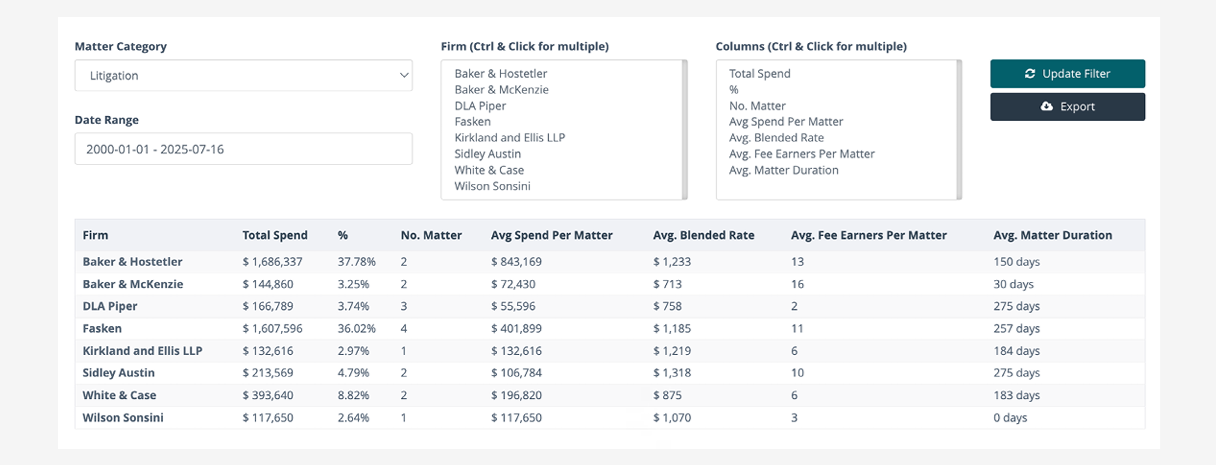
- Fewer hours billed per matter: Track whether firms are reducing effort while maintaining outcomes.
- Fewer timekeepers per matter: Leaner staffing can indicate better use of technology.
- Faster turnarounds: Measure how quickly matters are closing relative to historical benchmarks
Note: When evaluating these metrics, remember to control for matter risk and complexity. Higher risk and/or more complex work naturally takes more time and requires more fee earners for successful completion.
Brightflag helps control for these factors by letting you assign a risk and complexity score to each matter, so you can compare like with like. You can also segment the data by geography, practice area, or business unit to ensure you’re making equitable comparisons.
Reduced Time Billed for Routine Tasks
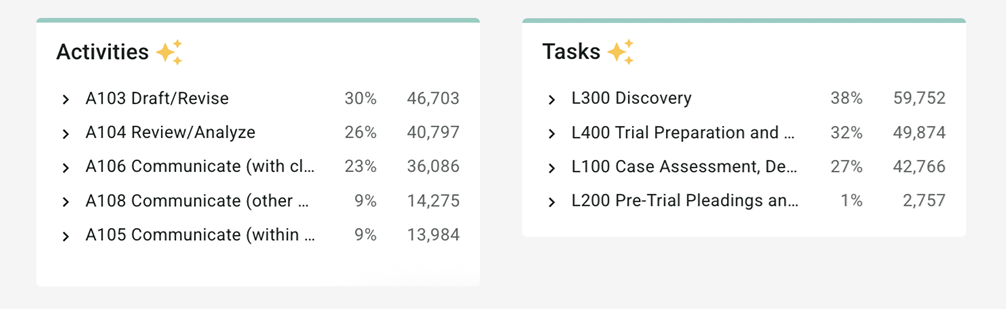
AI should reduce time spent on:
- Internal firm communication
- Project management
- Drafting documents
- Legal research
- Discovery tasks (in litigation)
- Due diligence reviews (in M&A)
A tool like Brightflag, which uses AI to automatically track how much time your firms are spending on activities like internal communication and tasks like discovery, helps you assess whether the time spent on these types of work is decreasing as your firms adopt generative AI.
Rate Sensitivity
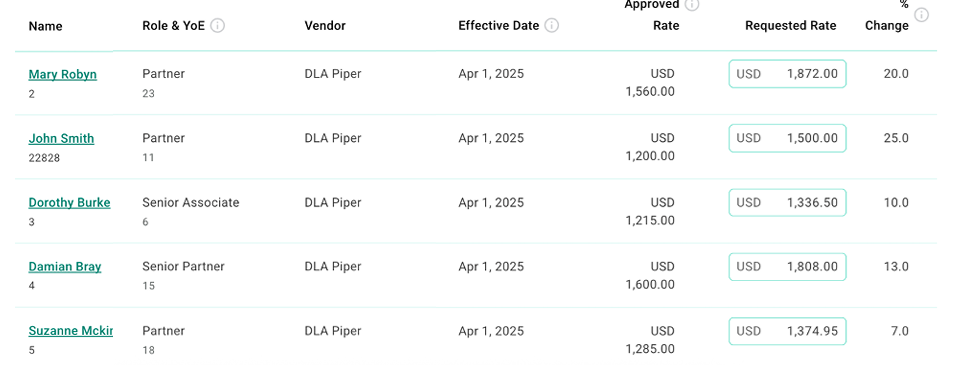
Even if AI reduces hours worked, rising rates can negate savings. That’s why tracking timekeeper rate trends is more important than ever in the era of generative AI.
Firms adopting AI should be delivering cost reductions. If rate increases are disproportionately large, they could offset the efficiencies gained. Brightflag enables in-house teams to track both trends together.
Benchmarking with Data
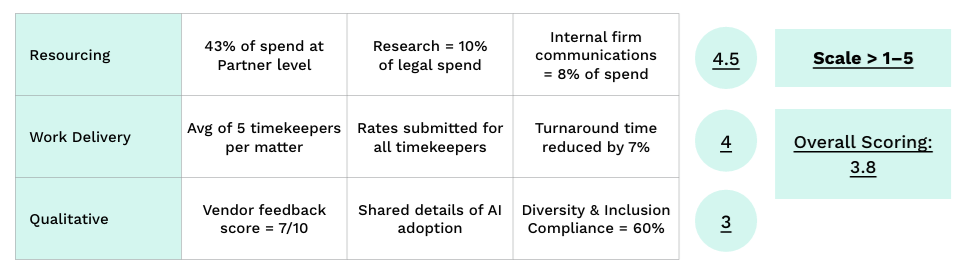
Use these metrics to create a performance leaderboard showing which firms are using AI most effectively. Share this data (in anonymized form) during firm relationship reviews to help lagging firms catch up and encourage all vendors to keep pace with best practices.
Communicating Outside Counsel AI Wins
Every in-house legal team today is being asked to demonstrate how they are using AI to drive efficiency, improve service quality, or reduce costs. Yet most teams face limited budgets, limited bandwidth, and pressure to carefully prioritize the few AI tools or initiatives they can realistically test each year.
Meanwhile, outside counsel are experimenting with and adopting AI while working on your matters. This makes them a natural extension of your AI strategy.
Legal departments should position outside counsel AI adoption as a core part of their AI strategy. To underscore the impacts of this initiative, it’s essential to clearly communicate how you’re driving law firm AI adoption on your matters and the benefits it’s creating across your organization.
What to Communicate (and to Whom)
Ensure you’re regularly sharing updates to your legal team, executive team, and wider business about:
- Why outside counsel AI adoption matters: Law firms handle a significant portion of your legal work. When they use AI, they can deliver higher-quality services faster and at lower cost, thereby driving better outcomes for your business.
- What the legal team is doing to support AI adoption:
- Updating outside counsel guidelines to encourage beneficial use of AI
- Making AI a core part of firm relationship reviews
- Tracking the real impact of AI use with data from Brightflag
- The value delivered to the business:
- Faster matter resolution times
- Lower matter costs
- More scalable, predictable legal service delivery
By proactively highlighting these efforts, legal departments can show that they are embracing innovation responsibly and strategically, earning credibility as both stewards of quality and drivers of transformation.
Conclusion
Generative AI is reshaping the legal profession, and in-house teams and law firms both have a key part to play in that change. With the right expectations, guidance, and monitoring in place, your outside counsel can be a powerful driver of innovation and efficiency that ultimately benefits your in-house team and the organization at large.
You don’t have to embark on the difficult task of managing your law firms’ AI strategy all by yourself, though.
By partnering with Brightflag, you’ll gain the tools and data needed to:
- Encourage meaningful, measurable AI adoption
- Demonstrate the impact of AI across your legal matters
For a personalized look at how Brightflag can help you execute a successful outside counsel AI strategy, book a demo with us today.
Related Resources

See Brightflag in action
Put this playbook to work. See how legal teams use Brightflag to manage outside counsel, control spend, and prove their value — in a 30-minute walkthrough.