Law Firm Billing Rates Report
Trends & Drivers within the Am Law® 100
 12 min read
In This Guide

A breakdown of the latest timekeeper rate trends within the Am Law® 100

Insights into how law firm AI adoption is impacting billing rates in 2026 and beyond

New analysis of how rates charged by Am Law® 100 firms’ UK offices compare to their US counterparts

Tips on how to mitigate the impacts of rate increases on your legal budget
Table of Contents
Introduction
Every year, timekeeper rate increase requests roll in like clockwork from outside counsel firms. And every year, in-house teams must ask themselves: Are these numbers reasonable?
Brightflag’s Law Firm Billing Rates Report, sourced from billions of dollars in analyzed outside counsel spend, provides corporate legal departments with the valuable benchmark data they need to answer that question with confidence.
This year, we’ve included new data on how firms are resourcing and completing work in the age of AI. This data shows early indications that AI may be contributing to new efficiencies and leaner staffing among Am Law® 100 firms. Still, rates continue to show substantial year-over-year increases, with this year’s average blended hourly rate settling in at $1,248, an 8.1% increase from 2025.
Below we’ll explore why AI efficiencies may actually be contributing to rising timekeeper rates. And we’ll dive deep into the other factors playing the most impactful role on outside counsel pricing, including: firm ranking, practice area, geography, and resourcing mix.
Additionally, we’ll be sharing some fascinating new data points in this year’s report, including:
- Am Law® 100 UK rate data. With Am Law® 100 firms continuing to expand their footprint in the UK, we take a look at how median timekeeper rates within UK offices compare.
- Recommendations you can act on. Practical guidance on combining these benchmarks with your firms’ historical performance data, drawn from your system of record for spend, matters, and vendors, to maximize the value of every outside counsel partnership
Methodology
This report analyzes billed rates from the Am Law® 100: the 100 highest-revenue U.S. law firms, as ranked by ALM*.
Brightflag’s dataset reflects billions of dollars in annual outside counsel spend. For the 2026 analysis, billed rates from January 1 through June 30, 2026 were included. For other years, full-year data were used. All figures are based on billed rates (the actual rates invoiced by firms), rather than rack rates or requested increases, providing an accurate reflection of what in-house teams are paying.
ALM Global Properties, LLC is the owner of U.S. Trademark Registration No. 2313571 for the mark “The Am Law® 100”
2026 Law Firm Billing Rates
The blended hourly rate among the Am Law® 100 rose by 8.1% in 2026, reaching $1,248 per hour.
This increase is roughly in line with the 8.3% year-over-year increase seen in 2025. It continues a three-year trend beginning with 2024’s 10% hike that has seen annual rate increases far outstrip the rate of inflation.
Notable Trend: Rates Declined Among Am Law® 101–200 Firms
While Am Law® 100 rates continued to rise, 2026 marked the first year since we began tracking data in 2021 where firms in the Am Law® 101–200 tier show a statistically significant decrease in rates.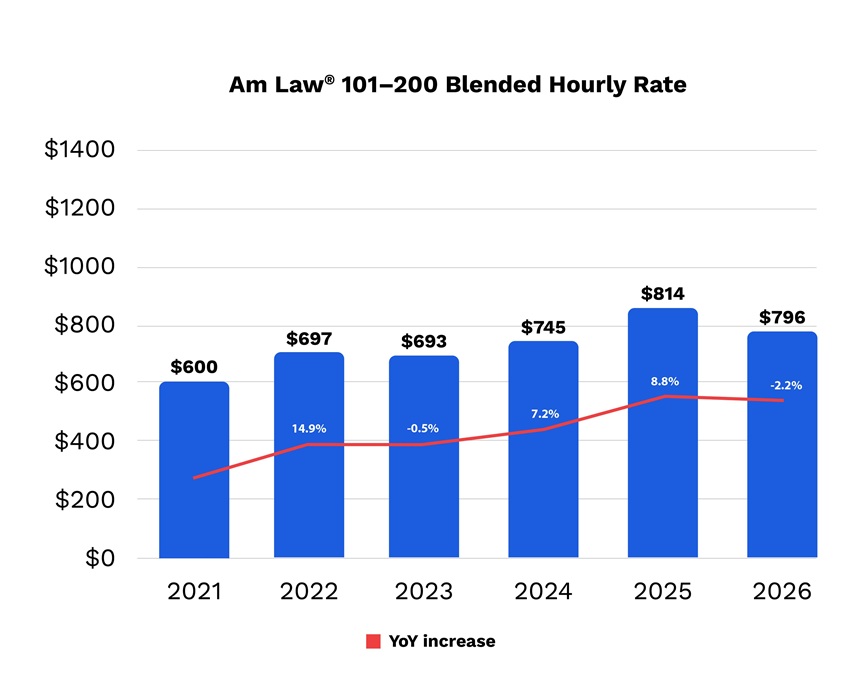
Possible explanations for this dip include:
- Increased competition for work within this band of firms, driving more competitive pricing
- Lower likelihood of high-risk, bet-the-company work being resourced to firms in this tier, resulting in a higher degree of comfort (and a higher likelihood of success) for legal departments that push back on rate hikes
The takeaway? Shifting appropriate work to firms outside the Am Law® 100 may result in even greater savings than usual this year.
AI’s Impacts on Law Firm Pricing
In last year’s report, we predicted that law firms’ increasing investment in legal AI tools could drive meaningful internal efficiencies and, as a result, notable impacts on how outside counsel firms both deliver and price their legal services.
Three metrics captured in Brightflag that we speculated could signal AI-driven efficiencies were:
- Hours Billed Per Matter
- Average Junior Associates Per Matter
- Average Time to Matter Close
This year, we’re sharing the data on those three key metrics, as well as insights into how recent trends may be shaping rates.
Metric: Hours Billed Per Matter
What the Data Showed
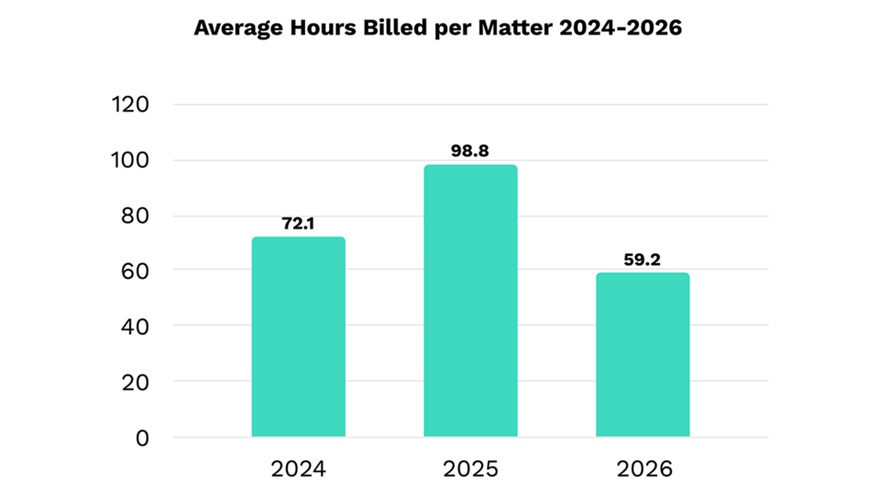
The average number of hours billed per matter fell from 98.8 in 2025 to 59.2 in 2026—a significant 40% reduction, and the lowest total in the last 3 years.
Takeaway
As legal AI tools automate historically time-consuming tasks like research, drafting, and revisions, the amount of hours billed for those tasks will likely continue to decline, leading to fewer hours billed per matter.
Metric: Matter Staffing
What the Data Showed
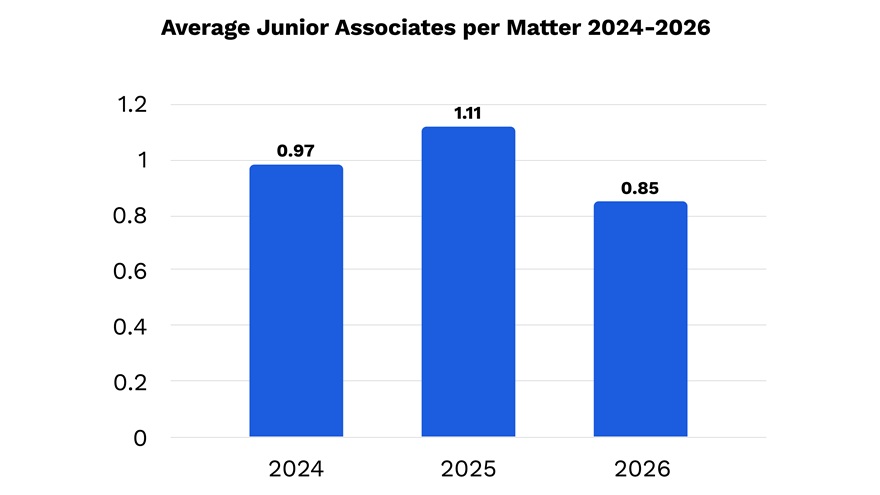
On average, there were 0.85 junior associates staffed on each matter in 2026—a 23.4% decline from 2025, and the lowest ratio of junior associate staffing in three years.
Takeaway
AI tools excel at many of the tasks that junior associates have typically been assigned, likely leading to an uptick in the use of AI and a reduction in the number of junior associates required to close some matters.
Metric: Time to Matter Close
What the Data Showed
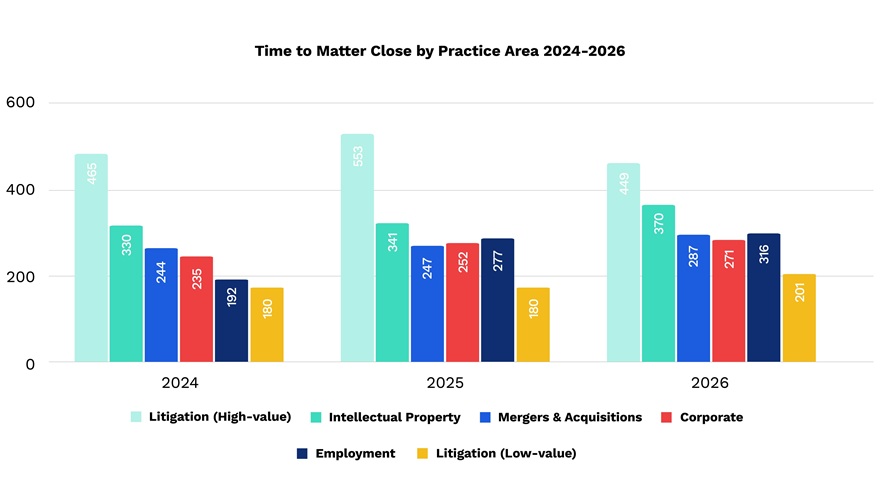
2026 marked the continuation of a three-year trend that has seen the average time to matter close moderately increasing across all matter categories, with the exception of high-value litigation.
Takeaway
It was reasonable to expect AI efficiencies within firms to drive down the average time to matter close, especially given that the total number of billable hours has declined. However, that didn’t end up being the case in 2026.
One possible explanation is delays caused by external matter dependencies. Court backlogs, regulatory agency slowdowns, and extended due diligence periods are just a few variables outside a law firm’s control that might have extended time to matter close without actually resulting in additional billable hours.
It’s also important to note that, because 2026 consists of partial year data which includes long-running matters that carried over from 2025, this year’s numbers may skew longer. A clearer picture of time to matter close trends will emerge once the full-year data is available.
How AI Efficiencies May Be Impacting Outside Counsel Rates
On the surface, fewer hours-billed-per-matter and fewer junior associates staffed on matters seem like trends that would result in cost savings opportunities for legal departments.
However, the reality is more complex.
To maintain revenue, firms are likely to adjust their pricing to offset the impacts of new staffing mixes and the reduction in billable hours. This may partially explain why rates have continued to rise substantially this year despite AI’s growing impacts on efficiency.
To contend with this, legal departments should develop an outside counsel AI strategy that clearly outlines their expectations around their law firms’ AI usage—and how related cost savings are ultimately passed on to their in-house team.
For tips on creating those guidelines, check out Brightflag’s Outside Counsel AI Strategy Guide.
The Key Drivers of Rates
Rates aren’t set in a vacuum. Several drivers shape what in-house teams actually pay, including: firm ranking, practice area, geography, and how matters are resourced.
Each factor represents a decision point when deciding which outside counsel firms to engage. That means each factor also represents an opportunity for legal teams to exert meaningful control over where their budget goes—and what rates they end up paying.
Here we’ll break down the latest trends in how these key drivers are influencing rates so your legal department can make informed decisions around how they resource their matters.
Firm Size
Firm ranking remains one of the strongest predictors of hourly rates. In 2026, partners at the top 25 firms charged an average of $1,909 per hour—a 16.7% increase over 2025, and nearly double the $1,004 average charged by partners at firms ranked 76–100.
Additionally, associates at top 25 firms billed $1,208 per hour, which outpaced even partner rates at firms in the back half of the Am Law® 100.
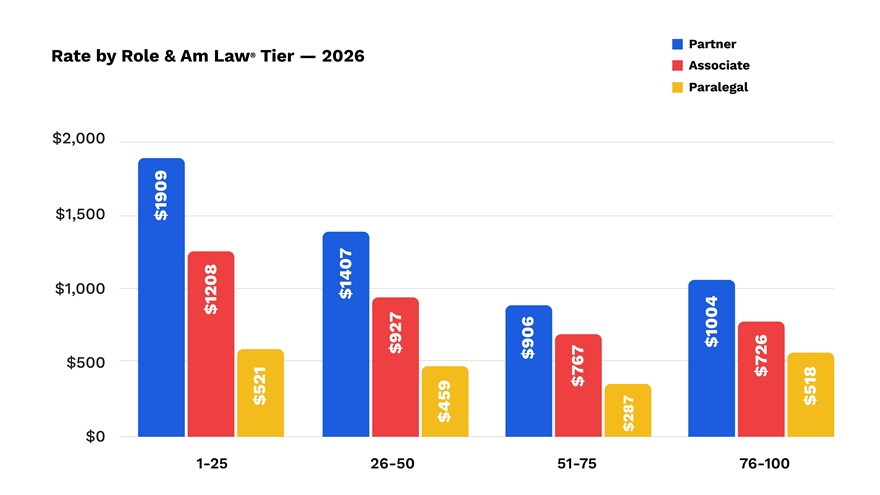
This data highlights the premium commanded by top-ranked firms and the potential savings available by reallocating lower-risk or routine work to smaller firms, even within the Am Law® 100.
Practice Area
M&A and corporate work remain the highest-priced practice areas.
In 2026, M&A partners at top-25 firms billed $2,089 per hour, a 13.3% increase from 2025. Corporate partners followed at $1,940 per hour, which represented a 14.6% increase year-over-year.
While practice area sets the baseline for rates, in-house teams still have meaningful opportunities to influence cost, particularly in their choice of firm ranking, the staffing mix applied to matters, and, where appropriate, the use of ALSPs for repeatable work like document review.
Geography
Rates continued to vary significantly by location in 2026.
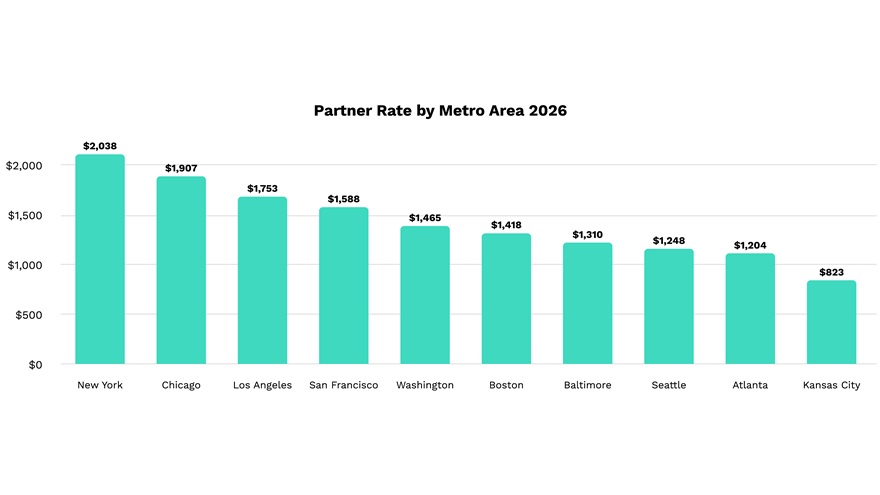
New York remains the most expensive market, with partners billing $2,038 per hour. Chicago ($1,907) and Los Angeles ($1,753) followed closely. Historically, these three cities have been the most expensive tracked metros, and combined their rates rose by an average of 11.9% compared to 2025.
In contrast, partners in Kansas City ($823) billed at significantly less than half the New York rate.
Even within the Am Law® 100, geographic differences create meaningful opportunities for cost savings.
New Data: Am Law® 100 UK Office Rates
One trend that has generated interest this year is the Am Law® 100’s growing presence within the UK; a development driven by a recent wave of transatlantic mergers, as well as increased investment in the UK by firms looking to create (or further develop) footholds in the global legal services market.
So how do rates within Am Law® 100 firms’ UK offices compare?
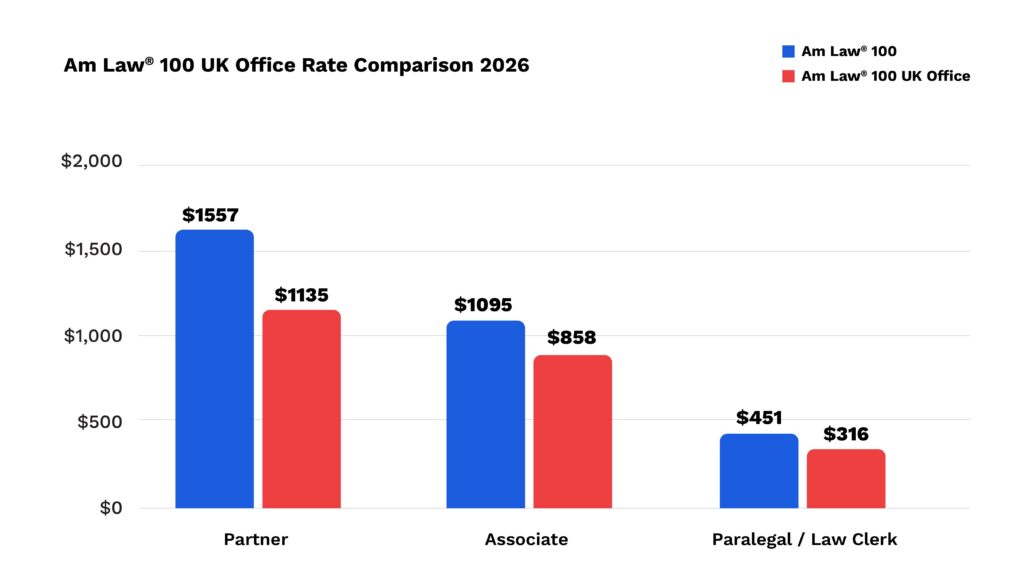
Adjusted to account for the exchange rate between the British Pound and US Dollar, median rates among partners at Am Law® firms’ UK offices were 27% lower than the overall partner median rate this year. This difference was relatively consistent across Associates (21% lower) and Paralegals/Law Clerks (29% lower).
For matters where in-house teams can select which of their law firms’ offices they resource work to, engaging a firm’s UK office (where applicable) offers a potential opportunity for savings.
Resourcing Mix
How firms allocate work across partners and more junior fee-earners plays a critical role in determining overall outside counsel spend.
In 2026, partners accounted for 33.1% of billable work at the top 25 law firms, compared to 47.5% at firms ranked 76–100.
While the greater partner involvement at lower-ranked firms might raise cost concerns, their partner rates are nearly half those at top-tier firms on average, which keeps overall matter costs down.
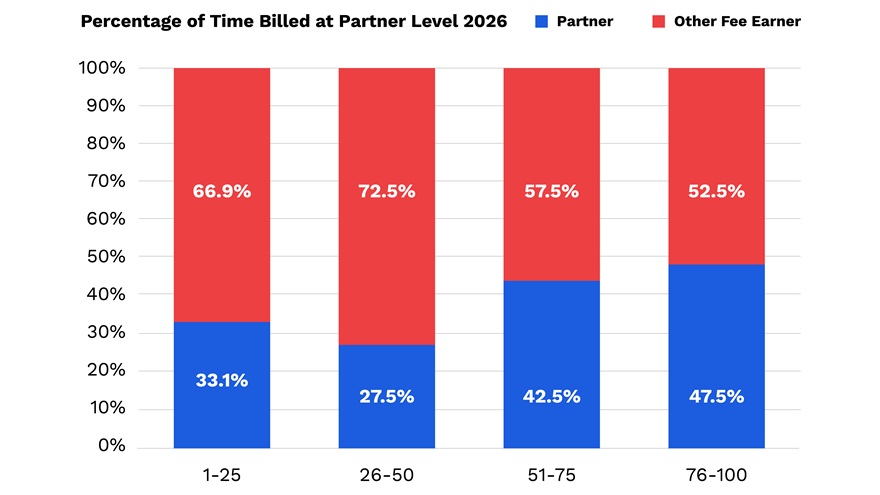
The takeaway for in-house teams: heavy partner billing at top-tier firms has a much greater financial impact than similar allocations at lower-ranked firms, due to their higher hourly rates. Monitoring resourcing patterns remains critical to controlling overall spend.
Industry vs. Internal Benchmarks: How to Unlock the Full Potential of Timekeeper Rate Data
The industry rate benchmarks found in this report are most powerful when paired with benchmarks generated from the historical matter, spend, and vendor data found in your legal department’s own system of record.
That’s because market research tells you what a reasonable rate increase looks like across the industry. But your own internal data provides insights into:
- How a law firm’s rates are trending historically for your legal department
- How a law firm’s rates compare to other outside counsel firms on your panel
- How a law firm staffs their matters relative to other firms doing comparable work
- Other KPIs like historical outside counsel guideline billing compliance, vendor performance reviews, and more
You can see what leveraging this internal data looks like in practice by taking the 2-minute self-guided tour of Brightflag’s Advanced Vendor Management functionality below.
Simply click “Get started” to begin the interactive demo:
Final Recommendations
Armed with the insights in this report, in-house teams can enter rate negotiations with a clearer understanding of what constitutes an acceptable increase—and greater confidence in pushing back when proposals exceed market norms.
At the same time, effectively managing outside counsel rates is not a one-time exercise. To keep legal spend under control, teams need to take a structured, ongoing approach to monitoring and managing their law firm engagements.
Here are a few strategies that legal departments can apply to get and stay ahead of outside counsel costs:
Clearly communicate matter scope at the outset.
Providing firms with as much information as possible about a matter at the outset, before they provide a quote, is an easy way to prevent scope-creep.
Clearly communicate expectations around staffing and timelines, and provide as much matter background information and enterprise knowledge as possible from the start. This helps proactively cut down on unexpected charges in areas like research further down the line.
Enforce agreed rates systematically.
Require firms to submit and adhere to approved timekeeper rates via an e-billing system.
Push back on excessive increases.
Use both industry and internally-sourced benchmarking data to challenge rate requests that exceed the norm.
Ask firms proposing rate increases above 8% to explain what’s driving the need for such a substantial hike. And don’t hesitate to leverage this report, as well the list of rate negotiation data points found in Brightflag’s Outside Counsel Pricing Strategy Guide, to secure the most competitive rates possible.
Right-source strategically.
With Am Law 101–200 rates meaningfully declining for the first time since 2021 this year, it’s a good time to tactically shift routine work down-market.
Reserve engagements with top firms for the highest-risk, most complex matters. Redirect routine or lower-risk work to regional firms, ALSPs, or flexible legal talent.
Monitor resourcing closely.
Track the proportion of partner time billed and ensure staffing is aligned with the complexity and risk of the task at hand.
Want more insights? Register for Brightflag’s Rates Report Webinar.
Join us on Monday, October 26 at 12 PM EST for an in-depth discussion on the results of this year’s Law Firm Billing Rates Report.
Brightflag’s Head of Community, Anna Richards, will be joined by Peter Boyajian (Legal Operations Manager at Nutanix) and Letitia Haynes-Fraiser (Director of Legal Operations at Cox Media Group) as they break down the latest data on law firm rate increases, and discuss strategies for mitigating their impacts on legal department budgets.
About Brightflag
Brightflag is the intuitive, AI-powered system of record that corporate legal departments trust when it comes to managing their matters, vendors, and spend.
Brightflag’s enterprise legal management platform provides complete visibility into legal work and spend, and allows in-house teams to manage and streamline tasks like legal invoice review, matter management, reporting, spend management, RFPs, and outside counsel management, all in one place.
To see how Brightflag can transform the way your legal department works, book a demo today.
Related Resources

See Brightflag in action
Put this playbook to work. See how legal teams use Brightflag to manage outside counsel, control spend, and prove their value — in a 30-minute walkthrough.