Legal Department Budget Planning Guide
 5 chapters
•
5 chapters
•
 16 min read
In This Guide

A customizable budget planning template to help streamline the development of an accurate corporate legal budget

Expert annual financial planning tips from legal operations leaders Suha Gehrer, Adrienne Schaal, and Dawn Hinz

The 4 best practices legal teams should implement to position themselves in the driver’s seat of their annual planning process
Table of Contents
Introduction
Creating an effective financial strategy for your in-house legal team starts with taking a proactive approach to annual budget planning. Yet far too often, legal teams fail to put themselves in the driver’s seat for this process—allowing finance to determine legal’s budget for the upcoming financial year.
The risks associated with this approach are numerous. After all, finance is not as in tune with the needs of the legal department as you and your team are. That means when it comes time to set the corporate legal budget for the upcoming financial year, finance will oftentimes base it on legal’s current-year budget—not factoring in variables like the growing legal requirements of the business, the need for additional headcount and technologies, and the fluctuating nature of legal spend.
In this guide, we’ll share how your legal team can take a proactive approach to annual budget planning and advocate for the resources you need to do your best work in the year ahead. Armed with these expert insights—and our customizable corporate legal department budget template—you’ll have everything you need to take control of the in-house team’s financial future.
Isn’t Legal Spend Inherently Unpredictable?
A common refrain we hear from legal teams is: “Legal spend is inherently unpredictable—so why should we spend so much time trying to plan for it?”
While some spend categories—such as acquisitions and major litigation—are difficult to predict year-to year, most legal spend actually can be fairly reliably budgeted for.
Commercial spend, for example, is typically a function of the number of customers and/or revenue your organization expects to add. Similarly, employment costs track alongside the number of hires your organization plans to make—or, conversely, the planned workforce reductions.
Legal’s budget doesn’t operate within a silo. In fact, it’s very closely tied to the decisions made by other departments within the organization. The benefit of this is that legal can use other departments’ annual plans to inform their own—in turn making many seemingly unpredictable spending categories far easier to project expenses for.
Of course, you can’t predict an opportunistic acquisition your company decides to pursue in Q3 next year, or major inbound litigation you’re not aware of yet. But that’s okay; finance does not expect such truly unpredictable spend to be part of legal’s budget anyway.
4 Corporate Legal Department Budget Planning Best Practices
Now that we understand that legal spend can be predicted, let’s dive into four best practices your legal team should implement when crafting those predictions to ensure they contribute to an accurate, appropriately resourced budget for your legal team.
1. Understand the annual planning calendar
Understanding your organization’s annual planning calendar and the key deadlines by which legal needs to submit information is essential to a successful financial planning process.
For most companies, annual planning begins during Q3—which means it will kick off sometime between July and September if your company’s fiscal year matches the calendar year. The larger and more complex your organization is, the earlier the annual planning process will begin.
If you’re unsure of the exact dates, simply ask your financial planning and analysis (FP&A) partner for an overview of the calendar and key deadlines. They’ll be happy you asked.
2. Make budgeting a team sport
Though legal ops and the GC should have a basic understanding of financial terminology, nobody is expecting them to transform into professional financial analysts.
This is where your FP&A partner comes into play. Don’t hesitate to reach out to them with questions about budgeting if there are things you don’t understand. Conversely, take the time to educate them on the finer details of how legal spend works so they can give you more informed advice.
By opening up these lanes of communication, you can solidify the mutually beneficial relationship between legal and finance, and make the planning process significantly easier. Developing a partnership with FP&A has the added benefit of establishing a champion for legal within finance who can better advocate for the in-house team’s needs during finance-only meetings.
FP&A is not the only partner you’ll need during annual budget planning. Everyone in the legal department should contribute. In particular, your practice area leads should leverage their proximity to the business to provide good intel on how legal service needs will change in the coming year. And legal team members at all levels should be made aware of the financial plan, and of their role in ensuring that it’s adhered to.
3. Make a compelling case for the resources you need
Annual budgeting season is the single best time to advocate for the additional resources your legal team needs to manage your growing workload. It’s the one time all year when you’ll have the opportunity to carve out a dedicated budget for those resources. If you wait until budgets have already been set to petition for a new legal tech tool or headcount, it becomes an uphill battle, because the funds will have to be reallocated from another area of the department or business.
As a result, it’s vital that you make a strong case for the resources you need during the annual planning process.
Demonstrate how the new legal tool, flex resource, and/or additional staff you’re looking to add can save the organization money in the long run. This is the time to tell a clear and compelling story as to how these resources will result in overall savings.
Pro Tip
In-house professionals often cite e-billing as the perfect first legal tech tool to advocate for during annual planning discussions. That’s because it’s fast and easy to implement and can secure a quick yet sizable return on investment—which makes advocating for additional legal tech resources much easier next time around.
4. Get complete visibility into your legal spend
Understanding your current legal spend and the factors shaping it is foundational to predicting what spend will look like in the future. However, getting those granular insights is painstaking if you don’t have a modern e-billing solution in your toolkit.
If you have a platform like Brightflag implemented already, you can easily pull reports to identify trends in how your legal spend has changed over the past year, and use those insights to determine the best way of allocating resources in the future.
Those without an e-billing solution in place will have a much harder time getting the spend insights they need to develop a reliable budget. However, this very fact can be leveraged to create a line item in the budget to purchase an e-billing tool in the upcoming year. After all, as we mentioned earlier, annual planning season is the perfect time to advocate for additional resources. And the insights that a tool like Brightflag provides can completely transform your team’s ability to effectively navigate the financial planning process next time around.
Your Legal Department Budget Planning Template
With a few best practices now under your belt, it’s time to craft your legal budget for the upcoming year using our editable legal department budget template.

Before we dive deeper into how to populate your template, here’s a quick overview of the major data points you’ll need, and some tips for populating those data points to come up with an accurate financial plan for the upcoming fiscal year:
Budgeting Data Point |
Why It’s Important |
| Total Spend by Year | This provides a high-level overview of year-to-year changes in legal spend, and can serve as a benchmark for your future budget as you analyze and refine it. |
| Outside Counsel Spend | Outside counsel engagements are often the biggest drivers of legal spend, so having an accurate picture of both carry-over spend and new work coming down the pipeline will highly impact the reliability of your future budget. |
| Headcount | Budgeting for future headcount provides an opportunity to analyze and adjust your future staffing strategy. It provides a prime opportunity to advocate for adding new positions and/or reallocating roles. |
| Technology | Reviewing your current tech expenses can reveal opportunities to consolidate or eliminate redundant services. This is also where you’ll earmark budget for new tools you need to make future legal work more efficient. |
| Training, Memberships, and Bar Fees | A high-level overview of all your trainings, memberships, and fees can underscore areas ripe for consolidation or group discounts to help free up additional budget. |
| Corporate Overhead | Legal doesn’t just pay for legal work, so it’s important that the budget factors in their share of company expenses like rent and utilities. |
| Travel and Team-Building | Though not as extensive as spend in other areas, travel and event expenses can add up, and need to be accounted for. |
Every organization’s annual planning process is structured differently—from the data that the finance team needs, to the formats they prefer to receive it in. With that in mind, this template is intended to serve as a starting point. We recommend you speak to your FP&A partner to understand their specific needs.
1. Total spend by year
To begin, look at total spend across all spending types (e.g. headcount, outside counsel spend, etc.) per fiscal year. You can get this information from your FP&A partner.
Total spend per year is not indicative of what you’ll spend next year, but it will give you an overview of year-over-year spending changes, and will help you sense-check the budget numbers as you conduct your more detailed analysis. It will also help you craft the high-level story of how and why spend is expected to change next year compared to previous years.
| FY23 | FY24 | FY25 | FY26 | FY27 to date | |
| Total Spend |
2. Outside counsel spend
Now it’s time to turn your attention to outside counsel spend, which includes spend on law firms and alternative legal service providers.
Step 1: Consider carry-over spend
Work with your practice area leads to determine which current work will roll over into next year.
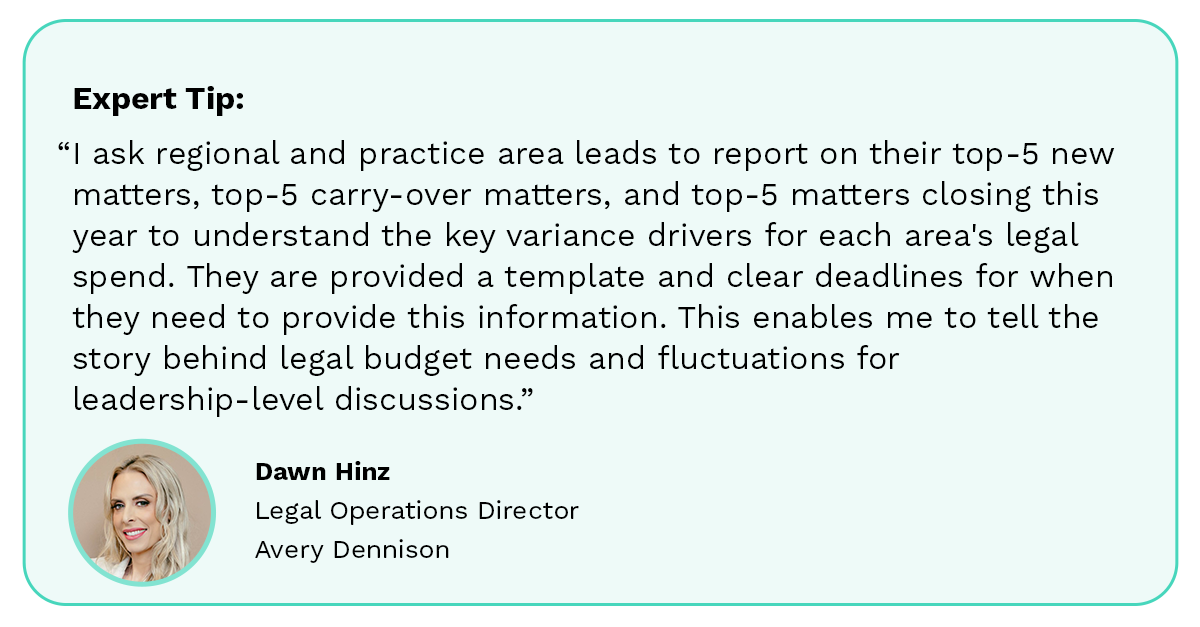
Start by focusing on top-spending matters in each area to identify the biggest potential swings in spend. Then work on grouping smaller matters related to business-as-usual work together by practice area to avoid having to go through each matter one-by-one.
For both the large matters and the smaller, business-as-usual work, consider what you’ve spent this year to date and whether you expect spend to increase or decrease next year.
To help with this analysis, you can project your year-to-date spend to create an estimate of what your current spend will look like at the end of the year. For example, let’s say you have spend-per-matter data for this year through the end of June. You can calculate how much you’re likely to spend in total by year’s end by multiplying your current spend by 12, then dividing by the number of months that have elapsed so far (in this case, 6).
| Matter Name | Practice Area | Current FY Spend to Date | Annualized Spend | Estimated Spend Next FY |
| Project Blue | Corporate | $1,000,000 | $2,000,000 | $1,500,000 |
| Acme v. Corpco | Litigation | $400,000 | $800,000 | $1,200,000 |
| Busines-as-usual Corporate Matters | Corporate | $500,000 | $1,000,000 | $1,000,000 |


Step 2: Factor in new work
Next, work with your practice area leads to plan out what additional matters will come up next year based on their knowledge of the business. Again, you can focus on itemizing the highest spending matters, while grouping smaller matters by practice area and estimating a total for each group.
Use your historical spending data for similar matters in the past to estimate costs for new work.
Use the annual plans of other teams to validate this analysis. Look at drivers like:
1. Other departments’ annual plans
As mentioned earlier, other departments’ initiatives have a direct impact on how the fiscal year plays out for legal—especially when it comes to outside counsel spend. Key areas you’ll want to check in on to help with planning for new work include:
- Sales: Customer/revenue growth will impact your commercial spend
- Headcount growth and/or reductions in force: This will impact your employment spend
- Real estate & facilities: This impacts your real estate spend
- New products: This directly influences IP spend
2. Litigation
When it comes to budgeting for litigation, you’ll want to break things down into two main buckets:
- Ongoing large litigation: Ask your outside counsel to estimate costs for next year for litigation that’s still underway.
- Ordinary-course litigation: If you are in a sector with a steady volume of litigation each year—such as financial services—use your historical run rate to plan for cases likely to arise next year.
3. External factors
Remember: You can’t plan for truly unpredictable events, and finance doesn’t expect you to. That said, when planning for known external factors that might influence
outside counsel spend, be sure to factor in:
- New regulations that will apply to your business: Think about what new regulations will come into effect for your industry next year, and budget for the regulatory advice needed to adapt to them.
- New policies needed due to external changes: A great example of this is the recent rise of AI, which has necessitated new policies to be drafted to protect organizations from data security breaches, IP infringement, and more.
4. Timekeeper rate increases
These will be easier to account for if your organization has a standard policy regarding acceptable rate increase requests (e.g. 3% year-over-year increase).
5. Spending trends and resourcing
If you have all your data on outside counsel spend in-hand, you have an opportunity to analyze it for trends and propose adjustments moving forward.
Take some time to identify your highest-spending matter types, and areas where you’re seeing the largest increases next year compared to this year. Then consider if you can move some of this work to less expensive outside counsel or send it to ALSPs. You may also want to make the business case to add new legal tech, flex legal resources, or headcount to get the work done at a lower cost.
3. Headcount
It’s now time to turn your attention to headcount. FP&A should be able to provide the figures here, or you may need to ask HR.
It’s important to look at the fully loaded cost of each role, which includes not just salaries, but bonuses and employee benefits. You should also add salary increase assumptions here. Talk to your FP&A partner about the latitude you’ll have to increase salaries next year.
| Role | Location | Fully Loaded Compensation | Status | Notes |
| Senior IP Counsel | California | $200,000 | In Seat | N/A |
| Regulatory Counsel | Washington | $150,000 | Open Position | Accounted for in current FY budget |
| Legal Operations Associate | New York | $80,000 | To be filled Q1 FY28 | Reallocated headcount from contracts paralegal leaving NY team |
Make sure to include currently open roles and any empty positions you’re looking to backfill. Be strategic here: does an empty seat need to be filled with someone in the same position on the same team, or can it be reallocated for greater efficiency? Reallocating headcount also provides a prime opportunity to add a legal operations position to your team to ensure your department can operate as effectively as possible.
4. Technology
This is typically a much smaller bucket of spend than outside counsel spend or headcount. However, it can play a crucial role in helping you save on costs within those other larger buckets. So it’s important to carefully consider your spend and strategy here.
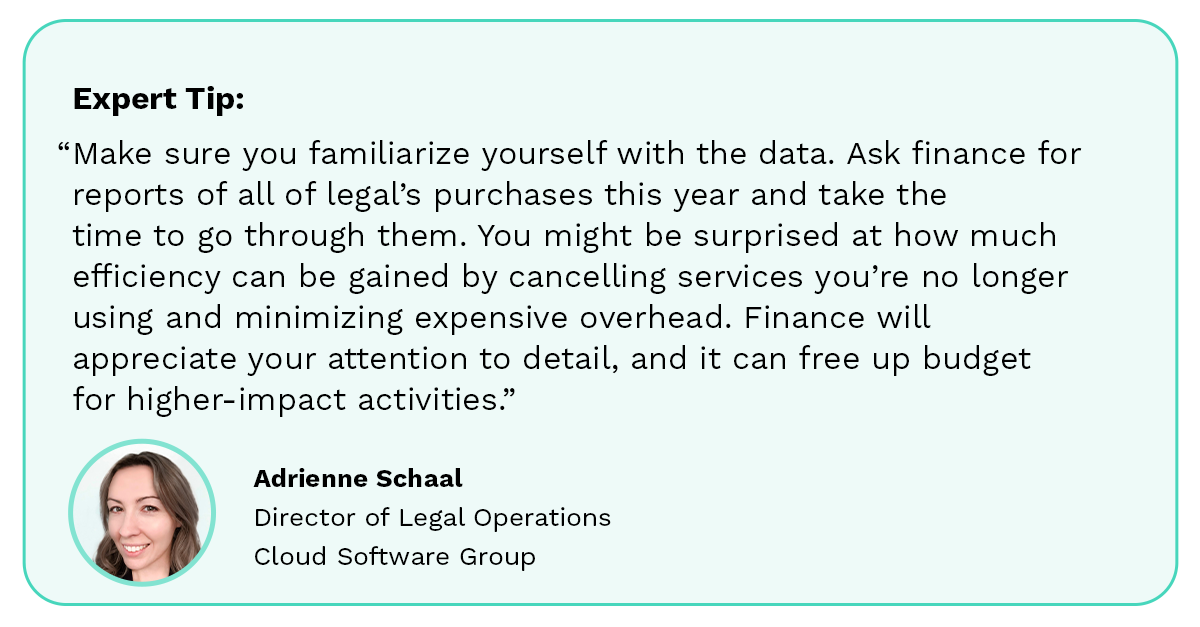
Ask your FP&A partner for an itemized list of the tech tools legal currently pays for. Dig into this data and you might find you’re paying for services you don’t use anymore, or that you’re using multiple services and accounts that you can consolidate for better prices.
Once you’ve eliminated or consolidated existing services, be sure to account for the new tech you need to better manage legal spend next year. Many Brightflag customers have found that the easiest way to onboard an e-billing tool in the next fiscal year is to clearly state the need for it in the budget this year.
| Existing / New System | Subscription / License ($) | Implementation ($) | Integration ($) | Notes | |
| System 1 | Existing | $XX,XXX | $XXX,XXX | $XX,XXX | Need to expand licenses due to new hires |
| System 2 | Existing | $XXX,XXX | $XX,XXX | $XX,XXX | 2 year contract, costs same as this year |
| Brightflag | New | $XX,XXX | $X,XXX | $XX,XXX | We need a new e-billing system to better control legal costs |
5. Training, memberships, and bar fees
This bucket covers conferences and CLE attendance, membership in organizations such as CLOC and ACC, and costs for state bar fees for practicing attorneys.
As with the technology bucket, FP&A can provide an itemized list of current charges. Review it to see if there are opportunities for consolidation or for group discounts.
| Description | Total ($) | Notes |
| State bar fees | $XX,XXX | Bar fees slightly increasing due to new attorney hires |
| ABA Members | $XX,XXX | Slightly increasing due to new attorney hires |
| CLOC Members | $XX,XXX | Consolidated for a group discount |
| ACC Members | $XX,XXX | Slightly increasing due to new attorney hires |
| CLE Attendance | $XX,XXX | Slightly increasing due to new attorney hires |
6. Corporate overhead
Legal doesn’t just pay for legal work. In most companies, legal is also expected to pay for their share of company expenses like rent, utilities, phone services, etc.
Your FP&A partner can provide legal’s share of corporate overhead. For your planning, it’s important to simply remember that this makes up part of legal’s total budget for the year.
| Total ($) | |
| Legal’s share of corporate overhead | $XX,XXX |
7. Travel and team-building
Legal doesn’t just pay for legal work. In most companies, legal is also expected to pay for their share of company expenses like rent, utilities, phone services, etc.
Your FP&A partner can provide legal’s share of corporate overhead. For your planning, it’s important to simply remember that this makes up part of legal’s total budget for the year.
| Description | Total ($) | Notes |
| Legal department offsite | $XX,XXX | Moved to a more cost-effective location |
| Legal ops team travel | $XX,XXX | Once per quarter to other company office locations |
| GC travel | $XX,XXX | Once per month |
Cost allocations/chargebacks
n many cases, legal expenses are not paid out of legal’s budget, but are instead charged back to the business unit that uses those services. For example, the cost of patent registration may be charged back to the product department.
It’s best to speak to your FP&A partner to understand how cost allocation works in your business and what information they need to help them allocate costs effectively.
Next Steps After Creating Your Budget
After some thoughtful research, you’ve crafted a legal budget that you can be proud of—one that aligns with your in-house team’s needs for the upcoming fiscal year, and establishes the legal department as financially fluent business leaders.
Now use the data in your budget to craft a compelling narrative for why legal spend is changing in the upcoming year. This story should be high-level enough that the GC can explain it to the CFO, and your FP&A partner can represent it in finance-only meetings.
However, be prepared to provide further detail when finance asks questions about your data. And don’t be afraid to showcase how you’re saving the business money—whether it’s by moving work to lower-cost legal service providers, implementing new tech to automate manual processes, or some other strategic initiative.
How to Streamline the Annual Budgeting Process
Securing the legal budget you need is only the start of the journey.
After all, budgets are living documents, and are never perfectly accurate. They require regular monitoring and proactive management throughout the year. And doing that work requires full transparency into how your spend is actively tracking against your budget.
Brightflag’s e-billing system can help you accomplish this. From intuitive reports, to the ability to create and track budgets at both the cost center and matter level, Brightflag enables the deep insights you need to manage your legal spend as effectively as possible.
To learn more about how Brightflag can help you gain visibility into legal work and control costs, book a demo with us today.
Related Resources



See Brightflag in action
Put this playbook to work. See how legal teams use Brightflag to manage outside counsel, control spend, and prove their value — in a 30-minute walkthrough.