The Ultimate Guide to Legal Spend Management
 11 chapters
•
11 chapters
•
 17 min read
In This Guide

How to benchmark your current legal spend management program, and create a plan to optimize it

A breakdown of the 6 elements that enable a successful legal spend management program

Tips for leveraging legal AI tools for better cost control
Table of Contents
Introduction
What if your legal department could not only control costs, but also unlock deeper insights, build stronger vendor relationships, and elevate its strategic value to the business?
In today’s legal environment, spend management is no longer a back-office function or an end-of-year reporting task. It’s a foundational component of building a legal team that can operate proactively, demonstrate impact, and stay aligned with evolving business priorities.
This guide serves as your roadmap to building a modern legal spend management program, providing practical strategies, proven frameworks, and real-world examples that will help your in-house team drive visibility, control costs, and operate efficiently at every level.

The Benefits of Effective Legal Spend Management
With effective legal spend management, in-house teams gain:
- Visibility: Legal departments need complete visibility into legal work and spend so that they can effectively manage legal risk—and associated financial risk— across the business. Increased visibility also allows for more strategic decisionmaking and smarter use of resources.
- Cost control: Controlling costs effectively ensures that legal expenditures align with both departmental budgets and organizational priorities—and that the legal department has the resources it needs to do its best work.
- Value optimization: Every engagement with legal vendors should deliver business value. Legal spend management gives you the data to make sure law firms and other legal service providers pair high-quality work with cost-effective staffing.
- Efficiency: Streamlining operations, automating repetitive tasks such as invoice review and spend reporting, and optimizing the use of the in-house team’s limited resources are all useful legal spend initiatives in their own right. But they’re also benefits that often result from rolling out an effective legal spend management program.
The Four Stages of Legal Spend Maturity
It’s difficult to chart a path forward if you’re not sure where you currently stand. That’s where a legal spend maturity model can help.
Whether you’re a small in-house team just starting to piece together a strategy, or a large legal department that’s looking to optimize the legal spend management structure that’s already in place, this maturity framework will help you understand the areas of this guide that will be most relevant to your needs.
Here are the four stages of legal spend maturity, as well as what teams at each stage should prioritize in order to progress:
Ad Hoc
At this stage, spend management processes are informal or nonexistent. Teams rely heavily on manual data entry, disconnected systems, and anecdotal insights. There is little ability to track spend in real-time or enforce billing standards.
Most teams start here, and it works fine at low levels of spend. However, as the company, the team, and legal spend start to grow, the ad hoc approach can start to feel chaotic, signaling that a change is needed.
What to Prioritize at This Stage
Set up a system for real-time oversight of spend, and automate invoice workflows to reduce manual work.
Areas of Focus: Centralized Spend Tracking, Automated Invoice Review
Standardized
At this stage, basic processes have been implemented, such as invoice review workflows and standardized outside counsel guidelines. Legal invoices are submitted, reviewed, approved, and sent to AP from one centralized system, and the finance team is able to get the data it needs from your legal team to close the month (i.e. accruals). However, data is not being used to optimize spend management.
What to Prioritize at This Stage
Work to improve upon the foundations you’ve put in place. Speak with outside counsel about common billing guideline violations to improve compliance, or set a goal to increase accruals submission rates to provide better data to your finance team.
Areas of Focus: Granular Budgeting, Automated Accruals & Reporting
Optimized
At this stage, legal departments are leveraging technology platforms to automate key processes like invoice review, budget tracking, and law firm evaluations. Data is centralized and accurate, enabling better decision-making and improved cost control.
What to Prioritize at This Stage
Increase the use of data for planning and ongoing resource management. For example, create law firm performance scorecards based on your data and discuss them with firms during relationship reviews.
Areas of Focus: Outside Counsel Management, Benchmarking
Strategic
At this stage, effective legal spend management is fully integrated into legal service delivery. Predictive analytics guide future budgeting and resourcing decisions, and legal leaders use spend data to demonstrate their strategic value to the business.
Areas of Focus: AI Optimization
Key Features of a Successful Legal Spend Management Program
Whether you’re currently building out a plan for managing your legal department’s spend, or you have an established program in place that you’d like to optimize, it’s important to become familiarized with the core features that all successful legal spend management programs share.
Centralized Spend Tracking
Centralized spend tracking is the foundation of effective legal spend management. It creates a unified system where all legal spend data is stored and keeps all of your invoices, matters, budgets, and accruals in one place, making it easier to see where your money is going.
Think of it as your legal spend command center.
Below you can see an example of how this works using the spend dashboard in Brightflag.
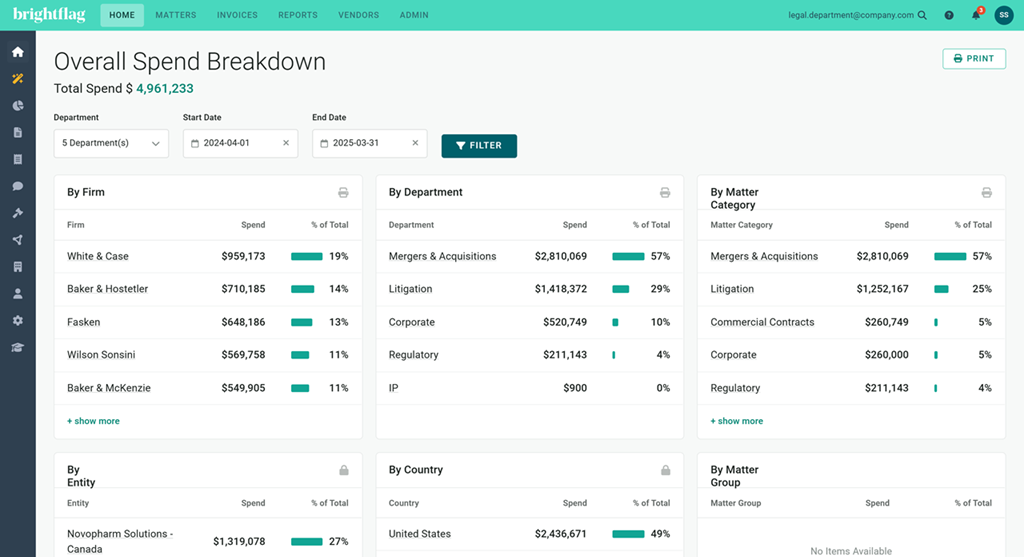
The benefits of having a centralized system like this in place include:
- Immediate spend insights: Spot the main drivers of legal spend and identify risks to your legal budget in real-time.
- Faster decisions: Out-of-the-box views into spend metrics for quicker resourcing and budget management decisions.
- Predictability: No more waiting around for reports from finance to understand spend—get the insights you need at your fingertips to ensure no surprises.
Automated Invoice Review
When your in-house team doesn’t have to spend their time manually reviewing and approving legal invoices, they have more time to devote to the high-impact legal work that demands their attention.
There are two aspects of invoice automation that can make it such a powerful tool:

Rules-based Workflows
Every dedicated legal spend management system enables rules-based workflows. This process streamlines invoice review by using a series of predefined, conditional rules to automatically send invoices to the correct reviewers and—once approved— forward those invoices on to finance.
This eliminates the manual work of having to send invoices over email, and ensures nothing falls through the cracks. Legal departments often cut invoice review and approval times down significantly by leveraging this type of workflow.

AI Invoice Review
Poring over legal invoices, trying to verify that each line item aligns with the work you requested and complies with your legal team’s outside counsel guidelines, is a painstaking process. Fortunately AI is perfectly suited to handle the task.
In Brightflag, for example, our purpose-built AI analyzes every line item within a legal invoice. It then categorizes the legal work performed and checks it against your billing guidelines—without your in-house team having to lift a finger.
Non-compliant entries—like block billing, excessive research time, or disallowed activities—are then automatically flagged, and invoices are automatically routed to the appropriate reviewers for approval or escalation. This end-to-end process is a relatively new capability—pioneered by Brightflag—that ensures consistency, transparency, and faster decision-making across legal spend.
It also helps your legal department conserve its most valuable resource: time.
Success Story: SMBC
The legal team at SMBC saved $2.7 million by consistently applying their outside counsel guidelines with the help of Brightflag’s AI-assisted invoice review.
Budgeting at Every Level of Spend
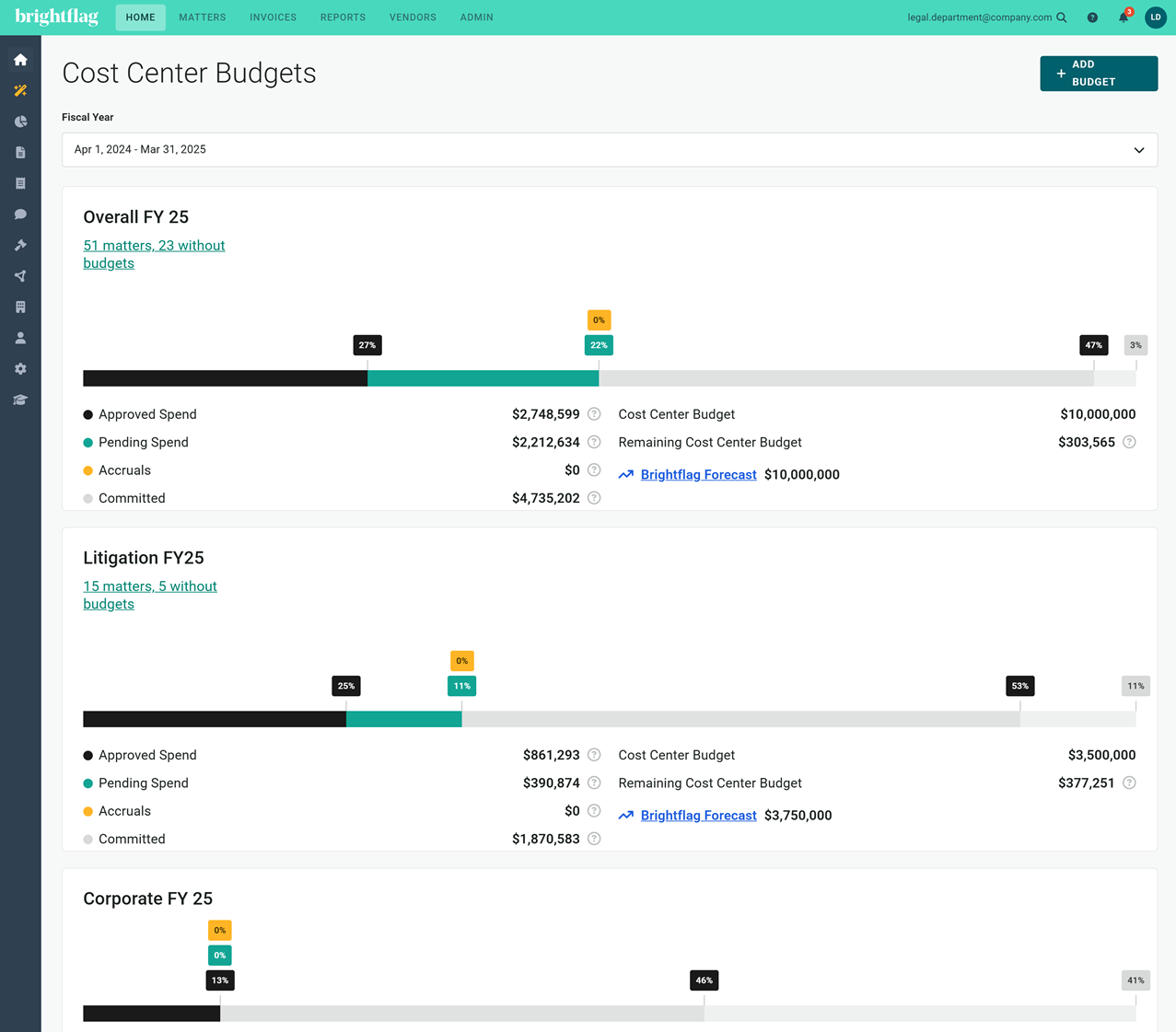
Budgeting provides a framework for effective legal spend management. It not only helps with planning for future legal spend, but also provides benchmarks that your legal team can use to gauge in real-time when spend is trending beyond what was expected.
Overall budgets are the starting point. But as your legal department’s budgeting process matures, you’ll want to begin getting more granular. That means setting budgets at the practice area and matter level as well.
Budgeting at all three levels of spend allows for legal teams to:
- Stay aligned on strategy and cost: With budgets tied to specific practice areas or matters, teams can plan more intentionally, allocate resources where they’ll have the most impact, and ensure external spend aligns with business priorities.
- Spot issues early: Granular budgeting helps surface variances and trends before they become problems—whether it’s an unexpected surge in IP litigation costs or underutilized budget in a particular region.
- Enable accountability without micromanagement: Legal leaders get the oversight they need, while empowering matter and practice area leads to manage their spend within clearly established guardrails.
- Improve forecasting accuracy: Historical budget data at every level feeds more confident planning and sharper predictions for the future.
Pro Tip
If you’re new to setting budgets on your matters, focus on budgeting for the 20% of matters that drive 80% of your legal spend, or as a starting point, your top 10 highest-spending matters.
Automated Accruals Collection and Reporting
Chasing down accruals information from law firms and submitting everything to finance before their monthly deadline can create a lot of work for legal. And even with all that effort, it can be tricky to ensure every firm submits on time each month.
Thankfully you can streamline the legal accruals process by automating how data is collected from law firms and submitted to finance. With a legal spend management tool like Brightflag, legal teams can schedule accrual requests and handle the outreach with automated reminders—including a centralized dashboard to track responses. This ensures firms submit accurate, timely accruals data in a consistent format every month.
Once responses are collected, your legal spend management system should make it easy to send accrual data in a format tailored to finance’s needs via an automated, scheduled report— reducing manual work and improving cross-functional collaboration. The result is a faster, more reliable accrual process that enhances accuracy, improves firm accountability, and ensures legal is always ready for audit or reporting requirements.
Reporting and Benchmarking
The benefit of creating an effective legal spend management program and centrally tracking invoices, matters, budgets, and vendors is that you now have a treasure trove of data to help you improve legal service delivery. Paired with a well-designed legal spend management tool, this should give your legal team the robust reporting capabilities they need to take their decision-making to the next level.
Here are the reporting components your legal spend management tool should have to unlock greater value from your data:
At-a-Glance Insights
Whatever software you use should have customizable dashboards that provide high-level insights into your legal spend.
Within Brightflag, these dashboards can be tailored to show the most relevant metrics to your team. Whether you’re interested in spend by vendor, case type, or geographical region, this view enables you to quickly grasp the state of your legal expenditures without having to sift through endless spreadsheets.
Detailed Breakdowns
The tool you use should also offer detailed reporting options that provide more granular insight into your spend. Want to know how much you’ve spent on a particular vendor or what matters are driving the majority of your legal spend? The reporting feature should help you drill down into the data to answer those questions.
These breakdowns can also be useful for spotting and proactively responding to noteworthy trends in your spend.
For instance, a report on employment litigation spend could indicate a steady rise in costs that you didn’t account for in your annual plan. Noticing this early may prompt you to dig into the cause and identify that it’s the result of an increase in wrongful termination claims. This would help you readjust your expectations for spend in that area going forward—as opposed to looking up at the end of the year and being surprised to find you shot by your annual employment litigation budget.
Comparisons & Benchmarking
Finally, you’ll want to ensure whatever reporting tool you use offers comparison metrics that allow you to benchmark your legal spend—and your vendors—using historical data and industry benchmarks. This comparative analysis will provide a clearer picture of how well your legal spend management efforts are faring, highlight where legal resourcing could be more cost-effective, and identify areas for improvement going forward.
Outside Counsel Selection and Management
Engagement with outside counsel firms typically accounts for the majority of corporate legal spend. That’s why it’s so important to ensure that you’re working with the right outside counsel partners, to deliver the right outcome for your business, at the right cost. Your own historical data, as well as industry benchmarks, are the fuel that help you get there.
Leaning on Data to Choose the Right Outside Counsel Firm
Trust plays a major role when selecting which outside counsel firms to partner with. Oftentimes firms with long-standing working relationships with your legal department, who understand the nuances of your organization well, will be the ones that earn your business.
But balancing these trusted relationships with data insights can take the value received from these partnerships to the next level.
What does this look like in practice?
Let’s say a matter arises that you know will require a large amount of spend. Using historical data, you can easily assess how all the firms who have worked with on similar matters for your team in the past compare in terms of:
- Staffing approaches
- Cycle times
- Outcomes
- Budget adherence
These data points can then be weighed alongside factors like firms’ familiarity with your legal department and the quality of your working relationships to ensure the firm you choose is the best, most cost-effective fit for the work at hand.
Data doesn’t have to only be prioritized when dealing with high-spend matters either. Similar metrics can be leveraged when resourcing lower-spend work too (e.g. when comparing IP registration work within specific geographies).
Outside Counsel Management
As is the case in any partnership, maintaining a good relationship with your outside counsel firms requires open lines of communication. It also demands a commitment from your inhouse team to regularly share honest feedback with firms on where they can improve—and a commitment from outside counsel to take that feedback to heart.
Here are a few ways to facilitate effective outside counsel management for the entire lifecycle of your work relationships:

Data-Backed Touchbases
In-house teams are sometimes hesitant to share direct feedback with their firms, fearing that it could strain the relationship. However, outside counsel often want to know how they can improve so that they can work towards strengthening their partnership with your team.
To facilitate this, make sure you’re scheduling regular performance check-ins with your firms, and come prepared to these discussions with data to back up your input.
Here are some examples of what that could look like:
- Do the timekeeper rate increase requests you’ve received from a firm seem higher than anticipated? Leverage industry research like Brightflag’s Am Law 100 Rates Report to understand what a reasonable rate might look like, and lean on that data during negotiations to make a compelling case for the rates you think are fair.
- Have you noticed issues like excessive partner time or a large number of timekeepers billing on a matter? With a tool like Brightflag, you can easily keep track of data on your matters’ resourcing mixes and staffing. With this information in hand, you can then open a focused dialogue with outside counsel about limiting partner time only to the amount required, and encouraging lean staffing that aligns with matter complexity

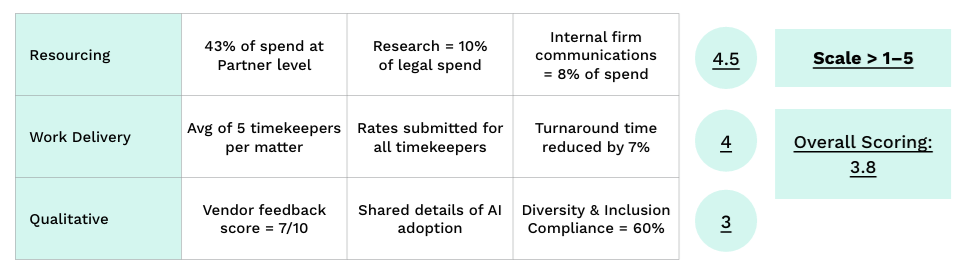
Vendor Scorecards
Consider structuring the conversations you’re having with outside counsel around a vendor scorecard created specifically for the firms you’re speaking with. These scorecards can assign numerical scores to the aspects of outside counsel work that are most important to your legal team (e.g. billing hygiene, resourcing, reliability). And they can also include benchmark data from other firms you’re working with relating to things like blended hourly rate and budget adherence to drive better outcomes.
Legal departments are no longer wondering if they should incorporate AI into their legal spend management initiatives. They’re actively seeking out tools with embedded AI capabilities that will truly move the needle in terms of what they can accomplish.
Here are a few must-have AI capabilities that legal departments should prioritize adding to their legal spend management toolkit, as well as some advice on how to develop a comprehensive outside counsel AI strategy:
Invoice Review
As mentioned earlier, AI-powered invoice review is one of the foundations of effective legal spend management. It not only enables streamlined workflows and comprehensive application of outside counsel guidelines, but it also serves as the process through which vital matter and spend data is collected for strategic analysis.
Generative AI Agents
Every day, in-house legal teams have to answer questions regarding their work and spend. Questions like:
- What’s our legal spend this year, broken down by department?
- How much has Law Firm X invoiced us this year?
- What are our top open matters in terms of spend?
Generative AI agents, like Ask Brightflag, make it possible to ask these questions in plain language and receive instant answers—no complex report-building, menu navigation, or technical expertise required.
Quick Fact
Ask Brightflag was the first generative AI assistant created specifically for legal spend and matters. It helps in-house teams surface immediate data insights, remove reporting bottlenecks, and manage legal work and spend with conversation instead of clicks.
Invoice Summaries
Imagine being able to review and approve legal invoices on the go, from your email inbox, with the tap of a button.
With AI-generated invoice summaries, that’s become a reality for many legal teams.
Brightflag’s Invoice Summaries feature, for instance, automatically notifies approvers via email when an invoice is ready for review—sharing an AI-generated summary of the work being billed for, the vendor and billing information, and any potential outside counsel violations that Brightflag’s AI flagged during its initial analysis.
From there, reviewers can either approve the invoice directly from the email, or dive into the Brightflag platform to review in greater detail. This unlocks huge time savings for legal departments—allowing reviewers to work through pending invoices on their way to work or while waiting for their coffee—and clears more time to focus on other high-impact tasks.
Developing an Outside Counsel AI Strategy
Law firms’ adoption of AI tools can lead to greater efficiency and increased cost savings for your legal department—but only if you’re aligned with them on how to apply the technology to your matters.
In general, conversations with firms regarding their AI usage should center around the following core principles:
- Value creation: Outside counsel should be encouraged to adopt generative AI tools where they improve work quality and/or result in work being delivered at a better price.
- Data protection: Your data should not be used to train AI models unless the model is purpose-built for your exclusive use.
- Cost expectations: Firms should not charge clients for their AI tools or computing resources. Billable time should reflect the effort and expertise of human lawyers, not the background infrastructure supporting them.
For a full breakdown on how to encourage the best use of AI by your law firms and measure its impact, check out Brightflag’s “How to Create an Outside Counsel AI Strategy” guide.
Frequently Asked Questions
Do you need a dedicated system to effectively manage legal spend?
While spreadsheets and manual workflows may suffice early on, a dedicated legal spend management system provides the visibility, control, and automation required by legal teams that manage significant budgets. It ensures consistent enforcement of billing guidelines, real-time budget tracking, accurate reporting, and stronger collaboration with finance— none of which are sustainable without a centralized, purpose-built platform.
What’s the best way to communicate with other business stakeholders about legal spend, and illustrate that legal is managing their spend effectively?
Use data to tell a clear, business-focused story. Leverage your legal spend management system’s dashboards and reports to show how spend aligns with budget, how cost-saving initiatives are performing, and how external resources are being used efficiently. Tailor messaging for each audience—CFOs may want ROI and forecast accuracy, while business units may focus on resourcing and matter outcomes.
What change management considerations should be considered with rolling out a new legal spend management tool or new legal spend management processes?
Start with clear goals and stakeholder alignment. Involve legal, finance, IT, and outside counsel early, and communicate how the change will benefit each group. Provide training tailored to user roles, phase rollout where possible, and seek out internal champions to support adoption. Change management is as much about people as it is about process and technology.
What are the key considerations to ensure the legal spend management system I choose is right for the organization?
Look for a platform that offers:
- Faster matter resolution times
- Lower matter costs
- More scalable, predictable legal service delivery
How does legal spend management and matter management overlap?
Legal spend and matter management are closely linked, and understanding spend without matter context provides an incomplete picture. Matter management provides the structure for tracking legal work, while spend management tracks the associated costs. Together, they offer a full picture of what work is being done, by whom, for how much, and with what business impact. A strong ELM platform unifies both.
Related Resources


See Brightflag in action
Put this playbook to work. See how legal teams use Brightflag to manage outside counsel, control spend, and prove their value — in a 30-minute walkthrough.