The General Counsel's Guide to Legal Spend Management
 11 chapters
•
11 chapters
•
 14 min read
In This Guide

Benchmark the maturity level of their current approach to spend management program

Implement key legal spend management initiatives that provide greater visibility into work, help control costs, and improve legal’s reputation within the business

Leverage AI to free up time for the legal team, allowing them to focus more on high-value work
Table of Contents
Introduction
Legal spend management today is about far more than just tracking invoices. For modern General Counsel, it’s a strategic discipline—one that helps control risk, allocate resources effectively, and demonstrate the legal team’s ability to speak the language of business: money.
The insights generated from an effective legal spend management program also elevate the GC’s strategic role. When resourcing decisions and outside counsel performance reviews are grounded in data rather than anecdotes, legal can engage the business with greater confidence and credibility.
Finally, modern spend management streamlines in-house workflows and enables more constructive outside counsel relationships, giving legal teams more capacity to focus on high-impact advisory work—the work that most directly protects and enables the business.
Your team already brings deep legal expertise. With the right legal spend management foundations, you’ll also have the time, data, and credibility to maximize your legal department’s impact. Here’s how to build the program to get you there.
Benchmarking Your Legal Spend Maturity
Understanding where your legal department stands today when it comes to the maturity of its legal spend management program is essential to charting a confident path forward.
Whether you’re leading a small, fast-moving legal team, or overseeing a large global department, knowing which of the four stages of maturity you’re currently in will help you focus on the initiatives that can drive the greatest impact.

AD HOC
At the Ad Hoc stage, spend management is largely reactive. Spend is tracked through email and spreadsheets, and insights depend on anecdotal recollections rather than data.
For many GCs, this phase introduces familiar pain points: difficulty answering spend questions from the CFO, limited visibility into where money is going, and a growing sense that manual processes are consuming your team’s time.
These challenges tend to sharpen as the business grows. What once felt manageable can quickly become a source of operational risk—budget surprises, inconsistent billing practices, or delayed reporting to finance.
What GCs Should Prioritize: Establish real-time visibility into spend and reduce manual review burdens. Even small steps toward automation—like centralizing invoices or creating a legal spend dashboard—deliver immediate results.

Standardized
GCs at the Standardized stage have implemented foundational processes such as invoice workflows, outside counsel guidelines, and consistent invoice submission. Finance receives what it needs to close the month, and the department gains a
baseline understanding of where dollars are being spent.
At this stage, legal teams have usually implemented a legal technology tool (e.g. e-billing), but may not be leveraging it as well as they could to optimize spend management.
What GCs Should Prioritize: You have the legal spend management foundations in place—now it’s time to build on them. Dig deeper into your data to surface trends. Examples might include seeing which business units in your organization are experiencing spikes in legal spend, or which practice areas have surpassed their budgets. These insights can often lead to more strategic resourcing and budgeting conversations. Additionally, consider ways of helping your legal team work more efficiently by applying automation to tasks like accruals collection and reporting—which will have the domino effect of improving legal’s relationship with finance as well.

Optimized
At this stage, legal departments are leveraging technology platforms to automate key processes like invoice review, budget tracking, and law firm evaluations. Data is centralized and accurate, meaning GCs encounter fewer surprises, have clearer
insights into resourcing patterns, and enter executive and board conversations with more confidence in their financial data.
Typically, the next step for GCs at this level of maturity is to find ways of leveraging all the data they’re now collecting to become even more intentional with their resourcing strategies and optimize their budgets.
What GCs Should Prioritize: Use your data to inform strategic planning, resourcing, and outside counsel management. Introduce structured scorecards and benchmarking to encourage higher performance and better cost discipline from
your firms.

Strategic
At this stage, spend management becomes a true strategic capability embedded in how legal delivers value to the business. Predictive analytics and historical benchmarks help guide budgeting, staffing, and firm selection decisions. And the GC
can articulate precisely how the department’s investments align with enterprise risk and business outcomes.
This is also where legal’s reputation as a disciplined, data-driven partner solidifies. With trustworthy forecasting and a proactive view of risk, conversations with the CEO, CFO, and board shift from retrospective reporting to forward-looking strategy.
What GCs Should Prioritize: Expand the use of AI-driven insights to make data-driven resourcing decisions and select outside counsel. Historical data on firms that have been engaged on similar matters—including metrics on fee earner resourcing,
billing guideline compliance, and qualitative performance—can help match your team with the right firm for the job. Leaning on matter-level data, especially for high-spend matters, will also give you the granularity you need to be as strategic as possible during vendor evaluations.

“When we’re able to explain where our costs are coming from, and how we’re managing them, we become a good corporate steward of the legal function.”
-Jeff Barlow, GC at Momentive Technologies
How GCs Operationalize Legal Spend Management
Legal operations can be an invaluable partner in building an effective spend management program. They often lead system implementations, standardize workflows, manage vendor and tech evaluations, and build the infrastructure needed for accurate reporting and predictable budgeting—taking your high-level strategy as a GC and putting it into practice.
“A great legal ops professional helps a GC to lift up out of the trees, take a step back, and see the forest. They can see the processes across our legal functions, and all of our outside counsel providers, and give strategic advice from that big picture vantage point.”
-La-Toya Hackney, General Counsel at Saint-Gobain North America
If you’re a small or resource-constrained legal department though, a dedicated legal ops headcount may not be in the cards. In these instances, it’s essential to select legal spend management tools that are straightforward to implement, and provide the support you need to integrate legal operations best practices into your team’s workflows independently.
Platforms that can automate processes like invoice review, create consistency in reporting and analysis, and surface actionable spend insights can help shoulder much of that burden. Choosing a legal technology provider that values personalized support—and will provide your department with a dedicated Customer Success Manager to ensure you’re achieving full value from the tool—is also invaluable.
The Features GCs Need from Their Legal Spend Management Program
CENTRALIZED SPEND VISIBILITY
As the executive responsible for both managing legal risk and demonstrating fiscal stewardship, GCs need a single, accurate source of truth for how outside counsel and internal resources are being deployed.
When spend is centralized, you can quickly identify cost drivers, spot emerging risks, and understand how legal work aligns with business priorities—all without relying on anecdotal updates or end-of-month reconciliation from finance.
Real-time dashboards, like Brightflag’s shown below, make it easier to evaluate vendor performance, assess resourcing across practice areas or business units, and ensure that the department’s budget story is always accurate and defensible.
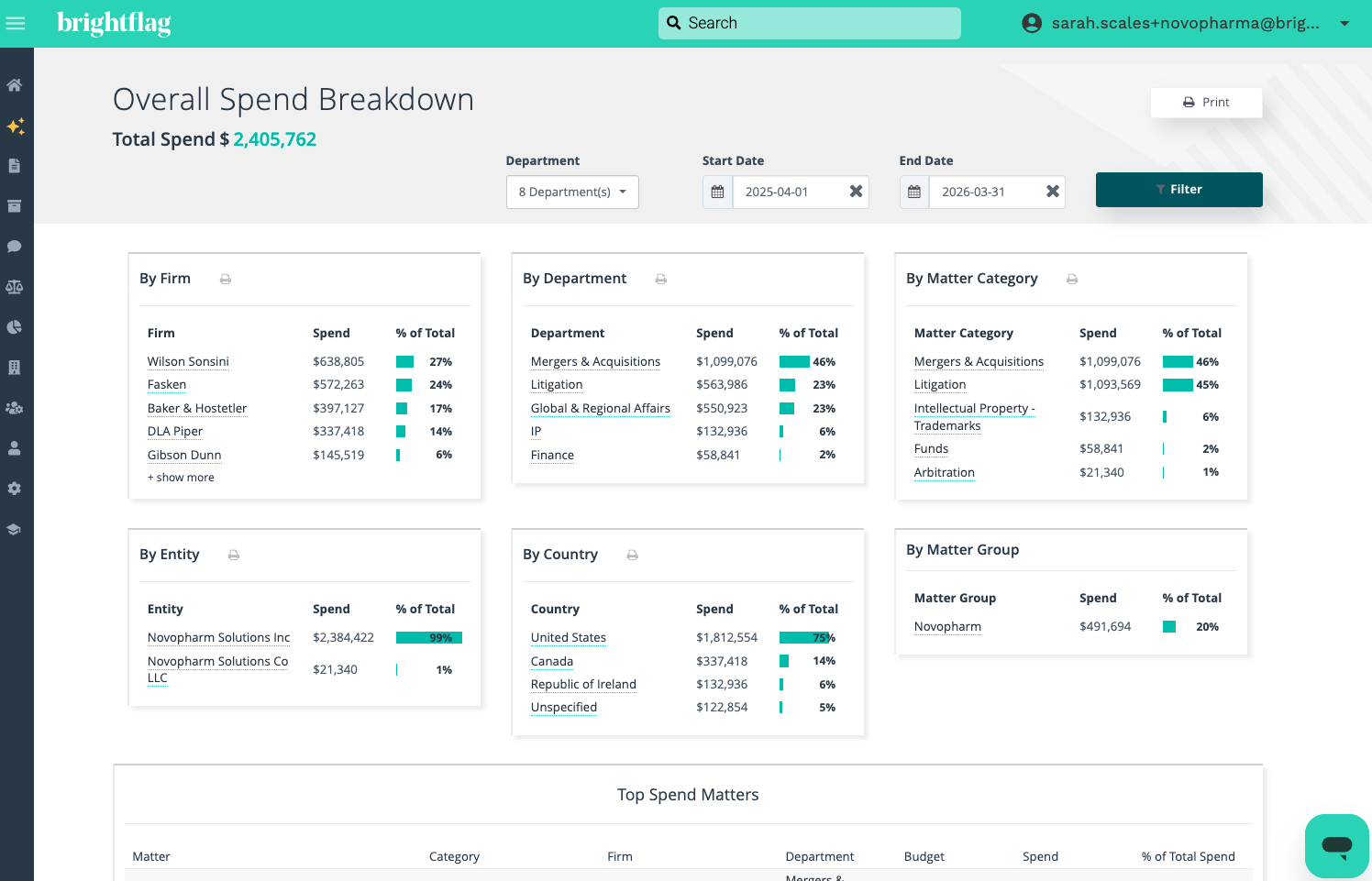
Centralized spend tracking also strengthens your partnership with finance by eliminating delays, inconsistencies, and surprises. With a full picture of spend at your fingertips, you can respond confidently to executive questions, make faster resourcing decisions, and forecast with greater precision.
“The finances of the company really drive a lot of the decision-making… If you don’t understand that as a General Counsel you miss out on a lot of opportunities to advise.”
-Andrew Stephens, CLO
PREDICTABLE BUDGETING
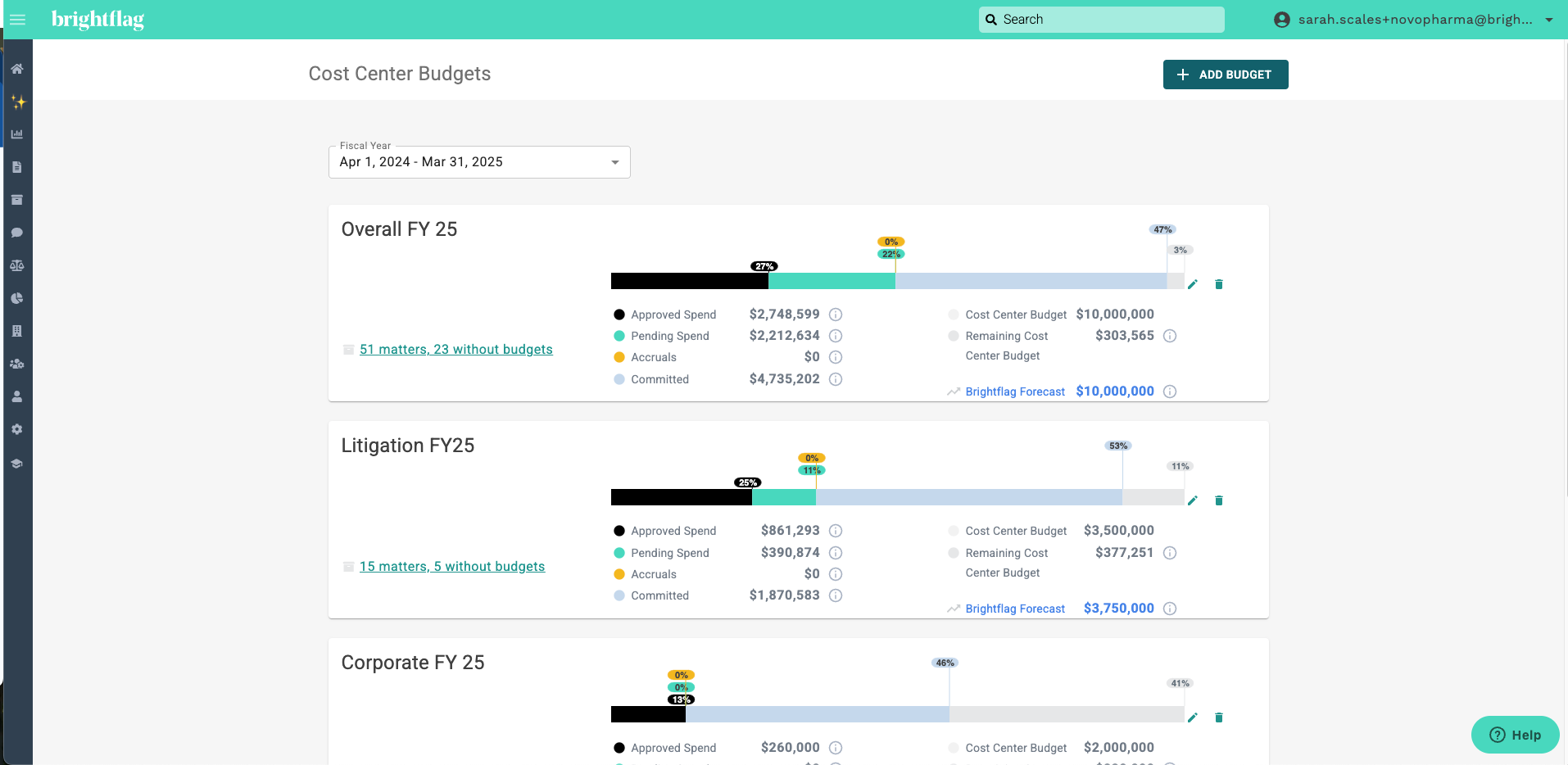
Budgeting provides a framework for effective legal spend management. It not only helps with planning for future legal spend, but also provides benchmarks that GCs can use to gauge in real-time when spend is trending beyond what was expected.
Tracking your overall legal department budget in real time is the starting point. But as your legal department matures, you’ll want to get more granular. That means setting budgets at the practice area and matter level as well. This approach can help you:
Spot issues early: Granular budgeting helps surface variances and trends before they become problems—whether it’s an unexpected surge in IP litigation costs or underutilized budget in a particular region.
Stay aligned on strategy and cost: With budgets tied to specific practice areas or matters, teams can plan more intentionally, allocate resources where they’ll have the most impact, and ensure external spend aligns with business priorities.
Enable accountability without micromanagement: Legal leaders get the oversight they need, while empowering matter and practice area leads to manage their spend within clearly established guardrails.
Improve forecasting accuracy: Historical budget data at every level feeds more confident planning and sharper predictions for the future.
OUTSIDE COUNSEL MANAGEMENT
Selecting and managing the right outside counsel partners is essential to the success of the legal department and, by extension, the business. GCs depend on having access to world- class experts they can call upon in emergency situations, as well as reliable teams they can turn to for more routine work to be done efficiently.
That said, operating in a business environment means it’s essential to optimize the value legal receives from its outside counsel partners as well. This is especially true given that outside counsel costs typically make up ~50% of the legal budget.
Data—both internal and industry-wide—is the lever that enables you to make confident, defensible decisions about whom you engage, how work is staffed, and whether resources are being deployed strategically.
USING DATA TO SELECT THE RIGHT FIRMS
Trust and long-standing relationships matter. Many GCs rely on firms that understand the business, the leadership team, and the company’s risk tolerance. But pairing that trusted judgment with clear data elevates decision-making and helps ensure that each matter is assigned to the firm best positioned to deliver value at the right cost.
Historical data can help you quickly compare firms across dimensions that directly affect budget predictability and outcomes including:
Staffing patterns: How do firms typically resource similar matters?
Cost efficiency: Do firms charge us for non-value-add work, like basic research or multiple partners attending the same calls and meetings?
Budget adherence: Do their actuals consistently align with approved budgets?
Performance: Have the firms scored well on vendor performance surveys
your team has run?
Complementing the qualitative strengths of your existing firm relationships with these quantitative insights can be a huge value multiplier. It also supports a GC’s mandate to “run legal like a business” by ensuring that major matters—and even lower-spend recurring work such as local IP filings—are resourced based on value, not habit.
ONGOING OUTSIDE COUNSEL MANAGEMENT
Maintaining a good relationship with your outside counsel firms requires a commitment from your in-house team to regularly share honest feedback with firms on where they can improve—and a commitment from outside counsel to take that feedback to heart.
Ultimately, your firms want to understand your priorities around cost, risk, and service delivery. And the best way for your in-house team to communicate those priorities is by leading with data in your touchpoints with them.
Key areas where data can be leveraged include:
Timekeeper rate negotiations
Rate increase requests from law firms roll in like clockwork every year. But in-house teams aren’t powerless to push back against them—especially if they are equipped with data around what constitutes a fair market rate.
Benchmarking requested increases against a resource like Brightflag’s Am Law Rates Report, or against benchmarking data provided by your legal spend management tool, can set the stage for fair, market-aligned negotiations around rates. This, in turn, directly improves cost control.
Ongoing relationship reviews
Your spend management system is a powerful tool for gathering the data that can drive these conversations. Matter-level data, for example, can be used to identify patterns and calibrate expectations around staffing—ensuring it aligns with matter complexity and your in-house team’s expectations. Similarly, recurring billing issues can be automatically flagged by your spend management system for deeper analysis and discussion.
One helpful way to structure these conversations is to have your team create a vendor scorecard tailored specifically for the firm you’re sitting down with for a review. These scorecards can assign numerical scores to the aspects of outside counsel
work that are most important to the legal team (e.g. resourcing, reliability, billing hygiene). And they can also include benchmark data from other firms the department is working with related to things like blended hourly rate and budget adherence to drive better outcomes.
AI in Legal Spend Management: What Matters Most for General Counsel
AI has quickly become one of the most effective tools for helping GCs meet the growing expectations from their CEOs and CFOs surrounding financial discipline and strategic clarity.
Here are a few ways GCs are successfully leveraging AI’s capabilities to enhance oversight, improve forecasting accuracy, and free up their legal team to focus on higher-impact work.
AI-POWERED INVOICE REVIEW
Manual invoice review often consumes hours of the legal department’s time—time that could be invested in managing risk, developing strategy, or executive advisory work.
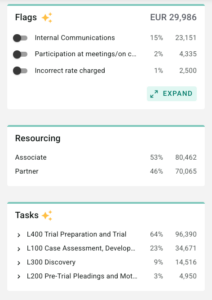
AI-powered invoice review automates the first-pass analysis of every line item, flags potential issues, and applies billing guidelines consistently.
Below, you can see an example of how Brightflag’s AI invoice review automatically flags non-compliant line items and categorizes tasks and activities.
For GCs, this delivers:
Time savings
When legal teams no longer have to devote time to manually combing through invoices, they can focus their attention on higher-impact work
Better cost control
Legal leaders can rest assured that they’re only paying for work that delivers value, and not items that should be considered a part of firm overhead (like time spent on basic research)
Data for more strategic decision-making
AI classifies the tasks and activities performed on each line item of your invoices, building a rich picture of resourcing and staffing that GCs can use to justify—or pivot—their approach
SUMMARIZATION
For GCs leading lean teams, every hour spent on administrative review is an hour pulled away from strategic work. Summarization tools, like AI-generated invoice summaries, help rebalance that equation.
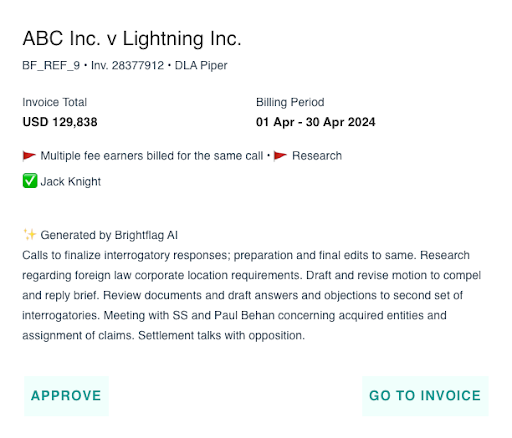
Brightflag’s Invoice Summaries feature, for instance, automatically notifies approvers via email when an invoice is ready for review—sharing an AI-generated summary of the work being billed for, the vendor and billing information, and any potential outside counsel violations that Brightflag’s AI flagged during its initial analysis.
GENERATIVE AI AGENTS
GCs field constant questions from the business—often with little lead time. Questions like:
- What have we spent on [high-risk matter] this quarter?
- How is spend trending to budget?
- What areas of the business are driving the most outside counsel instructions?
Generative AI agents eliminate reporting bottlenecks by turning natural-language questions into instant, accurate insights.
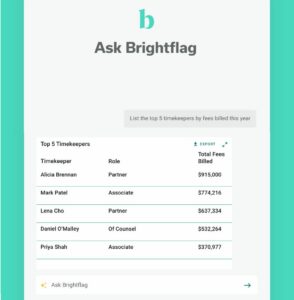
With a generative AI agent like Ask Brightflag, for instance, GCs can simply ask for the data they need, and the tool delivers it. This eliminates the need to build reports, tweak filters, or guess which data fields to include in order to get the insights you need.
In turn, GCs reap the benefits of:
- Faster cross-functional decision-making with finance and business leaders
- Teams that spend less time collating reports and more time delivering high-impact work
- Instant data to drive more agile planning
Developing an outside counsel ai strategy
Law firms are increasingly using AI for research, drafting, diligence, and discovery. So how can GCs ensure the value created through these various applications flows to their legal department?
Developing a strategy for how outside counsel should effectively deploy AI on your matters, and clearly communicating it with your firms, is a great start. Conversations around AI usage should center around the following core principles:
Value creation: Outside counsel should be encouraged to adopt generative AI tools where they improve work quality and/or result in work being delivered at a better price.
Data protection: Your data should not be used to train AI models unless the model is purpose-built for your exclusive use.
Cost expectations: Firms should not charge ‘pass-through’ costs for their use of AI tools or computing resources. Billable time should reflect the effort and expertise of human lawyers, not the background infrastructure supporting them.
For a full breakdown on how GCs can encourage the best use of AI by law firms and measure its impact, check out Brightflag’s “How to Create an Outside Counsel AI Strategy” guide.
Conclusion
Modern legal spend management isn’t just an operational discipline. It’s a strategic advantage that General Counsel can leverage to increase predictability, visibility, and access to the data they need to guide the business with confidence.
By applying the principles in this guide, your department will be well on its way to establishing a legal spend management program that maximizes your team’s resources and positions legal as a strategic, financially savvy partner to the business.
Related Resources


See Brightflag in action
Put this playbook to work. See how legal teams use Brightflag to manage outside counsel, control spend, and prove their value — in a 30-minute walkthrough.