The Private Equity Guide to Legal Spend Management
 8 chapters
•
8 chapters
•
 7 min read
In This Guide

Add greater predictability to outside counsel costs

Leverage AI and automation to save time and maximize the value the legal team can deliver to the Firm

Ensure cost-effective engagements by leveraging law firm benchmarking
Table of Contents
Introduction: Why Legal Spend Management Matters in Private Equity
In private equity, every decision is measured against the value it returns. This is especially true for the firm’s in-house legal department, as they play a critical role in enabling deals, maintaining regulatory compliance, and supporting growth.
Set against this backdrop, legal spend management for private equity legal teams isn’t merely about managing costs. It’s one of the most influential levers the legal department can use to secure real value for investors.
However, implementing an effective legal spend management program can involve challenges tied to the unique operational structures of private equity firms. Many teams struggle with limited visibility into spend as they attempt to piece together data across funds and deals. Invoices from outside counsel also typically arrive only once a deal closes, making real-time expense tracking difficult. And lean internal staffing often means that manual spend reporting and invoice review consume time without adding value.
This guide explores how private equity legal teams can implement best practices to address these challenges and deliver the transparency, control, and measurable ROI that firms and their investors expect.
The Components of an Effective Legal Spend Management Program for PE
When it comes to optimizing legal spend management within a private equity firm, there are a few tried-and-true features that successful teams depend on.
CENTRALIZED VISIBILITY INTO SPEND
Centralized spend tracking is the foundation of effective legal spend management because it enables real-time visibility into where the legal team’s resources are going. This, in turn, enables faster and more strategic decisions to be made regarding work and spend.
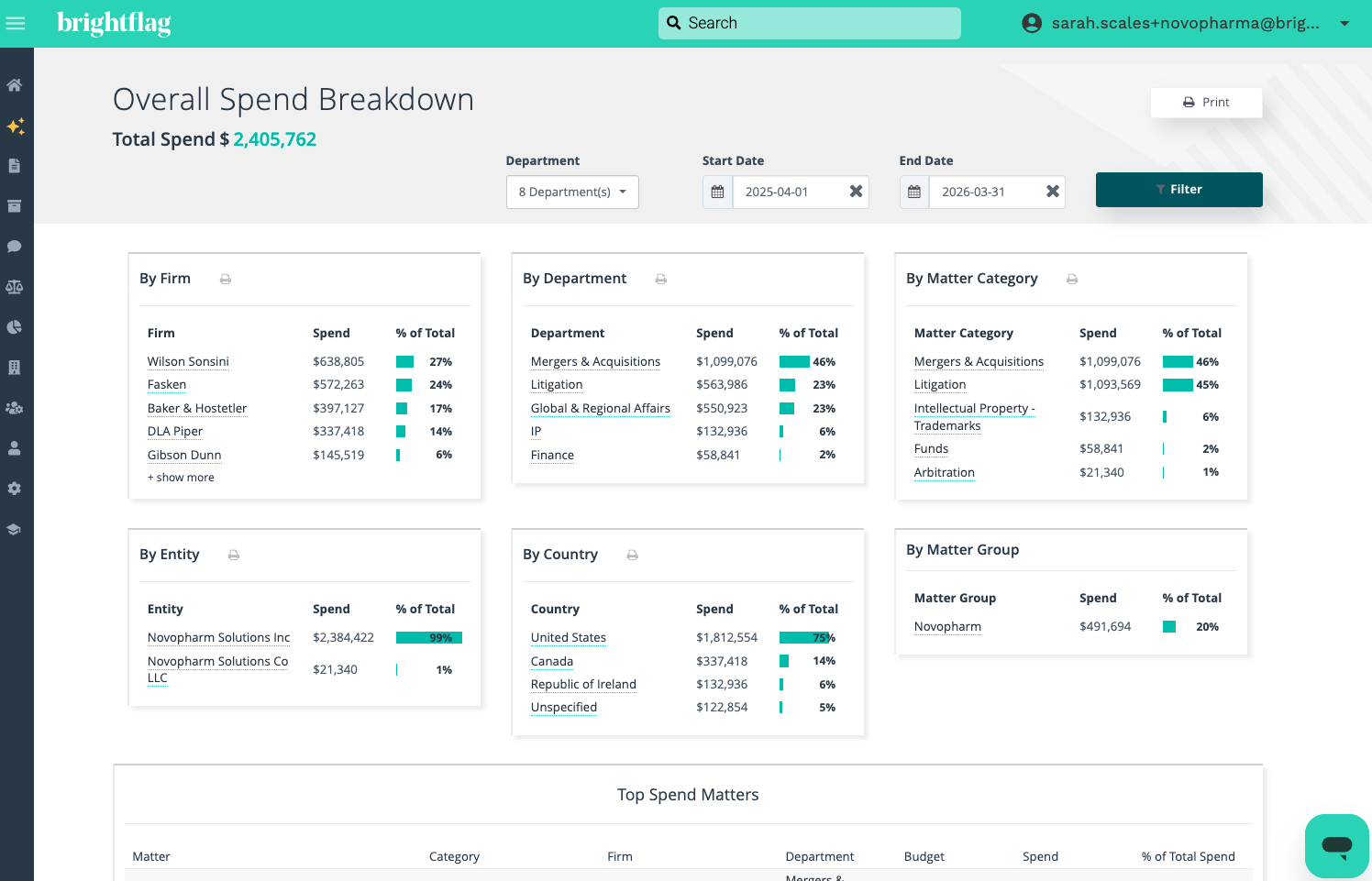
With a legal spend management tool like Brightflag, private equity legal teams can report confidently across transactions, funds, jurisdictions, and law firms. This single source of truth allows legal leaders to easily drill down into spend, supporting fund-level governance and strengthening transparency for finance teams, leadership, and limited partners. This level
of insight also ensures legal teams can respond quickly and accurately to executive questions, rather than relying on delayed or incomplete data.
SPEND PREDICTABILITY
For private equity firms, predictability is the North Star of effective legal spend management. Knowing what a deal is likely to cost at the outset, and tracking actual spend against that spend forecast as the deal progresses, is vital for optimizing how legal’s resources are being deployed.
The first step towards getting to that level of predictability is to implement a legal spend management system that’s capable of tracking and analyzing historical matter and spend data. Brightflag, for example, centralizes all this information, allowing legal teams to see how much they’ve spent on similar matters in the past. This data can then be used to build out more accurate cost estimates for new deals.
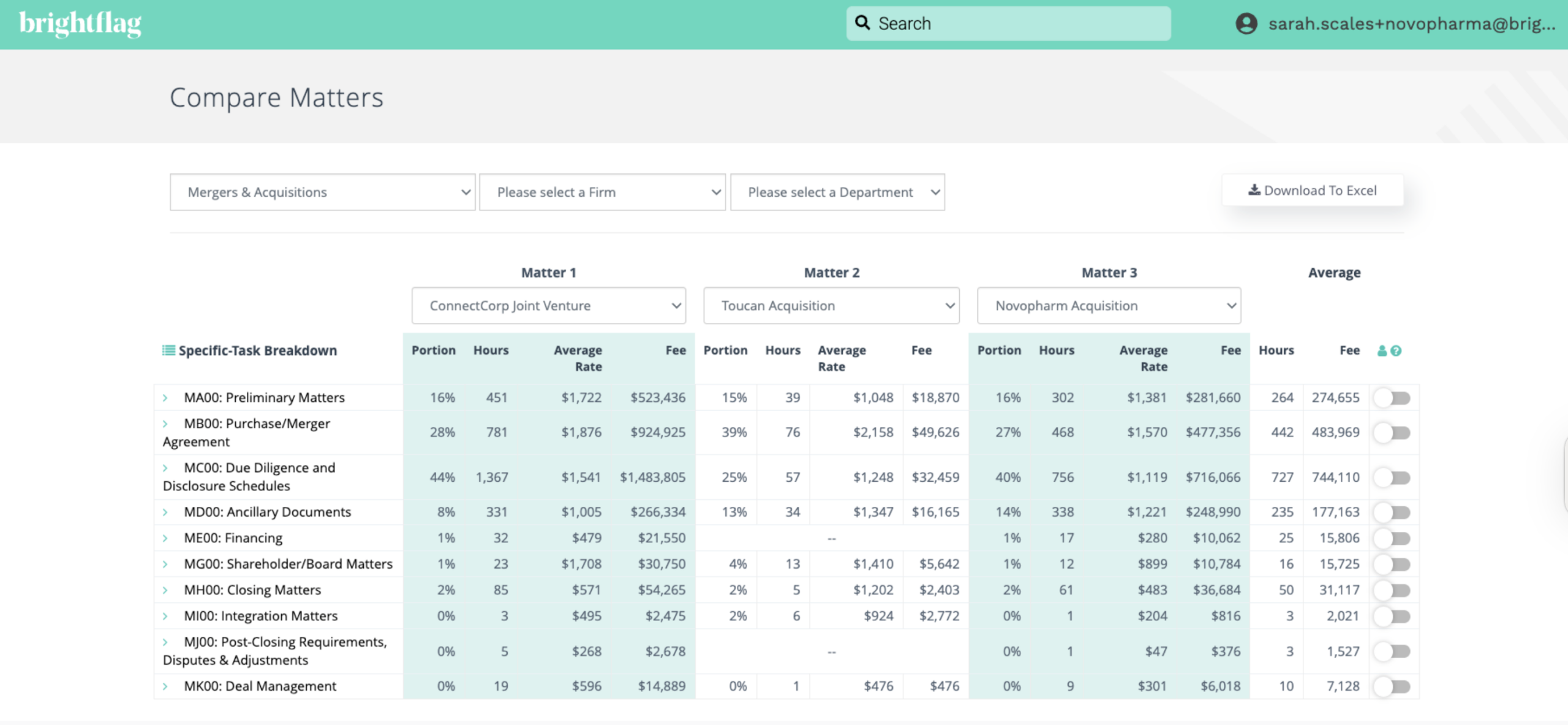
From there, it’s important to monitor spend throughout the deal lifecycle to ensure it aligns with expectations. That’s where pro forma invoices can help.
Deal-related legal work can accumulate significant costs, and waiting for the final invoice to arrive from outside counsel can lead to surprises. To counteract this, legal departments can request that their law firms submit pro forma invoices throughout the deal lifecycle so they can see how spend is tracking against the forecast while work is still ongoing.
Leveraging pro forma invoices using a tool like Brightflag helps private equity legal teams identify cost overruns while there is still an opportunity to course-correct. It’s also a useful way of improving the accuracy of accruals for finance. And unlike some other tools on the market, Brightflag’s pro forma invoice functionality doesn’t require integration with law firms’ internal systems for it to work effectively. That means it’s easy to get up and running quickly, allowing legal departments to begin getting the real-time visibility they need without relying on law firms to do all the heavy lifting of setup.
Over time, analyzing both pro forma and final invoice data together can help legal teams refine budget assumptions, understand true cost drivers in deals, and strengthen their role as proactive, financially disciplined partners to investment and finance teams.
AUTOMATED INVOICE REVIEW
Private equity firms receive some of the largest and most complex legal invoices in the market. Outside counsel typically submit invoices with thousands of line items. And those invoices need to be reviewed quickly as part of the closing process.
Manual invoice review can easily result in the legal team spending hours scanning narratives and checking rates—time which would be better spent supporting other transactions and advising investment teams.
AI-powered invoice review fundamentally changes this equation. By using AI to analyze invoices, work can be automatically categorized to provide immediate visibility into what’s driving spend. Resourcing insights and rates charged in excess of agreements are automatically flagged, ensuring all work meets expectations without the need for attorneys to pore over every line item.

“Potential savings are popping off the page now.”
– SVP of Compliance at a major private equity firm, shortly after implementing Brightflag
The benefits of invoice review automation extend to allocations as well. In instances where multiple funds are contributing financing to a deal, a tool like Brightflag makes it easy to ensure costs are distributed as required for SOX compliance. This takes what would otherwise be a painstaking manual process off the legal team’s plate, and frees them up to focus on higher-impact work.
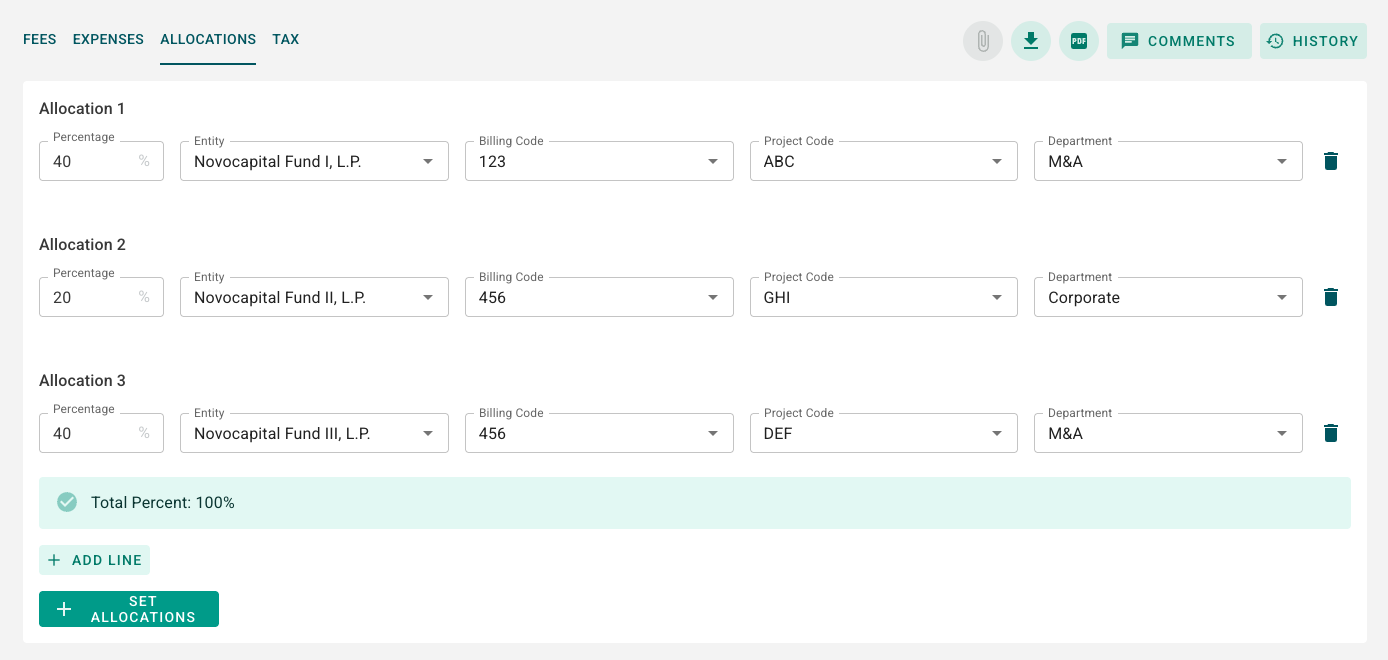
The ability to configure and automate approval workflows can also be a huge time-saver. When the instructing attorney, deal partner, and representatives of the funds that are incurring costs all need to give their stamps of approval before invoices get paid, having the invoice flow between each approver automatically can speed things along significantly.
OUTSIDE COUNSEL BENCHMARKING
Private equity legal teams rely on outside counsel for high-value, time-sensitive work. With only a limited number of vendors capable of handling such high-stakes work, many deals end up being resourced to a handful of top law firms—each of which charge some of the highest rates in the world.
Legal departments can still ensure cost-effective engagements with outside counsel, while also ensuring they’re getting the best rates and resourcing possible. However, getting there requires access to in-depth and reliable benchmarking data.
To gather that data internally, private equity legal teams can use their legal spend management platform to compare historical metrics on partner leverage, rates, and work delivery trends across firms. These insights can be used during firm selection to ensure work is being resourced to the best firm for the work, at the best price.
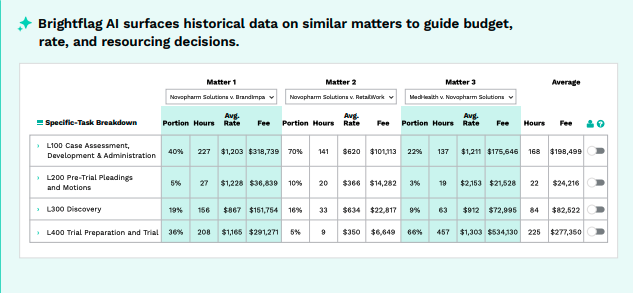
The value of this benchmarking data can be multiplied even further if your legal technology vendor provides support via a dedicated Customer Success team. At Brightflag, for example, our Customer Insights team works with private equity customers to provide benchmark data on the typical rate and resourcing profiles of other similar private equity firms. When paired with data from industry reports and clients’ internal metrics, this helps legal teams gain a complete picture of fair market outside counsel rates and optimal staffing setups.
GENERATIVE AI IN LEGAL SPEND MANAGEMENT
Private equity firms often don’t have a dedicated legal operations function they can lean on to streamline administrative work or help corral data insights. This often leads to a lack of insight into the data needed to effectively manage spend, and/or attorneys devoting their time to this work instead of focusing on delivering legal advice.
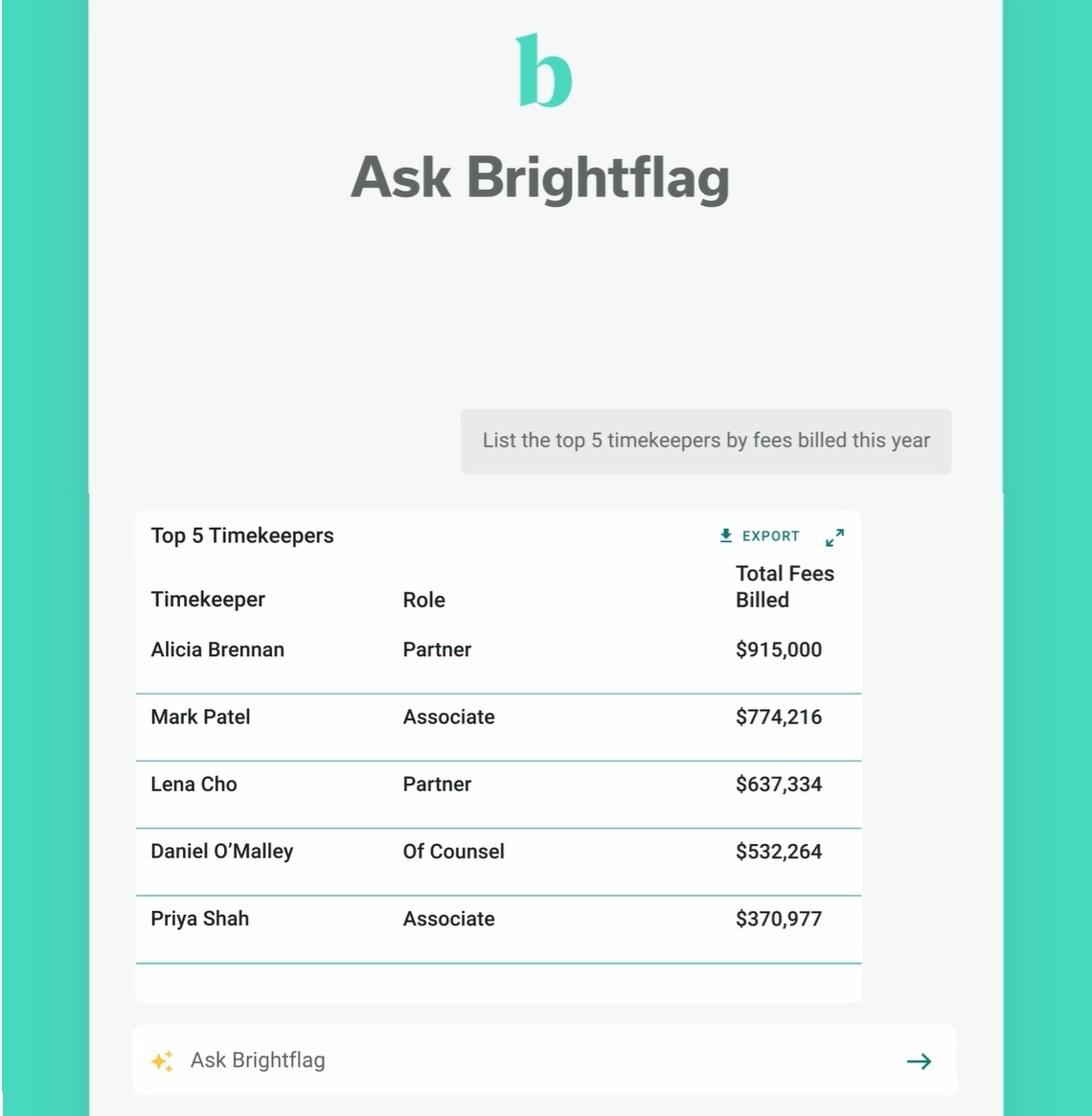
Generative AI agents are particularly well-suited to help in this area, since they specialize in data retrieval, structuring and interpreting information, and delivering quick insights.
With generative AI tools like Ask Brightflag, legal departments can get instant answers to questions like:
- How much have we spent with each of our law firms this year?
- What is Kirkland and Ellis’ blended hourly rate?
- How many matters are currentlyopen with Latham & Watkins?
Being able to get insights into work and spend using conversation instead of clicks lends itself to faster decision-making and more agile planning, and unlocks greater capacity for the legal department without the need for additional headcount.
Conclusion
In our conversations with private equity firms, we’re hearing more and more of them cite the impact that legal spend can have on their deals’ total returns.
A comprehensive legal spend management program helps protect that value. But it also has a cascading effect that improves the legal department’s efficiency, visibility, and strategic impact.
By implementing the components outlined here, your legal team won’t just enable better cost control. They’ll also create a legal function that’s fully empowered to support the firm’s deal economics and drive better outcomes for investors.
Related Resources


See Brightflag in action
Put this playbook to work. See how legal teams use Brightflag to manage outside counsel, control spend, and prove their value — in a 30-minute walkthrough.