eBook
The Complete Legal Cost Control Checklist
 5 chapters
•
5 chapters
•
 15 min read
In This Guide

Tips for creating a system of record for your legal spend to improve visibility into costs

Budgeting & annual financial planning insights

A breakdown of how to manage outside counsel rates and benchmark law firms

Outside counsel guideline enforcement best practices
Table of Contents
Introduction
Whether you’re going through a period of high growth and rocketing expenses or you’re in a phase of belt-tightening, it can be hard to know how to get a handle on legal spend.
To overcome this challenge, you can use some tried-and-true strategies to ensure your legal budget is well spent.
This legal cost control checklist outlines best practices Brightflag has developed helping hundreds of legal teams control costs. You can use it to create a baseline of how you’re doing today and to see where you can improve in the future.
The 4 Pillars of Legal Cost Control
To begin, let’s establish the four pillars that make up an effective legal cost control program:
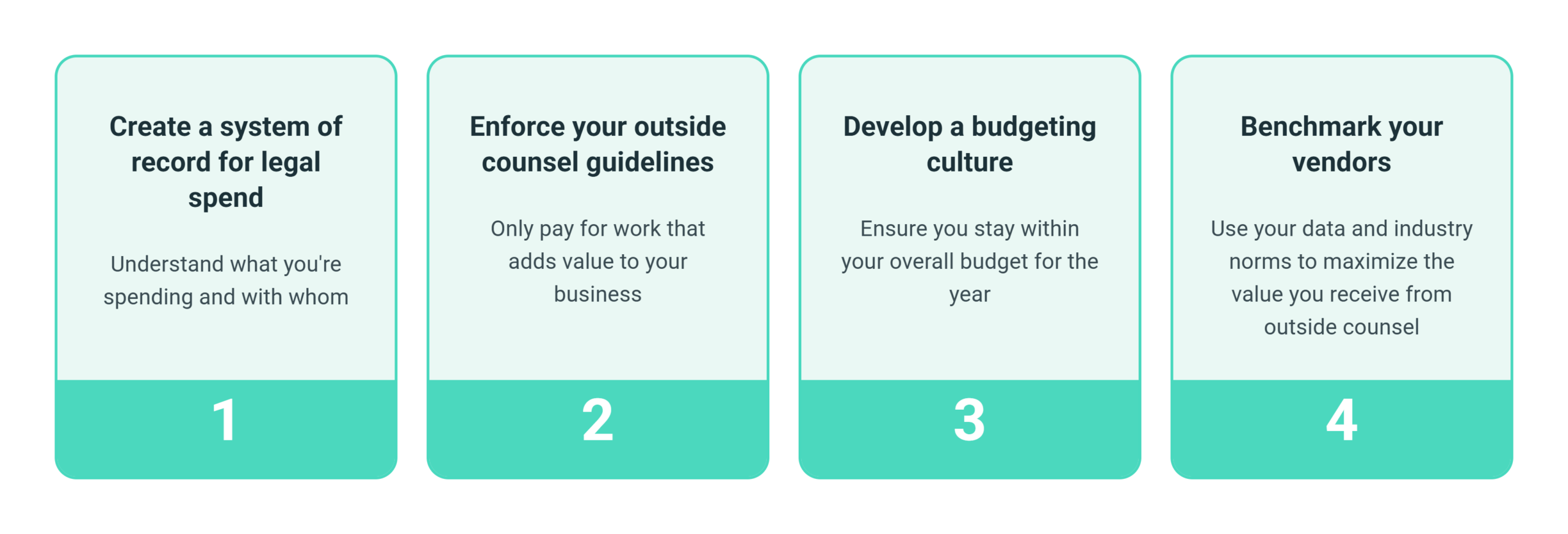
It’s best to start with the first pillar—creating a system of record for legal spend—and to work your way through the next pillars. But don’t worry, you don’t need to check everything off within each pillar before proceeding to the next. As you increase in maturity, you can deepen your proficiency in each area.
Creating a System of Record for Legal Spend
Establishing a system of record for your legal spend provides your legal team with the data they need to effectively and proactively control costs.
Here’s a checklist of the key capabilities you should be able to handle within your chosen system of record:
-
Track all legal spend in one centralized location.
It’s impossible to effectively control costs if your spending information is sitting in siloed emails and spreadsheets. The first step towards controlling costs is tracking spend in one system. Doing so enables you to understand what you’re spending and with whom, so that you can make informed decisions to reduce unnecessary costs.
-
Create dashboards that provide an overview of legal spend.
The ability to view key spending metrics at a glance ensures legal costs can be kept on track. This doesn’t have to be overly complicated. A visualization of your spend by firm, practice area, and a breakdown of your highest spending matters enables you to identify anomalies like higher-than-expected spend in particular areas and take actions to mitigate it.
-
Generate reports on historical data to inform future spending.
Once you have a system of record in place for legal spend, you’ve created a wealth of data on how much you have spent in the past for individual matters and matter types. You can tap into that data to understand your historical spending norms, set better budgets, negotiate better rates and discounts with your firms, and define more cost-effective resourcing strategies.
-
Develop ad-hoc spending reports.
Whether the finance team wants a breakdown of spend to budget for the past six months,or the GC needs data for a meeting in 30 minutes about spend to date on a large strategic matter, it’s important to be able to spin up reports to inform cost control initiatives quickly and easily. And members of the legal team should be able to self-serve and pull reports for all matters they have access to.
Enforcing Your Outside Counsel Guidelines
Consistent outside counsel guideline enforcement can lead to better cost control by ensuring your legal department isn’t paying for non-compliant work. Here’s what to focus on when crafting and implementing your outside counsel guidelines.
-
Formally document your outside counsel guidelines.
The first step in creating a cost-conscious invoicing process is documenting your outside counsel guidelines. Otherwise, invoice review is a matter of subjective opinion for each instructing attorney, and your outside counsel will not have clarity on what items are and are not billable. Reviewing Brightflag’s Sample Outside Counsel Guidelines can be a good place to start for creating or updating your own set.
-
Specify resourcing expectations within your guidelines.
While the details may change depending on the individual matter, your guidelines should clearly state your general expectations for efficient outside counsel resourcing.
This includes the expectation that law firm staff should operate at the “top of their license”, with junior lawyers doing the most advanced work possible by junior lawyers and ditto for all other fee-earner roles.
It should also cover the expectation that the number of fee earners working a matter should be kept to a minimum to increase knowledge density and decrease handover, and that the matter lead should approve the outside counsel team for each matter.
-
Be clear about the activities your legal department will and won’t pay for.
Ensuring that you only pay for activities that add value to your business is crucial for cost control. Your guidelines should clearly state what you consider to be part of the firm’s overhead and not billable, such as read-in time, administrative work, basic research, and excessive communications between internal firm staff.
-
Outline your commercial expectations.
Apart from focusing on how legal work gets done, your guidelines should also cover how you expect the relationship with outside counsel to be managed. This includes mandating regular relationship review meetings and ensuring timekeeper rate and budget request processes are clear.
-
Specify your billing requirements.
Billing requirements cover when and how you expect to be billed. Requiring that you receive bills in a timely manner (e.g., less than 30 days after the work was completed) and with the correct level of detail (e.g., individual line items without block billing) ensures you have the information needed to effectively control costs.
In addition, specifying the format you require bills to be submitted in (PDF or LEDES) and where vendors should submit invoices ensures that invoice review can be completed in a prompt and efficient manner.
-
Review and update your guidelines at least every six months.
Outside counsel guidelines should be viewed as living documents that need to be updated as your expectations change and as you build data on what guidelines have and have not delivered on cost control objectives in the past.
We recommend taking a look at your guidelines every six months. Here again, Brightflag’s Sample Outside Counsel Guidelines are a good source for best practices and specific wording you can use.
-
Ensure that both invoice reviewers and vendors understand the guidelines.
Outside counsel guidelines are only valuable if they’re understood by your internal team and your vendors.
Technology can help to apply your guidelines to each invoice, so you don’t need to teach anyone to recite the rules by heart. That said, all parties should be aware of the existence of the guidelines, their general contents, and their strategic importance as a tool for controlling costs.
-
Clearly define invoice review workflows.
Nothing complicates cost control more than unclear invoice review roles and responsibilities.
The following details should be specified before an invoice is submitted for review:
- Who is responsible for reviewing the work performed on the invoice? This is typically the attorney who instructed outside counsel.
- Do we require additional approval steps, such as when an invoice is above a certain total amount?
Having a software tool that automatically routes invoices helps ensure the correct processes are followed every time.
-
Establish an invoice review process that verifies outside counsel guidelines compliance on every invoice line item.
Your team likely has a high volume of invoices to review every month, with the number ranging from the tens to the thousands. This means ensuring each invoice line item is in accordance with your outside counsel guidelines is no small feat. Add to that the fact that your invoice reviewers are time-strapped and don’t have time to do a line-by-line review with reference to your guidelines.
Luckily, technology can be leveraged to automatically check invoices against your outside counsel guidelines, adjust invoices, or flag items for subjective review.
Developing a Budgeting Culture
Budgeting sits at the core of any effective legal cost control program. By setting, tracking, and managing your legal department budget, you can stay on top of costs before they spiral out of control.
Here’s how to develop a budgeting culture that will make a real impact.
-
Be systematic when setting legal’s fiscal year budget.
The finance department typically sets budgets for each function in the organization based on what that function spent in the previous fiscal year.
The problem is that when it comes to legal issues, what was spent last year is a poor indicator of what costs can be expected in the coming year. For example, if a large litigation matter has just begun, or a major merger or acquisition is planned for next year, these items will have a large impact on spend.
It’s important to systematically look at items that might affect next year’s legal spend to contribute to budget-setting conversations.
Annual Financial Planning Tips
- Collaborate with other business units to understand their plans for next year and estimate the work needed to support them. For example, the expected number of new products launching will affect the number of patent registrations, while the planned number of hires will result in a predictable volume of employment work.
- Looking at your run rate of litigation matters in previous years to estimate the number of matters that will open next year.
- Assess expected regulatory changes for the new year.
For more annual financial planning tips (and a budget planning template), check out Brightflag’s Legal Department Budget Planning Guide.
-
Set budgets for each practice area.
Group or practice area budgets allow you to allocate budget to each team within legal. This provides further granularity in budget tracking and enables you to more easily identify when spend is tracking higher than you initially planned within a given practice area. It also ensures that practice area heads are held accountable for controlling costs within their own functional area.
You can start by defining litigation and IP budgets for the fiscal year. Like legal’s overall budget, these practice area budgets can be defined based on historical spend and an analysis of what might cause spend to be different in the next budgeting cycle.
-
Set budgets for the majority of your matters.
Setting matter budgets is one of the most effective methods of cost control because it provides you with the greatest certainty over legal costs and the ability to proactively course correct when matter costs are trending higher than expected.
Even if the budget set on a matter represents a best guess rather than an accurate prediction, it immediately brings cost consciousness to the conduct of legal work. Over time, the accuracy of budgets will improve due to increased familiarity with the budget-setting process, and your wealth of historical data on matter budgets and overruns will help inform future budgets
-
Collaborate with vendors when setting matter budgets.
Setting matter budgets internally provides a good degree of cost control, but using budget setting as a forcing function for cost discussions with law firms makes them even more impactful. That way, outside counsel are aligned on your cost control goals and understand the importance of resourcing your matters in a cost conscious manner.
-
Ensure vendors do not begin work until matter budgets are approved.
Requiring an approved budget before work begins ensures that vendors are incentivized to collaborate on the budget before they can start the clock and bill hours. It also ensures that work is performed in a cost-conscious manner from the outset.
-
Require vendors to request approval for all work exceeding budget.
No matter how rigorous your budgeting program is, initial budgets won’t always be accurate.
Unforeseen events can arise and work product can take longer than anticipated. While vendors and in-house attorneys should strive for accuracy in the initial budget, a defined process for requests to increase the budget should be put in place to ensure reasonable requests can be accommodated.
-
Leverage an effective budget-tracking system.
To ensure that spend is kept under budget, the in-house team should be able to understand spend against budget at a glance. The GC, finance, and legal ops need to see this at the overall, practice area, and matter levels.
In addition, instructing attorneys should be alerted when spend is tracking to exceed budget on an individual matter, so they can take action to either finalize or expedite the law firm’s work, agree a budget increase, or stop work being done that was not agreed to.
-
Assign internal owners to each matter budget.
For legal teams to be truly successful with budgeting, it’s important to create a culture of budgeting where in-house team members understand the value of good budget setting and are motivated to ensure budget accuracy for the matters they manage. Individual accountability is the key to creating a successful budgeting culture.
At the outset, instructing attorneys can be made accountable for ensuring that a budget is created for every matter.
As your budget program matures, accountability can extend to ensuring that budgets are accurate and not overrun. The legal teams that are best at cost control ensure that budget setting and budget accuracy are baked into the objectives and performance reviews of iin-house team members.
-
Reject invoices that are over budget.
Invoices that come in over budget should always be rejected by the in-house team. If a budget needs to be extended due to genuine unforeseen circumstances in the matter, this should be done through the budget increase request process prior to approving the invoice.
Instilling a hard-and-fast rule that over-budget invoices are rejected ensures predictability in legal spending, incentivizes law firms to be upfront about the true costs of a matter, and reinforces your processes for maintaining fiscal discipline.
Benchmarking Your Vendors
How often your legal department engages outside counsel firms—and which firms they choose to engage—can have a significant impact on their ability to control costs.
Here are some best practices for matter resourcing and vendor evaluation.
-
Engage outside counsel only after weighing alternative options.
Many companies send work to outside counsel, and in particular to traditional law firms, simply because it’s what they’ve always done. This is despite the fact that resolving a matter internally is almost always more cost-effective than sending it externally.
When internal lawyers work matters, you not only benefit from a lower cost but also a deep understanding of your business and appetite for risk.
The challenge, of course, is that in-house teams have limited resources to work on matters internally.
The cost-effectiveness of internal resourcing is also a great justification for growing your in-house team. For example, if you have a rising regulatory workload driven by ever-growing privacy regulations, extra headcount for a privacy lawyer can be justified by looking at how much it costs to send this steady stream of work to outside counsel.
When to Engage Outside Counsel
To better weigh your options for resourcing, matters should only be sent externally if:
- Your in-house team requires specialist expertise, and the volume of work in this specialty is low, so it does not make sense to hire internal headcount for this work.
- The matter is high-risk, and guidance from trusted counsel helps lessen the risk. For example, large litigation matters or highly strategic financing work.
- Your team has capacity issues which means the work cannot be done internally. This justification should be used sparingly, as chronic capacity shortages are more
economically solved by hiring internally.
By tracking the above reasons for briefing on each external matter, you can ensure that your team is outsourcing work for the right reasons, and is managing all work in a cost-effective manner.
-
Leverage data when selecting outside counsel firms.
In-house attorneys typically choose which outside counsel to engage on a matter based on longstanding relationships and trust in certain firm’s partners and project teams.
This is understandable and valuable, especially for high-risk matters where trust and deep knowledge of your business enables outside counsel to work quickly and effectively.
The downside of this approach is that lower-risk and less strategic work also tends to be sent to the same high-cost firms.
By making a simple change and considering what work can go to regional firms or alternative providers, significant cost savings can be realized.
-
Consider alternative fee arrangements (AFAs) for the majority of matters.
Hourly rates remain the legal industry’s default billing model. With cost control becoming a more urgent priority, however, alternative fee arrangements (AFAs) are attracting significant attention. From monthly retainers and volume discounts to blended rates and fixed fees, AFAs can be excellent tools for incentivizing cost efficiency and increasing financial predictability. Even introducing a few of the most basic models to your legal spend management strategy can generate valuable savings.
-
Require approval on all timekeeper rates and rate increase requests.
Ensuring that billing rates are agreed upon ahead of time and can only be increased with express agreement is the best way to begin assessing and benchmarking your vendors.
Tracking timekeeper rates ensures you can identify when large rate increase requests are submitted, and that you can assess these for reasonableness. It also provides you with rich data for vendor benchmarking analyses.
-
Regularly hold relationship reviews with key vendors.
For any vendor you work with regularly, it’s important to meet at regular intervals to assess how things are going and to align on your cost control priorities.
Discussing how matters are resourced, billing hygiene, and providing feedback on performance ensures that cost effectiveness stays top of mind.
-
Measure vendor performance.
While having discussions with vendors on their performance based on gut feel is better than nothing, vendor relationship reviews are more impactful when you can share tangible data, including how they’re performing compared to their peers.
Outside Counsel Metrics to Track
Ultimately, the metrics you track will depend on the overall goals and preferences of your legal department, but some key metrics we suggest are:
- Budget compliance
- Blended hourly rate
- Discounts provided
- Leverage/percentage of spend resourced at partner level
- Adherence to your outside counsel guidelines
- Vendor feedback score
- DEI metrics
- Timely invoice submission (e.g., percentage of invoices submitted less than 30 days after the work was completed)
-
Leverage industry benchmark data (and/or your own internal vendor data) to compare firms.
Comparing vendors using your own historical data is powerful, but it’s even more powerful when you can tap into the wealth of data on typical costs of engagement for other similar companies.
Benchmarking data can be particularly helpful for timekeeper rate negotiations, and developing an outside counsel pricing strategy. Knowing how much companies within your industry, or of a similar size to you, are charged for similar types of work can help you negotiate more favorable rates with your firms.
-
Develop a panel of preferred vendors.
Creating a panel of firms helps to centralize your legal work. It takes the guesswork out of outside counsel engagement for the in-house team while allowing you to benefit from economies of scale. When you provide more work to particular vendors, you give yourself a good bargaining position to negotiate rates and volume discounts.

Related Resources



See Brightflag in action
Put this playbook to work. See how legal teams use Brightflag to manage outside counsel, control spend, and prove their value — in a 30-minute walkthrough.