How to Benchmark Law Firm Billing Rates

Outside counsel spend is the single largest line item in most legal department budgets, and law firm billing rates sit at the center of it. That’s why knowing how to benchmark law firm billing rates is so important.
The challenge has always been access to the data. Law firms have sophisticated pricing teams working from deep historical datasets. But in-house teams have often had to rely on faith and instinct to determine what constitutes a good rate.
This guide breaks down the two types of rate benchmarking that give legal departments real leverage, and where to find the data for each.
Industry Benchmarks
Industry benchmarks answer the first question your team needs settled: what is the market actually charging, and why?
Brightflag’s annual Law Firm Billing Rates Report is built to answer exactly that.
Each year, the report analyzes billions of dollars in outside counsel spend to track how rates are trending across the Am Law 100; the 100 highest-revenue U.S. law firms as ranked by ALM.
Importantly, the analysis is based on billed rates, meaning the rates that actually hit invoices, rather than rack rates or requested increases. That distinction matters when you are trying to understand what in-house teams are really paying.
2026–2027 Law Firm Billing Rate Benchmark
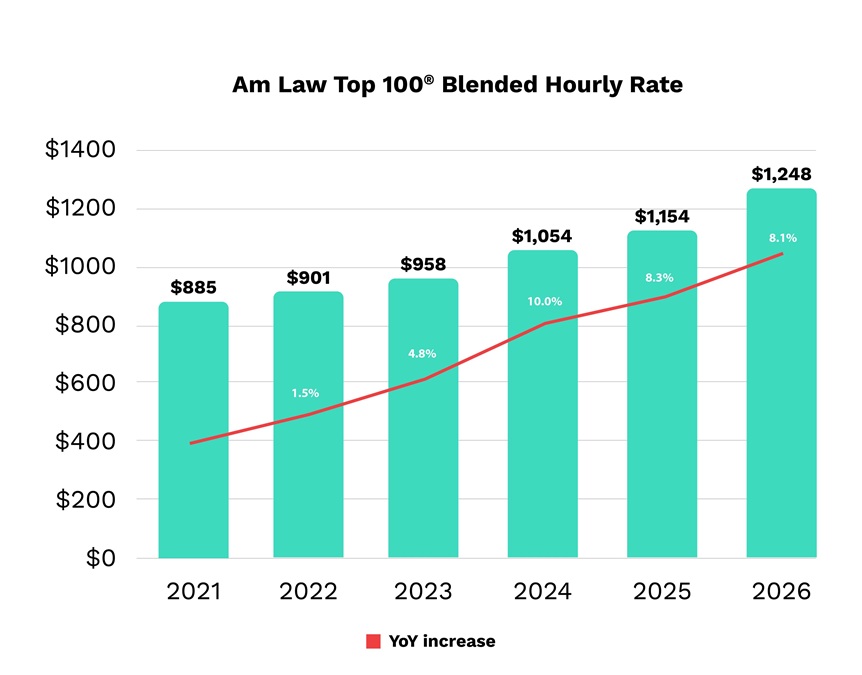
The headline number from this year’s rates report: the average blended hourly rate among the Am Law 100 reached $1,248 in 2026, an 8.1% increase over last year. That continues a three-year run of increases well ahead of inflation, beginning with 2024’s 10% jump.
The Factors Driving Law Firm Billing Rate Increases
Beyond the top-line figure, the report breaks down the factors driving what firms charge. Each one represents a decision point where legal teams can exert real influence over their spend.
Firm ranking
Ranking remains one of the strongest predictors of hourly rates.
In 2026, partners at top-25 firms averaged $1,909 per hour, a 16.7% increase over 2025 and nearly double the $1,004 average at firms ranked 76 to 100. Associates at top-25 firms billed $1,208, outpacing even partner rates at the back half of the Am Law 100.
Practice area
M&A and corporate work remain the highest-priced practice areas. M&A partners at top-25 firms billed $2,089 per hour in 2026, up 13.3% year over year, with corporate partners close behind at $1,940, a 14.6% increase.
Geography
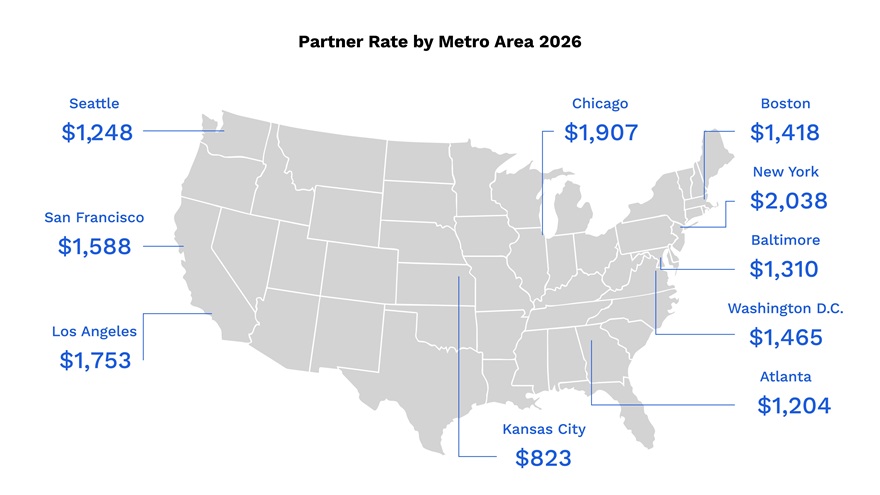
Location continues to drive significant variation. New York is the most expensive market, with partners billing $2,038 per hour, followed by Chicago at $1,907 and Los Angeles at $1,753. Those three metros saw rates rise an average of 11.9% over 2025.
At the other end, partners in Kansas City billed $823, less than half the New York rate.
Resourcing mix
How firms allocate work across seniority levels plays a critical role in total cost. In 2026, partners accounted for 33.1% of billable work at top-25 firms compared to 47.5% at firms ranked 76 to 100.
Heavy partner billing at top-tier firms carries a much greater financial impact given their higher rates, which is why monitoring resourcing patterns matters as much as monitoring rates.
Law Firm AI Use
This year’s report included new data on how firms are resourcing and completing work in the age of AI, with early signs of real efficiency gains.
Notably, there were 0.85 junior associates staffed per matter in 2026, a 23.4% decline from 2025 and the lowest ratio in three years. And the average number of hours billed per matter fell 40%. These are two indications that AI efficiencies may be having a significant impact on how law firms approach work.
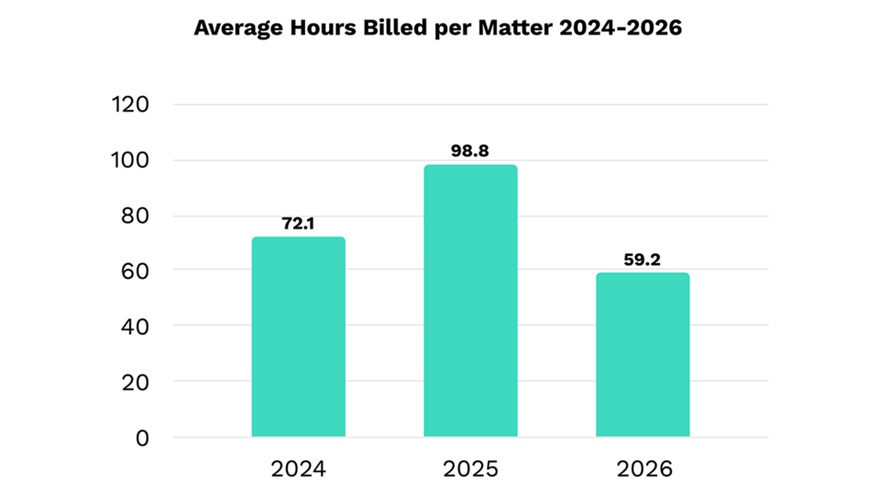
The twist is that leaner staffing and fewer billed hours has not translated into lower costs for in-house legal teams. To maintain revenue, firms appear to be adjusting pricing to offset fewer billable hours, which may partly explain why rates kept climbing this year. The practical response is to build an outside counsel AI strategy that sets clear expectations about how firms use AI and how the resulting savings get passed along.
Access the full Law Firm Billing Rates Report for more insights.
Internal Benchmarks
Industry data tells you what the market charges. It cannot tell you what your firms charge you, how that has changed over time, or which of them delivers the most value on the work you actually send out.
That requires a system of record for your matters, vendors, and spend.
Internally Benchmarking Law Firm Billing Rates: The System of Record Unlock
A system of record is the single source of truth that serves as the backbone for your legal department’s data and workflows.
For outside counsel management, that is your enterprise legal management (ELM) platform. A well-built one defines the data model, enforces business logic, manages the lifecycle of your data, provides auditability, governs permissions, and acts as the integration hub that other systems connect to through APIs and MCP servers.
In practical terms, it means every invoice line item your firms submit becomes structured, comparable data. Brightflag, for example, runs each invoice line item through its patented AI to codify and standardize it, producing a consistent dataset built entirely from your own work.
Once that foundation is in place, internal rate benchmarking lets your team answer questions industry research never could:
How are this firm’s rates trending for us specifically?
Not the Am Law 100 average, but your legal team’s average with this firm over the past several years.
How does this firm’s rates compare to the rest of our panel?
Side-by-side comparison on the matter types you actually send out.
How does this firm staff matters relative to peers doing comparable work?
Two firms can quote similar rates and produce very different invoices depending on how that work is resourced.
What do the other KPIs say, beyond just the law firm billing rate?
Billing guideline compliance history, vendor performance reviews, budget-to-actual variance, and matter cycle time all round out the picture.
That last point is where internal benchmarking pulls ahead. Rate data tells you what a firm costs. Staffing, compliance, and outcome data tell you whether it is delivering value.
Here is what it sounds like to kick off a rate conversation when it is grounded in internal benchmarks:
“Over the last 18 months you’ve averaged $650/hour on our employment matters with 3 associates per matter. A comparable firm on our panel averages $580 with 2. Help us understand the difference.”
Internal Rate Benchmarking in Action with Brightflag’s Advanced Vendor Management
Having the law firm billing rate data is one thing. Getting it in front of the person making a resourcing decision, at the moment they make it, is another.
That is the gap Brightflag’s Advanced Vendor Management functionality closes.
The insight behind it is simple: How do you make data-driven vendor decisions on 100% of your matters—not just the ones that go to RFP?
Advanced Vendor Management brings enriched vendor profiles, configurable rules of engagement, and real-time insight directly into the moment a decision gets made. And it goes beyond just law firm billing rate benchmarking, layering in insights into how firms resource and complete work as well.
Here are some examples of the functionality in action:
Vendor comparisons
Every firm you work with gets a living profile that pulls law firm billing rate benchmarks, staffing insights, compliance data, and matter-level feedback into a single structured scorecard.
This creates a picture of outside counsel firms that updates as the work happens: what they charge, how they staff, whether they follow your guidelines, how your team rated the outcome. It turns the annual “how are our firms doing?” conversation from an exercise in anecdote into an exercise in evidence.
AI-driven vendor selection insights
When outside counsel need to be engaged on a matter, Brightflag surfaces AI-powered recommendations and side-by-side firm comparisons, highlighting the right firms for that kind of work based on what your own history says about their rates, staffing, and performance.
Rules of engagement you configure keep selections aligned with policy, so panel discipline holds up even on the fast, small, routine matters where it usually erodes first. The person making the choice does not need to go find the data. The data comes to them.
RFP creation
For work that does warrant a competitive process, RFPs live inside Brightflag with structured evaluation criteria tied to your internal data rather than to whatever firms choose to tell you about themselves. Use custom templates by matter type, invite firms to participate directly from the platform, and compare bids alongside AI-powered vendor insights. When you make a selection, the agreed pricing and scope connect straight to matter budgets. That last part is the difference between negotiating a rate and actually realizing it.
Because all of this sits inside your system of record, there are no integrations to maintain, no second platform to learn, and no gap between where decisions get made and where the work gets managed.
Law Firm Billing Rate Benchmarking Success Stories
- Sonnedix used benchmarked rates, common billing violations, and budget adherence data to guide a panel consolidation from more than 60 providers to fewer than 30. As their team put it, good data takes the heat out of these conversations, and most firms are actually eager for objective feedback from clients.
- Ocado Group used Brightflag’s reporting to compare performance across firms, enabling the team to benchmark, track trends, and introduce measures like AFAs and volume trade discounts. Their reporting on the partner-to-associate split proved especially revealing, giving them a concrete basis to ask firms for the resourcing they wanted.
- A Forrester Total Economic Impact study commissioned by Brightflag quantified the rate enforcement piece directly: 0.75% of spend avoided on inaccurate timekeeper rates, driven by automatic flagging or rejection of submissions with unexpected rate changes, unapproved timekeepers, or missing rate information.
Putting It All Together
Effective rate benchmarking runs on two tracks.
- Industry law firm billing rate benchmarks give you the market context to evaluate whether a rate increase request is reasonable. The 2026 Law Firm Billing Rates Report puts the Am Law 100 blended average at $1,248, up 8.1%, and breaks down how firm ranking, practice area, geography, resourcing mix, and AI adoption shape what you pay. That is your anchor point in any negotiation.
- Internal law firm billing rate benchmarks turn that context into action. With a system of record capturing and standardizing your billing and matter data, you can see how each firm’s rates are trending for your department, how they compare to peers on your panel, how they staff comparable work, and whether they are meeting your guidelines. That is what lets your team move from pushing back on a number to making better resourcing decisions across every matter.
Together, they give legal departments something that used to be out of reach: a pricing strategy as well-informed as the ones their law firms bring to the table.
Want to see what your own data says about your firms?
Book a personalized demo of Brightflag and see how Advanced Vendor Management, AI-powered invoice analysis, and a purpose-built system of record help in-house teams benchmark rates, compare firms, and get more from every outside counsel relationship.
How to Benchmark Law Firm Billing Rates FAQ
How do you benchmark law firm billing rates?
Legal departments can benchmark law firm billing rates in two ways.
First, compare your law firms’ rates against industry data, such as Brightflag’s annual Law Firm Billing Rates Report, which analyzes billions of dollars in outside counsel spend to track Am Law 100 rates by firm ranking, practice area, geography, and resourcing mix.
Second, build internal benchmarks from your own historical billing data in a legal system of record, which shows how each firm’s rates have trended for your department and how firms compare on staffing, compliance, and performance. Industry data tells you whether a rate is reasonable. Internal data tells you which firm to assign the matter to.
What is a reasonable law firm rate increase in 2026?
The average blended hourly rate among Am Law 100 firms rose 8.1% in 2026, reaching $1,248. That figure is a useful anchor: a request meaningfully above 8% is worth questioning. Increases varied by segment, with partners at top-25 firms up 16.7% and firms ranked 101 to 200 seeing rate declines for the first time since 2021.
What data do you need to benchmark law firm rates internally?
Internal rate benchmarking requires standardized, line-item-level billing data covering timekeeper rates by role and seniority, hours billed by each timekeeper level, matter type and complexity, billing guideline compliance history, budget-to-actual variance, and vendor performance review scores. This data has to be consistent across firms to be comparable, which is why it needs to live in a system of record rather than spreadsheets or individual invoice PDFs.
What is a legal system of record?
A legal system of record is the single source of truth for a legal department’s matter, vendor, and spend data. It defines the data model, enforces business logic, manages data lifecycle and state, provides auditability, governs permissions, and acts as the integration hub other systems connect to. For outside counsel management, that system is an enterprise legal management (ELM) platform like Brightflag.
How do you compare law firms beyond their hourly rates?
Compare law firms on staffing mix (the ratio of partner to associate hours on comparable matters), billing guideline compliance rate, budget adherence, matter cycle time, and internal stakeholder performance ratings. Two firms quoting similar rates can produce very different total costs depending on who does the work. Brightflag’s Advanced Vendor Management consolidates these metrics into a vendor profile that updates as work happens, enabling side-by-side law firm comparison at the moment a matter is assigned.
Does rate benchmarking actually reduce legal spend?
Yes. A Forrester Total Economic Impact study commissioned by Brightflag found that customers avoided 0.75% of total outside counsel spend on inaccurate timekeeper rates alone, through automatic flagging of unexpected rate changes, unapproved timekeepers, and missing rate information. Teams using benchmarked rates for panel decisions have reported larger structural savings, including Sonnedix consolidating from more than 60 providers to fewer than 30.
How often should legal departments benchmark law firm rates?
Review industry benchmarks annually, timed ahead of your firms’ rate increase cycle so you have market context before negotiations begin. Internal benchmarks should be continuous rather than periodic, since a system of record updates vendor performance data with every invoice, making current rate and staffing data available whenever a matter needs resourcing.
Share:


Sinead Kenny

Director, Customer Insights at Brightflag