eBook
Your Law Firms Have a Pricing Strategy. Do You?
A Guide to Maximizing Outside Counsel Value
 8 chapters
•
8 chapters
•
 14 min read
In This Guide

A step-by-step guide to timekeeper rate negotiations

The data points legal teams use to improve outside counsel spend management

Examples of how to leverage AI for more strategic vendor management

Tips for outside counsel benchmarking and cost-effective matter resourcing
Table of Contents
Introduction
Your Law Firms Have a Pricing Strategy. Do You?
Whether it’s preparing a proposal for a client’s RFP, or finalizing timekeeper rate increase requests, law firms are always leveraging their data to build informed pricing strategies that ensure they’re receiving maximum value for their work.
Shouldn’t your in-house team apply that same approach to how they manage their outside counsel spend?
In this guide, we’ll showcase some of the keys to implementing an outside counsel pricing strategy. This includes a step-by-step guide to timekeeper rate negotiations, as well as tips for benchmarking your law firms and executing RFPs. Because if your law firms can benefit from having a data-backed pricing strategy, there’s no doubt your in-house team can too.
Chapter 1
Building the Foundation: A Strong System of Record
Your legal department can’t optimize their outside counsel spend if they don’t have clear benchmarks for what qualifies as “good” when it comes to:
- Matter staffing and pricing
- Timekeeper rates
- Vendor performance
- Billing guideline compliance
However, creating those benchmarks requires comprehensive, comparative data.
Your legal department can collect and track this information in spreadsheets and internally built tools. But to really scale the impact of your data on your outside counsel pricing strategy—and eliminate the heavy-lifting that comes with manual data entry, report-running, and analysis—your legal department will want to implement a purpose-built system of record.

What is a system of record?
A system of record is the single-source-of-truth that serves as the backbone for your legal department’s data and workflows. Every corporate legal department has multiple systems of record, each for a particular domain (e.g. spend, contracts, legal hold, etc.).
To be effective, a system of record should be able to:
- Define the data model
- Enforce business logic
- Manage the state and lifecycle of your data
- Provide auditability
- Govern permissions
- Act as the integration hub that other systems connect to through APIs and MCP servers
Since the focus of this guide is maximizing the value received from outside counsel, we’ll be referring to enterprise legal management (ELM) platforms, because they serve as the system of record for vendors, matters, and spend.
For an in-depth breakdown of legal systems of record and how they unlock the full potential of AI and tooling for in-house teams, check out Brightflag’s “The AI-Native Corporate Legal Department Technology Stack” whitepaper.
Once you have a system of record in place that you can trust to govern, analyze, and provide insights into your matters, vendors, and spend, your in-house legal team will have all the data they need to improve outside counsel cost control, right at their fingerprints.
Let’s explore the three key areas where this data can be applied to maximize the value received from your firms.
Chapter 2
Timekeeper Rate Negotiations
Timekeeper rate increases aren’t the only driver of rising outside counsel costs. But they can have a significant impact on your legal department’s bottom line. And without a plan in place for reviewing and negotiating them each year, they can quickly become overwhelming for your legal team to effectively manage.
Here’s a step-by-step guide to building structure around timekeeper rate negotiations, and leveraging the data from your system of record to manage the impact of rate increases.
Step 1: Establish Leverage
Negotiation is nearly impossible without meaningful leverage, and your firms are unlikely to budge when it comes to their rate increase requests if your in-house team doesn’t have feasible alternatives that they can resource their net-new matters to.
To build that leverage, use the vendor data in your system of record to identify other firms that have performed similar work for you, who could potentially step in to provide their services if needed.

Reminder: Your matters aren't monoliths
Alternative resourcing arrangements don’t have to mean the wholesale replacement of a firm. They could include routing only certain portions of work (e.g. document review, due diligence, contract analysis, etc.) to lower-cost vendors, or to alternative legal service providers (ALSPs). They could also involve moving some work in-house, or hiring temporary staff to handle certain types of work.
Step 2: Set the Cadence and the Rules of Engagement
One factor that can make rate increase requests feel particularly hectic is the lack of a clear framework on how and when firms should submit these requests. When requests trickle in throughout the year, it’s hard to implement a system for reviewing and negotiating them.
The solution? Create a rate increase request policy that establishes:
- How often requests can be submitted
Recommendation: Once-a-year - When requests should be submitted
Recommendation: The first half of Q4, so new rates can be factored into annual budget planning
Legal teams should also make a point of establishing with their firms that there is no guarantee rate increases will be approved as-is. Additionally, early or ad-hoc asks from firms should not be accepted, as this will only pull increases forward and place greater strain on your budget.
Having a clear policy like this in place—and formalizing it within your outside counsel guidelines—ensures all requests are received within the same window of time. This allows your legal team to have visibility into rate requests across their entire panel of firms, and makes it easier to see how requests stack up and which requests are the most reasonable.
Step 3: Identify Your Negotiation Team & Prepare Your Data
Your in-house attorneys are typically best-suited to lead outside counsel negotiations. That’s because:
- They’re familiar with the work your firms have done
- They know the areas where a firm’s work is critical (and where it can be replaced)
- They have cultivated peer relationships with members of the outside counsel team
That said, attorneys sometimes worry that pushing back on rate increases could strain the relationship they’ve cultivated with their outside counsel partners.
This is the part of the process where legal operations shines.
The role of legal ops in these negotiations is to gather the benchmarking data attorneys rely on to have a purely fact-based discussion about rates. This allows attorneys to continue to nurture the firm relationship while opening up a dialogue driven by objective data.
The Most Impactful Rate Negotiation Data Points
Here is some of the most compelling data that legal operations can provide to give your legal team the strongest footing possible during the negotiation process.
Historical firm rate increases
How much does the firm in question typically raise their rates each year? Is this year’s request in line with the historical average? Grounding increase requests in historical data can help your team spot outliers and flag them for a deeper discussion.
Industry benchmarks
Industry research, like the data found in Brightflag’s Annual Timekeeper Rates Report, is useful for identifying overarching pricing trends.
Is a firm requesting a 20% rate increase, when the average increase among Am Law 100 firms is 10.1%? That should spur a conversation on the factors feeding into that gap, and create an anchor point that your team can negotiate towards.
Average panel rate increases
One of the benefits of having your outside counsel firms submit all their rate increase requests at the same time every year is it enables your legal department panel-wide visibility into the average rate increase requests. Your panel’s average requested rate increase can also be a compelling statistic to point to in negotiations if it’s lower than the proposed increase a particular firm has submitted.
Staffing comparisons
Rate benchmarks are important, but data on how matters are being staffed can be just as impactful for driving overall savings.
For example, being able to pull data from your system of record and come to the table with an insight like:
“Over the last 18 months you’ve averaged $650/hour on our employment matters with 3 associates per matter; a comparable firm on our panel averages $580 with 2. Help us understand the difference.”
This can drive a broader strategic conversation around staffing that can help curtail the standalone impacts of rising rates.
Rate structure beyond hourly rates
How much of this firm’s work already sits under alternative fee arrangements (AFAs), flat fees, or negotiated discounts/rebates? A firm pushing a 20% hourly rate increase looks different if AFAs already cover 40% of their matters with you. That context should shape whether the increase request gets evaluated on its own or as part of the broader fee structure.
Outcome and efficiency data
Rate and staffing benchmarks show what a firm costs, not whether it’s delivering value. Pulling win rates, matter cycle time, or budget-to-actual variance for that firm gives attorneys a way to argue value alongside price, not just push back on the number.
Billing guideline compliance
Is the firm consistently late on invoice submission, or triggering repeat billing guideline violations like block billing, unapproved rate increases, or missing timekeeper approvals? Compliance friction is leverage too: a firm asking for a rate increase while generating avoidable back-and-forth on invoicing should have that behavior on the table at negotiation time instead of treating it as a separate issue.
Peer firm comparison
How does this firm stack up against other firms in your portfolio handling comparable matter types in key areas like rates, staffing mix, experience level, and results? Comparing like-to-like (e.g. two employment litigation firms, both handling similar volume) gives attorneys a concrete reference point beyond “the industry average,” and can surface questions worth raising directly, like why one firm bills more for less senior staffing than a peer with a stronger track record on similar matters.

Pro Tip: Connect Your System of Record to Your AI Workspace via MCP to Streamline Data Analysis
You can always pull the outside counsel data you need from your ELM system of record by manually running reports. But to make strategic analysis even faster and easier, connect your system of record to your AI workspace (e.g. ChatGPT, Claude, Gemini, etc.) via a Model Context Protocol (MCP) Server.
Integrating your system of record with your AI workspace via MCP gives your legal team the best of both worlds: AI workspaces’ ability to access and collate data with conversation instead of clicks, as well as the trust, security, and governance that a purpose-built legal system of record provides.
Step 4: Have the Conversation
Start by identifying your top-spend firms. This is usually the 3–5 firms that 60–70% of your outside counsel spend is allocated to. Then book time to meet with them individually.
The conversation should be framed as strategic planning—not strictly a negotiation. And the discussion should be structured as such. Topics addressed can include:
- A review of the upcoming work pipeline being generated by your in-house team
- A discussion about their team’s capacity, the business pressures they’re facing, and their track record working on your matters
- A deep-dive on your legal department’s budget outlook, your 18-month spend history with them, and the benchmarks your legal ops team has gathered from your data
When it comes time to discuss rate increases, ask your firms to help you understand the “why” behind them. Here are some common reasons law firms may cite—and how your legal department can respond.
Common Rate Increase Defenses (and How to Respond)
“That’s just the average rate increase across the market.”
How to respond: If you have industry data that contradicts this point, be prepared to present it and negotiate towards that lower percentage.
If the proposed figure is in line with industry averages, see if you can leverage the amount of work you’re sending their way to work out a volume discount. Frame it along the lines of:
“We really value this relationship and are happy with the work we’ve received. We’d like to send more work your way in the future, but need the rates to be competitive enough that we can justify the shift. Would you consider offering us a volume discount to make this possible?”
“Our costs are increasing—this is the minimum amount we can raise our rates while maintaining our margins.”
How to respond: Ask for a bit more detail here. Where are costs rising? Are there opportunities to leverage tools like AI to increase efficiency, and pass some of those savings on to your legal department to offset rising rates? If it’s rising staffing costs that are at issue, is there an opportunity to optimize how work is resourced to help offset the higher rates (e.g. keeping the number of fee-earners on a matter to the minimum to increase depth of knowledge and reduce time relaying information back and forth)?
Even if there’s little wiggle room on the rates themselves, there may be opportunities to get creative with how they ultimately hit your budget.
“Our rate card increase applies across all clients. We can’t carve out an exception.”
How to respond: Reframe the conversation away from rate card pricing entirely. Propose a negotiated structure instead, like a blended rate target, an AFA on a subset of matters, or a volume-based discount, and let the firm respond to that framework rather than defending their standard card.
“The increase is modest compared to the value we deliver.”
How to respond: Meet the value claim with value data. Reference your data points on win rates, cycle time, or budget-to-actual variance on their matters. You can frame this as: “We track outcomes across our panel. Can we look at those numbers together before settling on a rate?”
Pro Tip: Consider Multi-Year Fixed Rate Agreements
An arrangement that may be worth floating during rate negotiations is a multi-year fixed rate agreement with your most-engaged firms. This can not only add more predictability to your future budgeting processes, but it cuts down on the number of rate negotiations your team has to partake in every year.
How to frame the ask: The law firm retains a client and receives sustained work from them for multiple years, and in exchange the legal department gains predictability around pricing that can help with annual budget planning.
Chapter 3
Requests for Proposal (RFPs)
RFPs are a key part of any outside counsel pricing strategy. Usually reserved for a legal departments’ highest-spend matters (often $100k or more), RFPs encourage law firms to put their best foot forward by submitting competitive bids, and providing clear outlines for how they’ll staff and manage the proposed work.
On RFPs
When run effectively, RFPs have been shown to result in as much as a 15% reduction in matter costs.
For tips on when and how to craft a strong legal RFP, check out Brightflag’s “Five Elements of an Effective Legal RFP” blog.
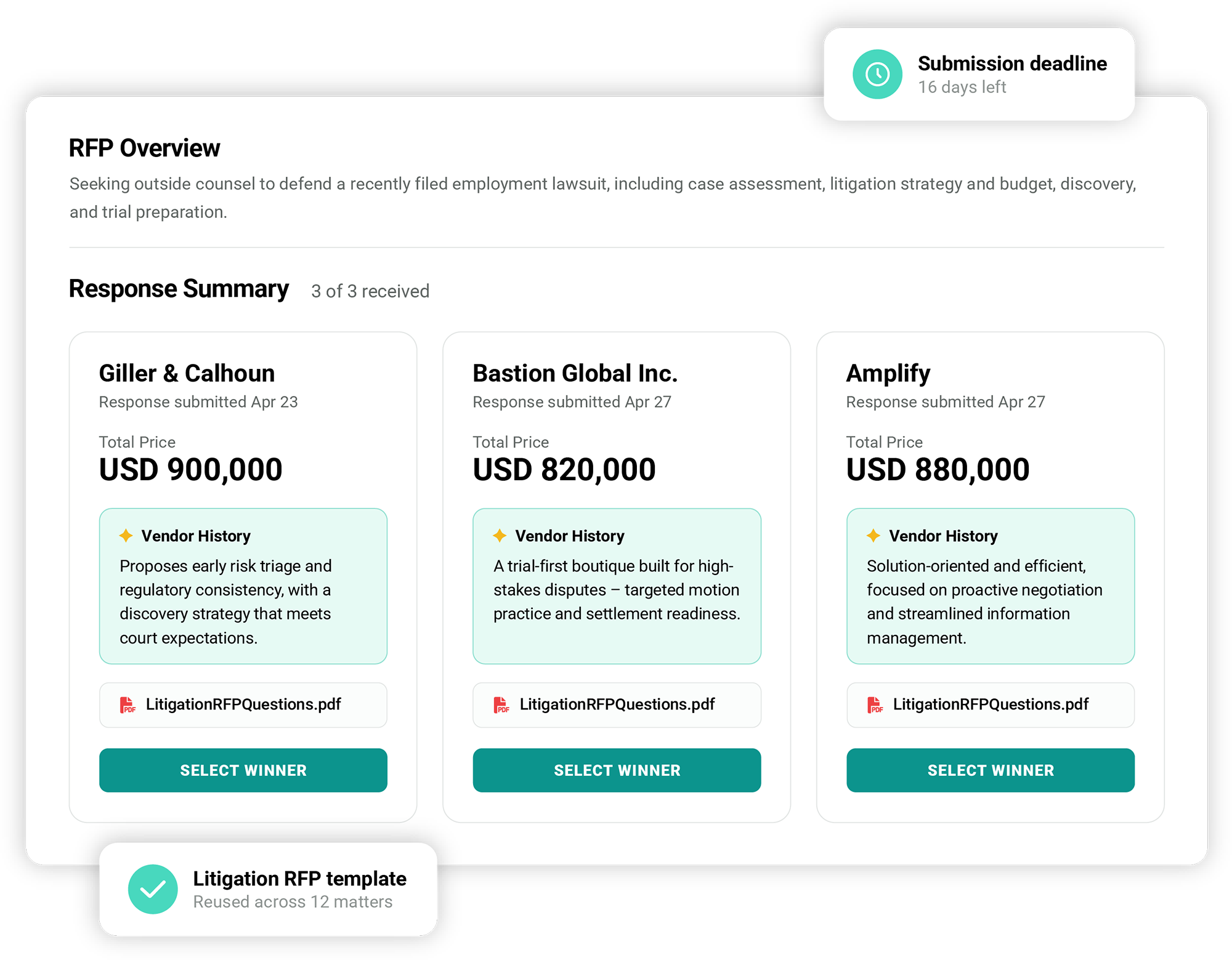
RFPs can be created and managed in email and spreadsheets. However, one of the reasons they’re often reserved only for a legal team’s highest-cost matters is because of how resource-intensive and time-consuming they can be to execute.
If your ELM tool has RFP functionality built-in, it can massively streamline the process by automating RFP generation and issuance. It also makes it seamless to apply the rich data collected by your ELM to the firm-selection process.
In Brightflag, for example, legal departments can use custom RFP templates for different matter types and invite vendors to participate in controlled auctions directly from the platform.
Chapter 4
Law Firm Benchmarking
It may not be feasible to run RFPs on all of your matters. But having a system of record in place for your law firm data makes it easy to be just as strategic with all of your outside counsel engagements.
That’s because it provides a holistic, historical picture of how firms have performed on the matters you’ve partnered with them on—and how their work compares to similar firms on your panel, both in terms of performance and cost.
Ideally, your system of record will be able to capture benchmark data on aspects of outside counsel work like:
- Spend by firm, matter type, and practice area
- Staffing ratios (e.g. partner:associate mix) by matter type and firm
- Rates actually paid (i.e. what hit invoices—not just what was proposed)
- Billing compliance (i.e. the share of invoices with outside counsel billing guideline violations)
- Matter cycle time, from intake to close, by firm and matter type
- Budget vs. actual, and where overruns took place
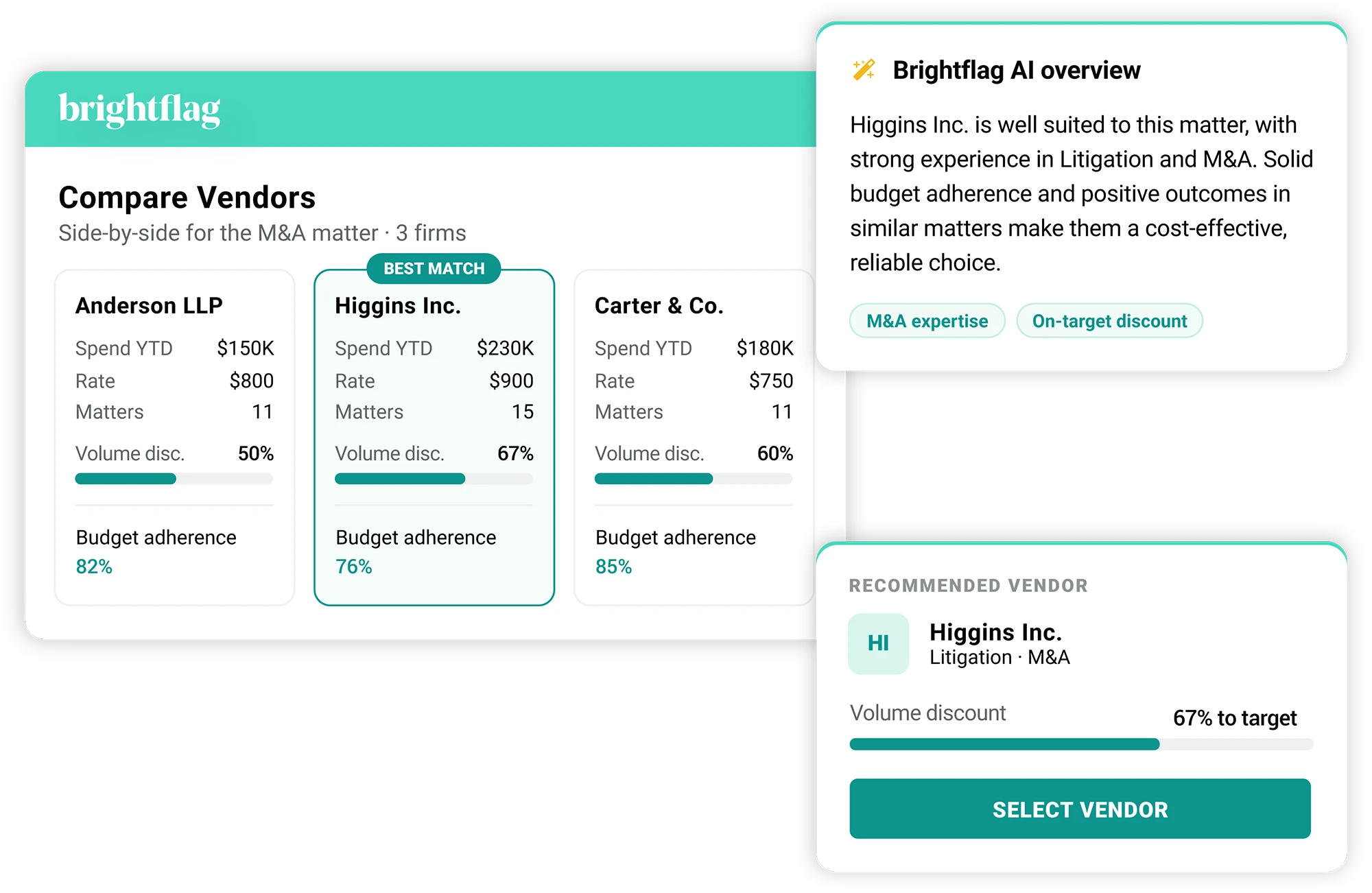
Your legal team can run reports in their ELM to compile this benchmark data manually, then use it to compare panel firms and select the best, most cost-effective ones for each of their matters. However, if your ELM offers built-in vendor benchmarking functionality, this process can be effectively automated.
Brightflag’s Advanced Vendor Management tool, for example, allows legal departments to instantly condense all of their data into concise vendor profiles. This makes side-by-side firm comparisons that much easier, and enables your legal team to identify the perfect firm for every matter, every time.
Chapter 5
The Tools You Need to Maximize Outside Counsel Value
By leveraging data, legal departments can move beyond reactive conversations towards more strategic partnerships with their firms. Better benchmarking, more informed rate negotiations, and data-driven firm selection all help create greater predictability. This enables stronger budget control, and increased confidence that every dollar of outside counsel spend is delivering value.
But these outcomes are only possible when you have the right foundation: A comprehensive system of record for your spend and matter data that pulls everything together into a reliable, single source of truth.
If you’re ready to maximize the value of your data and your outside counsel partnerships, book a personalized demo of Brightflag today, and see firsthand how our cutting-edge Advanced Vendor Management functionality, MCP integrations, and integrated AI tools are changing the way in-house teams operate.
Related Resources


See Brightflag in action
Put this playbook to work. See how legal teams use Brightflag to manage outside counsel, control spend, and prove their value — in a 30-minute walkthrough.