Legal E-Billing Software
See how Brightflag's legal e-billing solution streamlines work and unlocks deeper insights into matters, vendors, and spend.
Legal E-Billing: A Guide for In-House Legal Departments
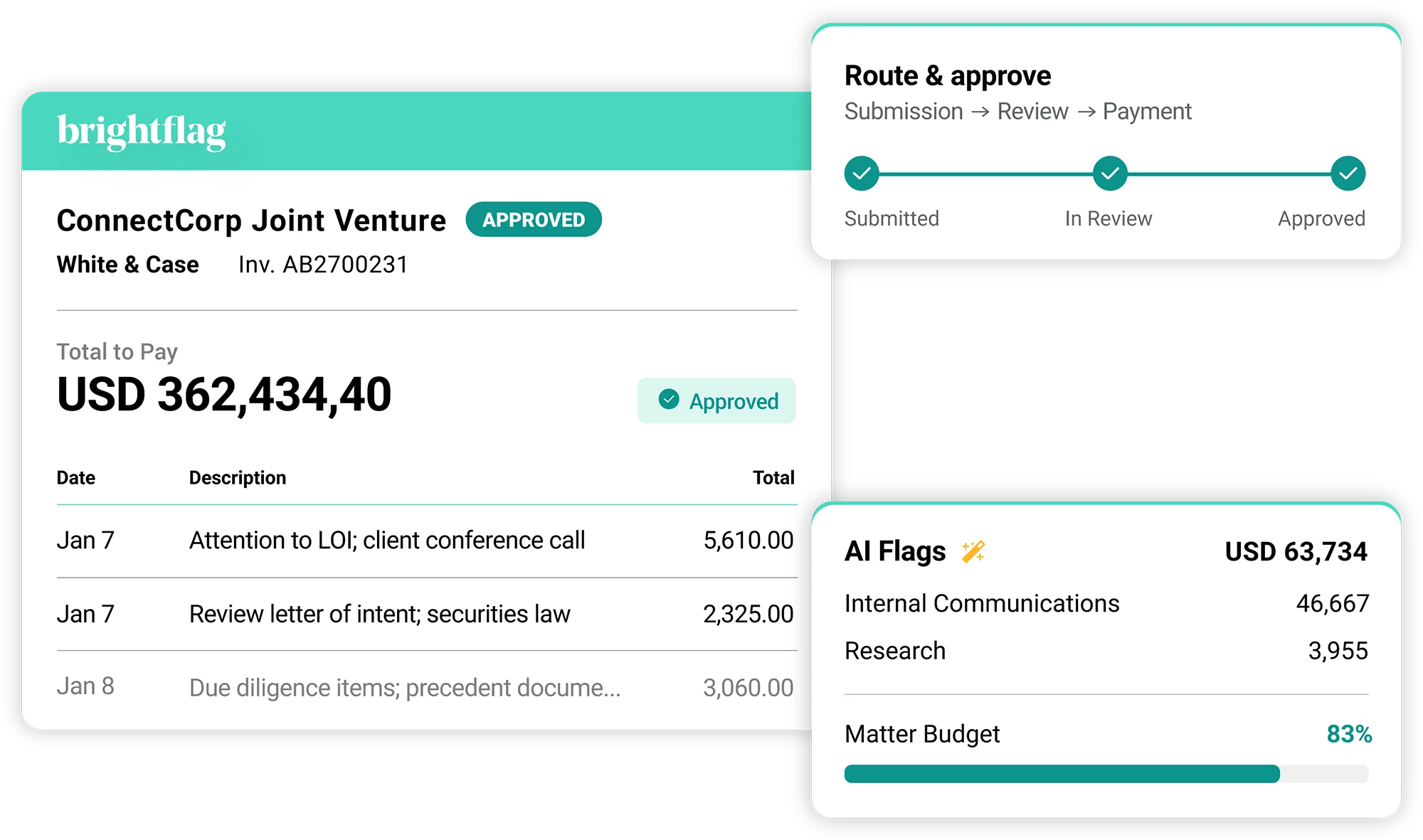
Legal e-billing is the electronic submission, review, approval, and payment of outside counsel invoices. Legal e-billing platforms facilitate this process by allowing law firms to submit invoices through a centralized portal, where they can be reviewed, amended, and approved by the in-house legal team before being routed for payment.
The best legal e-billing tools apply AI to the process to automate time-consuming tasks such as line item review, outside counsel guideline application, and data analysis. This saves legal departments time and unlocks deep strategic insights into the in-house team’s matters, vendors, and spend.
The CLOC State of the Industry Report found that 85% of legal departments now use electronic billing systems. This guide covers how legal e-billing works, how legal e-billing solutions streamline the process, and what its benefits are for in-house legal teams.
What Is Legal E-Billing Software?
Legal bill review software analyzes invoice line items against your outside counsel guidelines and agreed rates, flagging non-compliant charges before payment. It’s the step where most of the financial value in legal e-billing actually sits.
Traditional legal bill review services outsource this to a team of human reviewers, typically on a contingency fee. AI-powered review takes a different approach: every line item on every invoice is checked automatically, consistently, in minutes.
What that catches in practice:
- Rates above your agreed caps
- Unapproved timekeepers
- Block billing and vague narratives
- Duplicate entries and non-compliant work
- Expenses prohibited by your guidelines
- Missing volume discounts
Brightflag’s legal e-billing solution can even provide a generative AI summary of the work performed on each invoice, delivered to your inbox. From there, invoices can be approved directly from your email, or opened in the platform for further review if the flagged issues warrant a closer look.
Real-time feedback to firms at submission matters just as much. Surfacing a violation before the invoice enters your queue improves the next submission and gets your firms paid faster.
How Does Legal E-Billing Software Work?
Within a legal e-billing platform, the process typically unfolds across five stages, each of which can be largely automated:
- Submission. Firms upload invoices to a secure portal, with validation checks running at the point of submission.
- Classification. Line items are mapped to standardized task and activity codes so work is classified consistently across firms and matters.
- Review. Outside counsel guideline violations, rate discrepancies, and duplicate billing entries are flagged by AI before a human ever opens the invoice.
- Approval. Workflows route invoices by matter, value, or practice area to the designated approvers, with reminders for pending items.
- Payment. Approved invoices flow to AP/ERP automatically.
LEDES, PDF, XML. Which Invoice Formats Should Legal E-Billing Tools Accept?
All of the above.
LEDES (Legal Electronic Data Exchange Standard) is the structured file format built for legal invoicing, and it’s what most e-billing systems were designed around. But international and boutique firms often can’t produce LEDES files, and finance teams frequently want a PDF for their records.
Adding to this, e-invoicing mandates like those in the EU now often require invoices to be submitted in an XML (or XML-embedded) format.
That’s why the stronger approach is a platform that can extract structured data from all these formats, allowing 100% of your legal spend to be analyzed regardless of how it arrived.
Where UTBMS Codes Fall Short
UTBMS codes standardize how timekeepers describe their work. They’re useful, but every attorney interprets them a little differently, which makes cross-firm comparison unreliable.
AI classification solves this by applying consistent definitions to every line item, independent of who typed the narrative. That consistency is what makes benchmarking meaningful.
Integrating Legal E-Billing with a System of Record
A legal e-billing solution that streamlines the invoice review process will save legal departments time. But it won’t give them the comprehensive data insights they need to optimize how they manage their matters, vendors, and spend.
That’s what makes a legal e-billing tool that’s fully integrated into an enterprise legal management (ELM) system of record such a game-changer.
An ELM system of record takes the data collected from your invoices, structures it, centralizes it, and enables it to be easily accessed to unlock deep strategic insights into things like:
- How legal spend is tracking at the overall, practice area, and matter level
- How matters are progressing
- Which outside counsel firms are delivering the best, most cost-effective legal services
- And much more.
What Legal E-Billing Analytics Your Tools Should Track
Once your data is governed, legal spend management stops being retrospective. Some of the metrics legal e-billing software can capture which consistently shape decisions are:
- Spend by matter type, to establish what work within each practice area actually costs
- Effective rate by firm, which often diverges from rack rates
- Outside counsel guideline compliance by firm, which can serve as the basis for a specific rather than general conversation around billing hygiene
- Budget-to-actual by matter, to help flag budget overruns early enough to intervene
- Cycle time from submission to payment, which provides direct insights into firm efficiency
Intuitive reporting capabilities can streamline the process of turning this data into actionable insights. Or, if your legal e-billing platform has a generative AI assistant (like Ask Brightflag), you can skip manual report-building entirely and simply ask for the data you want using natural conversation, and get an answer in seconds.
What Are the Benefits of Implementing a Legal E-Billing Solution?
A Forrester Total Economic Impact™ study commissioned by Brightflag found a 387% ROI over three years for a composite organization implementing Brightflag as its first ELM.
These benefits came from improved billing compliance, captured discounts, avoided non-compliant timekeeper rate charges, better budget visibility, and invoice review productivity. One telecom legal ops leader described weekly reporting dropping from a full day to a few minutes.
And for teams replacing a legacy e-billing platform, a Forrester Total Economic Impact™ study commissioned by Brightflag found a 335% ROI and $958K NPV—evidence that the gap between older legal e-billing systems and AI-native ones is itself worth closing.
See Legal E-Billing in Action
The fastest way to understand modern legal e-billing is to use it.
Take a 2-minute self-guided tour of Brightflag below—no form to fill out, no sales calls—and see for yourself:
Legal E-Billing FAQ
What is e-billing in legal?
The electronic submission, review, approval, and payment of legal invoices through a dedicated platform rather than email and spreadsheets.
How is legal e-billing different from legal billing software?
Legal billing software is built for law firms to create and send invoices. Legal e-billing is built for in-house departments to receive, review, and analyze them.
Do law firms have to use LEDES?
Not with a platform that accepts PDFs and extracts the data automatically. Requiring LEDES narrows your panel unnecessarily.
How long does legal e-billing implementation take?
According to a Forrester Total Economic Impact study commissioned by Brightflag, a composite organization deployed Brightflag in just six weeks.