The Legal Operations Guide to Legal Spend Management
 9 chapters
•
9 chapters
•
 13 min read
In This Guide

A maturity model to help you chart out where improvements to your spend management model will have the greatest impact—no matter the size of your legal department

A full breakdown of the initiatives successful legal ops teams implement to get the most out of spend management

Examples of how legal operations can leverage AI to free up time and resources for their in-house team
Table of Contents
Introduction
Every legal operations professional knows that legal spend isn’t just a number—it’s a narrative. It reflects how strategically the legal team supports the business, how work flows across matters and stakeholders, and where opportunities for greater efficiency and impact are emerging.
A modern approach to spend management brings that narrative into focus. When legal ops teams unify data, introduce consistent processes, and leverage purpose-built technology, they unlock the insights needed to guide smarter resourcing decisions, strengthen cross-functional alignment, and clearly demonstrate the value legal delivers.
This guide explores the core components of an effective legal spend management program—and how legal operations can use these practices to maximize resources, elevate legal’s strategic influence, and help the department operate with greater clarity, confidence, and impact.
Benchmarking Your Legal Spend Maturity
A maturity model helps legal operations professionals to understand the current state of their legal spend management and identify areas for improvement.
Here are the four stages of legal spend management maturity, and what legal operations professionals should focus on at each stage to push their legal departments to the next level:

Ad Hoc
At this stage, spend management processes are informal or nonexistent. Teams rely heavily on manual data entry, disconnected systems, and anecdotal insights. There is little ability to track spend in real-time or enforce billing standards.
Most teams start here, and it works fine at low levels of spend. However, as the company, the team, and legal spend start to grow, the ad hoc approach can start to feel chaotic, signalling that a change is needed.
- What Legal Ops Should Prioritize: Establish a foundation for visibility and control by setting up a system that enables real-time oversight of spend. Additionally, work on automating invoice workflows to reduce manual work.

STANDARDIZED
At the Standardized stage, legal operations teams have introduced structure: consistent invoice workflows, documented outside counsel guidelines, and predictable month-end processes. Finance receives timely data, and the department has a clearer view into spend patterns. Many teams at this stage have also implemented an e-billing system, though adoption and optimization may still be evolving.
With the fundamentals in place, legal ops can begin moving from reactive reporting to proactive insight generation.
- What Legal Ops Should Prioritize: Build on your foundations by turning data into actionable insights. Examine trends—such as cost spikes by business unit, matter type, or region—to inform resourcing strategies and budget planning. Look for opportunities to automate recurring tasks like accruals collection or spend-to-budget reporting. These improvements not only increase efficiency but also strengthen legal’s relationship with finance through more reliable, self-serve reporting.

OPTIMIZED
At this level, legal operations teams are fully leveraging their tech stack to automate core processes such as invoice review, budget tracking, accruals, and vendor evaluations. Data is centralized, accurate, and readily available. Legal ops can deliver
deeper insights into work distribution, staffing patterns, and spend drivers—and can support leadership with confidence during planning cycles or executive reporting.
The focus shifts from establishing visibility to using data to shape more intentional, cost-effective decisions.
- What Legal Ops Should Prioritize: Apply your data systematically to drive strategic improvements in resourcing and vendor management. Implement structured law firm scorecards, benchmarking, and performance reviews to encourage consistent, cost-conscious behavior from outside counsel. Use trend analysis to forecast future needs, inform hiring decisions, and shape long-term operational plans.
STRATEGIC
At the Strategic stage, legal spend management becomes a core capability that consistently informs how the legal department operates. Predictive analytics, historical benchmarks, and firm-level performance data guide budgeting, staffing, and vendor selection. Legal ops becomes a trusted strategic partner—delivering reliable forecasts, reducing risk, and providing insights that influence enterprise decision-making.
At this maturity level, financial and operational excellence reinforce each other. Legal ops brings discipline, clarity, and innovation, while the business gains confidence in legal’s ability to plan, execute, and optimize.
- What Legal Ops Should Prioritize: Leverage AI-driven insights and matter- level data to enhance resourcing and firm selection. Historical performance benchmarks—resourcing mix, cost efficiency, and qualitative feedback—enable more strategic vendor evaluations and help match matters to the right firms. For high-spend or high-risk matters, these insights support more precise budgeting and more informed conversations with both legal leadership and finance.
The Features Legal Ops Needs from Their Legal Spend Management Program
Whether you’re currently building out a plan for managing your legal department’s spend, or you have an established program in place that you’d like to optimize, it’s important for legal operations teams to become familiar with the core features that all successful legal spend management programs share.
CENTRALIZED SPEND VISIBILITY
Centralized spend tracking is the foundation of effective legal spend management. It involves creating a unified system where all legal spend data is stored. Instead of having your in-house team’s invoices, matters, budgets, and accruals scattered across spreadsheets, emails, and personal drives, it consolidates everything in one place and makes it all easy to track.
Below you can see an example of how this works using the spend dashboard in Brightflag:
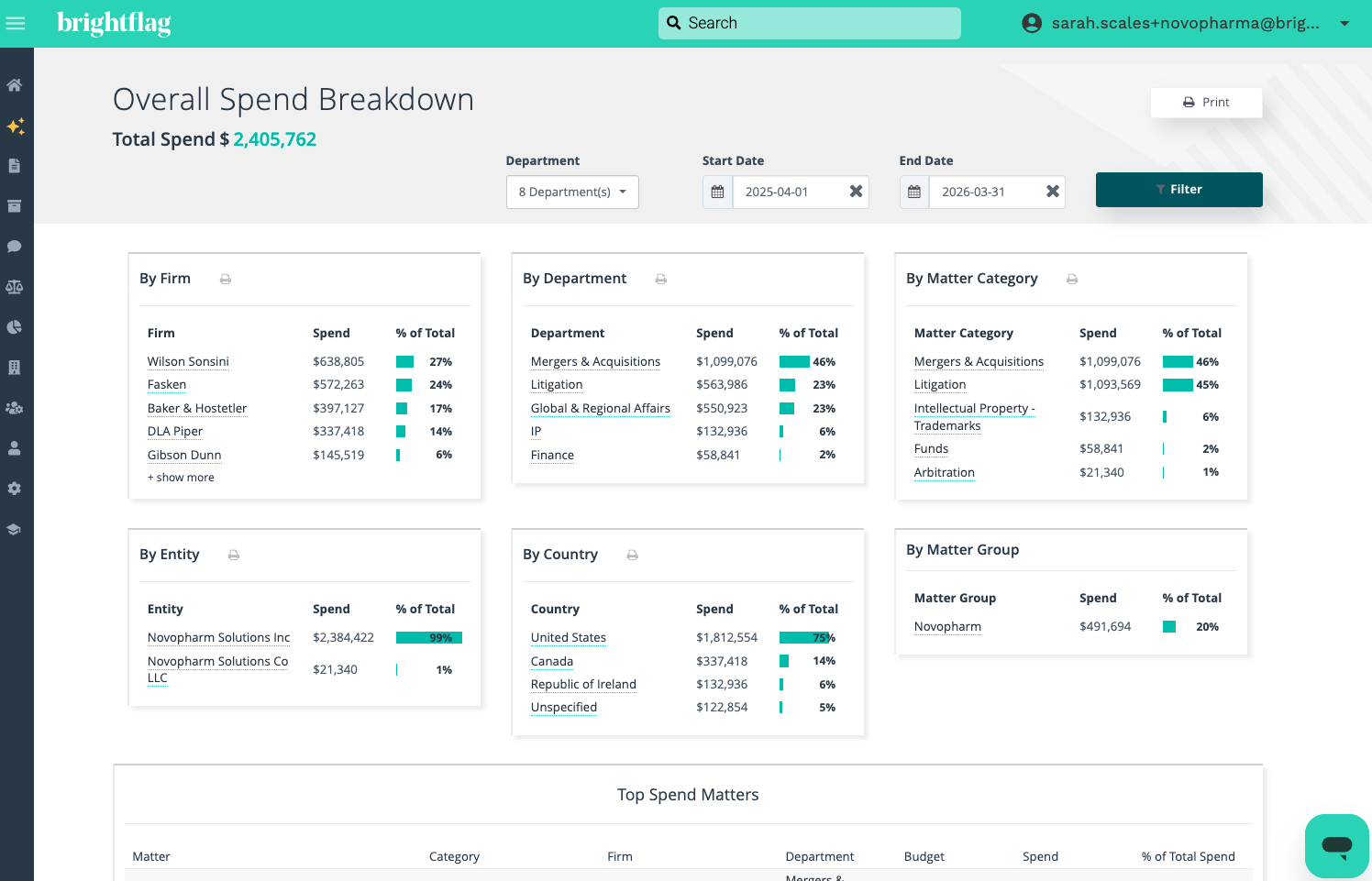
By centralizing all your spend data, your legal department gets real-time visibility into where money is going by vendor, practice area, department, geography, and more—with click-through options for matter insights. This enables immediate spend insights for faster resourcing decisions, and more clarity into how work is tracking against budget.
BUDGETING AT EVERY LEVEL OF SPEND
Budgeting provides the framework for effective legal spend management. It not only helps with planning for future legal spend, but also provides benchmarks that your legal team can use to gauge in real-time when spend is trending beyond what was expected.
It’s particularly important for legal operations to get budgeting right, because demonstrating good financial stewardship can strengthen legal’s partnership with finance. This, in turn, can make it easier to advocate for the resources the department needs come annual budget planning season.
Developing accurate overall budgets is a good starting point. But as your legal department’s budgeting process matures, you’ll want to begin getting more granular to secure deeper insights. That means setting budgets at the practice area and matter level as well.
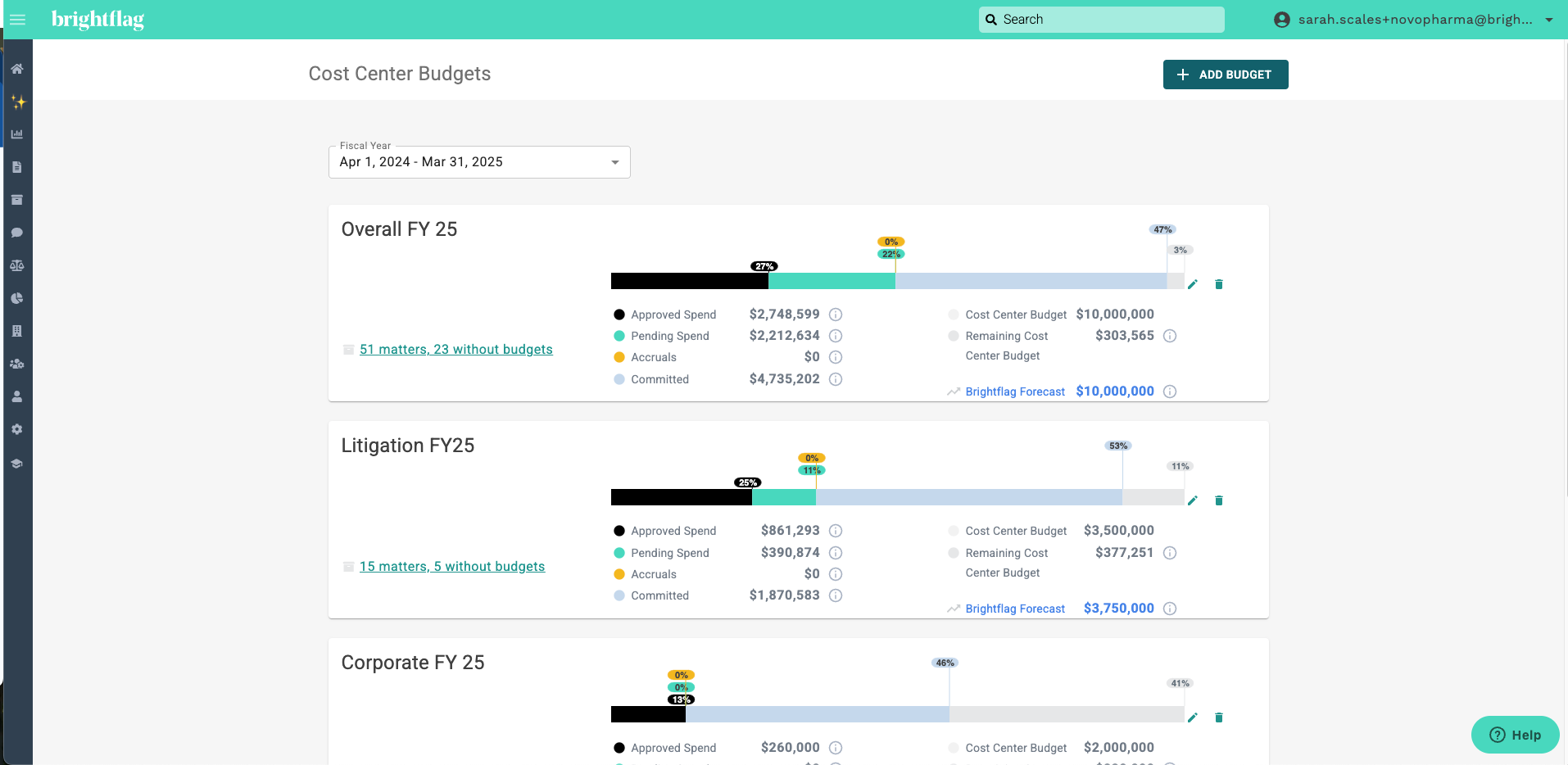
Above you can see an example of budget tracking at the overall and cost center levels in Brightflag. This level of oversight gives legal teams the data they need to allocate resources where they’ll have the greatest impact, and surface variances and trends before they become problems.
AUTOMATED ACCRUALS COLLECTION AND REPORTING
Chasing down accruals information from law firms and submitting everything to finance before their monthly deadline can create a lot of work for legal teams. And even with all that effort, it can be tricky to ensure every firm submits on time each month.
Thankfully legal ops can streamline the legal accruals process by automating how data is collected from law firms and submitted to finance.
With a legal spend management tool like Brightflag, for example, legal teams can schedule accrual requests and handle the outreach with automated reminders—including a centralized dashboard to track responses. This ensures firms submit accurate, timely accruals data in a consistent format every month.
Once responses are collected, your legal spend management system should make it easy to send accruals data in a format tailored to finance’s needs via an automated, scheduled report—reducing manual work and improving cross-functional collaboration. The result is a faster, more reliable accruals process that enhances accuracy, improves firm accountability,
and ensures legal is always ready for audit or reporting requirements.
OUTSIDE COUNSEL SELECTION AND MANAGEMENT
Engagement with outside counsel firms typically accounts for the majority of corporate legal spend. That’s why legal operations must work diligently to ensure the in-house team is engaging the right outside counsel partners to deliver the right outcomes for the business at the right cost. Your legal team’s own historical data, as well as industry benchmarks, are the
fuel that can help you get there.
Leaning on Data to Choose the Right Outside Counsel Firm
For in-house counsel, trust plays a major role when selecting which outside counsel firms to partner with. Oftentimes firms with long-standing working relationships with your legal department, who understand the nuances of your organization well, will be the ones that earn your business.
But balancing these trusted relationships with data insights can ensure that outcomes are delivered in a cost-effective manner.
Historical data can help you quickly compare firms across dimensions that directly affect budget predictability and outcomes including:
Staffing patterns: How do firms typically resource similar matters?
Cost efficiency: Do firms charge us for non-value-add work, like basic research or multiple partners attending the same calls and meetings?
Budget adherence: Do their actuals consistently align with approved budgets?
Performance: Have the firms scored well on vendor performance surveys you have run?
Complementing the qualitative strengths of your existing firm relationships with these quantitative insights can be a huge value multiplier.
Ongoing Outside Counsel Management
Maintaining a good relationship with your outside counsel firms requires a commitment from your in-house team to regularly share honest feedback with firms on where they can improve—and a commitment from outside counsel to take that feedback to heart.
Ultimately, your firms want to understand your priorities around cost, risk, and service delivery. And the best way for your in-house team to communicate those priorities is by leading with data in your touchpoints with them.
Key areas where data can be leveraged include:
Timekeeper rate negotiations:
Rate increase requests from law firms roll in like clockwork every year. But in-house teams aren’t powerless to push back against them—especially if they are equipped with data around what constitutes a fair market rate.
Benchmarking requested increases against a resource like Brightflag’s Am Law Rates Report, or against benchmarking data provided by your legal spend management tool, can set the stage for fair, market-aligned negotiations around rates. This, in
turn, directly improves cost control
Ongoing relationship reviews
Managing outside counsel relationships requires diligence from the legal operations team. That means monitoring data on work delivery and performance throughout the year, and regularly checking in with firms to review.
Your spend management system is a powerful tool for gathering the data that can drive these conversations. Matter-level data, for example, can be used to identify patterns and calibrate expectations around staffing—ensuring it aligns with matter complexity and your in-house team’s expectations. Similarly, recurring billing issues can be automatically flagged by your spend management system for deeper analysis and discussion.
One helpful way for legal operations teams to structure these conversations is by creating a vendor scorecard tailored specifically for the firm they’re sitting down with for a review. These scorecards can assign numerical scores to the aspects of outside counsel work that are most important to the legal team (e.g. resourcing, reliability, billing hygiene). And they can also include benchmark data from other firms the department is working with related to things like blended hourly rate and budget adherence to drive better outcomes.
AI in Legal Spend Management: What Matters Most for Legal Operations
Legal operations is fundamentally about enabling the in-house team to work efficiently and deliver maximum value to the business. Legal AI tools are designed with those same goals in mind. That’s why more legal operations teams are now embracing AI to enhance efficiency,
Here are a few of the key ways that legal operations teams are successfully utilizing AI to deliver value for their in-house team.
AI-POWERED INVOICE REVIEW
Manual invoice review often consumes hours of the legal department’s time—time that could be invested in managing risk, developing strategy, or executing advisory work.
AI-powered invoice review automates the first-pass analysis of every line item, flags potential issues, and applies billing guidelines consistently.
Below, you can see an example of how Brightflag’s AI invoice review automatically flags non-compliant line items and categorizes tasks and activities.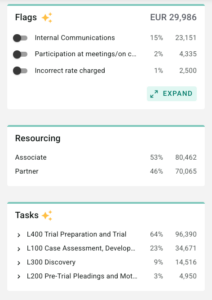
For legal operations, this delivers:
Time savings
Legal teams no longer have to devote time to manually combing through invoices
Better cost control
AI reduces the risk of billing errors and non-compliant charges slipping through the cracks
Data for more strategic decision-making
AI classifies the tasks and activities performed on each line item of your invoices, building a rich picture of resourcing and staffing for a more effective spend management strategy
SUMMARIZATION
One of the areas where AI really shines is in its ability to distill large amounts of complex information into easily digestible summaries. That makes it the perfect tool for removing the manual, time-consuming work of reviewing legal invoices from in-house team’s workloads.
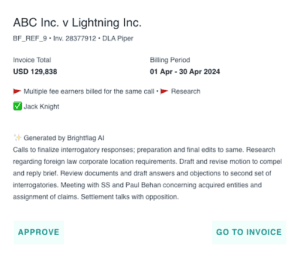
Brightflag’s Invoice Summaries feature, for instance, uses AI to deliver a concise summary of the work performed on each invoice via email, which includes the key tasks carried out. From that email, reviewers can also choose to review an invoice in more detail, or approve the invoice directly with one click.
GENERATIVE AI AGENTS
Generative AI agents are autonomous systems built on large language models that can understand instructions, take actions on behalf of users, and continuously adapt based on new information.
For legal operations teams, they can be a useful tool for streamlining complex workflows—like reporting and knowledge retrieval—with minimal human intervention.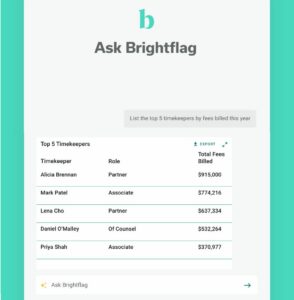
Say, for instance, that legal leadership and/or finance have a question that needs a quick answer. A question like:
What have we spent on [high-risk matter] this quarter?
How is spend trending to budget?
What areas of the business are driving the most outside counsel instructions?
With a simple prompt, a generative AI agent like Ask Brightflag can share instant, accurate answers to these questions—eliminating the need to build reports, tweak filters, or guess which data fields to include in order to get the insights you need.
In turn, legal teams reap the benefits of:
- Faster cross-functional decision-making with legal leadership, finance, and business executives
- Less time spent collating reports and more time delivering high-impact work
- Instant data to drive more agile planning
DEVELOPING AN OUTSIDE COUNSEL AI STRATEGY
Law firms are increasingly using AI for research, drafting, diligence, and discovery. So how can legal operations ensure the value created through these various applications flows to their legal department?
Developing a strategy for how outside counsel should effectively deploy AI on your matters, and clearly communicating it with your firms, is a great start. Conversations around AI usage should center around the following core principles:
Value creation: Outside counsel should be encouraged to adopt generative AI tools where they improve work quality and/or result in work being delivered at a better price.
Data protection: Your data should not be used to train AI models unless the model is purpose-built for your exclusive use.
Cost expectations: Firms should not charge ‘pass-through’ costs for their use of AI tools or computing resources. Billable time should reflect the effort and expertise of human lawyers, not the background infrastructure supporting them.
For a full breakdown on how legal operations can encourage the best use of AI by law firms and measure its impact, check out Brightflag’s “How to Create an Outside Counsel AI Strategy” guide.
Conclusion
Legal spend management sits at the heart of the legal operations function—not only because it supports responsible cost stewardship, but because it can both directly and indirectly shape how the entire legal department operates.
Legal spend management initiatives like centralizing data, automating manual processes, and thoughtfully integrating technologies like AI are means by which legal operations can optimize their department’s resources. But they also go a step further, helping to create the conditions required to unlock better workflows, more reliable reporting, and a stronger strategic foundation for legal service delivery. With these capabilities in place, legal ops is positioned to elevate the department’s impact and help legal deliver meaningful, measurable value to the business.
Related Resources


See Brightflag in action
Put this playbook to work. See how legal teams use Brightflag to manage outside counsel, control spend, and prove their value — in a 30-minute walkthrough.