EU E-Invoicing: A Legal Department Guide
E-invoicing requirements are rolling out across the EU, and by the end of 2026, they’ll be mandatory in many EU countries — especially for local, domestic transactions.
For corporate legal departments in the EU, that’s an important shift to plan for: e-invoicing adds a new, government-facing step to the invoice review, approval, and payment process. That’s exactly why it’s so important for EU legal departments, and the vendors they rely on, to have a plan in place for complying with their locality’s e-invoicing requirements.
Here’s what e-invoicing is, why the EU is implementing it, what it means for how vendor invoices flow through your legal department, and how Brightflag is helping legal teams and their law firms stay compliant as requirements take hold jurisdiction by jurisdiction.
What Is E-Invoicing?
E-invoicing (electronic invoicing) is the exchange of invoice data in a structured, machine-readable format — think UBL, XML, or PDF with embedded XML — rather than a PDF or paper document that a person has to read and manually key into a system.
Because the data is structured, it can be validated, transmitted, and processed automatically by both businesses and tax authorities, with far less manual handling than a traditional invoice.
This is the core distinction worth remembering: a PDF invoice is electronic, but it isn’t a true e-invoice unless the data itself is structured and machine-readable.
Why is EU E-Invoicing Being Implemented?
The EU’s e-invoicing push is anchored in the VAT in the Digital Age (ViDA) initiative, which introduces Continuous Transaction Controls (CTCs) — mechanisms that give tax authorities real-time or near-real-time visibility into business transactions.
ViDA and the national mandates built on it are generally framed around three regulatory goals:
Improving compliance with local tax regulations,
Gaining operational efficiency through fewer manual errors and faster processing at the tax-authority level
Enabling cross-border scalability by standardizing invoice formats so businesses can trade across EU member states more easily.
Is E-Invoicing Mandatory in the EU?
By the end of 2026, e-invoicing will be mandatory in many EU countries, particularly for domestic business-to-business (B2B) transactions. Belgium, Poland, France and Italy already require it. Germany, and others are phasing in B2B e-invoicing mandates by the beginning of 2027.
Because outside counsel invoices for local matters are exactly the kind of domestic transaction these mandates target, EU legal departments need a plan for complying with e-invoicing standards now, not once a mandate is already in effect.
Why are EU E-Invoicing Mandates Different in Every Country?
Once ViDA took effect in April 2025, EU member states no longer needed sign-off from the European Commission before rolling out their own domestic e-invoicing mandate.
That single change is what set off the wave of national rules we’re seeing now.
Each country has picked its own enforcement model and format from there. Poland’s KSeF, for example, is a clearance system: invoices have to be submitted to and validated by a central government platform before they’re even legally issued. France is taking a different route; a reporting model where the invoice moves between businesses first, and the tax authority just gets a copy alongside it.
The good news? Ahead of the EU’s 2030-2035 implementation timeline, that fragmentation is already starting to pull back together, with the semantic layer merging first.
In February 2026, CEN formally approved the updated EN 16931-1:2026 standard, rewritten to cover B2B use (not just B2G). France and Germany are updating their own formats, Factur-X and XRechnung, to stay aligned with it. Meanwhile, Italy is still catching up: its FatturaPA format runs smoothly, but isn’t natively EN 16931-compliant, and closing that gap is exactly what the 2035 deadline is designed to force.
The Pre-Invoice-First Approval Workflow: A Legal E-Invoicing Solution
For legal departments, our recommended approach to legal e-invoicing is built around the pre-invoice-first approval workflow.
In a pre-invoice-first approval workflow, invoice review and approval happens first, inside your spend management platform. From there, the approved invoice is routed back to the supplier (i.e. the outside counsel firm), who then sends it on to the government portal or network. Then, once it’s approved, it’s sent from the network to your organization’s AP department for payment.
How Pre-Invoice-First Approval Works
Here’s what a pre-invoice-first workflow looks like in practice. In this example, Brightflag is serving as the legal spend management system of record, with the outside counsel law firm serving as the “supplier,” and a corporate legal department as the “buyer.”
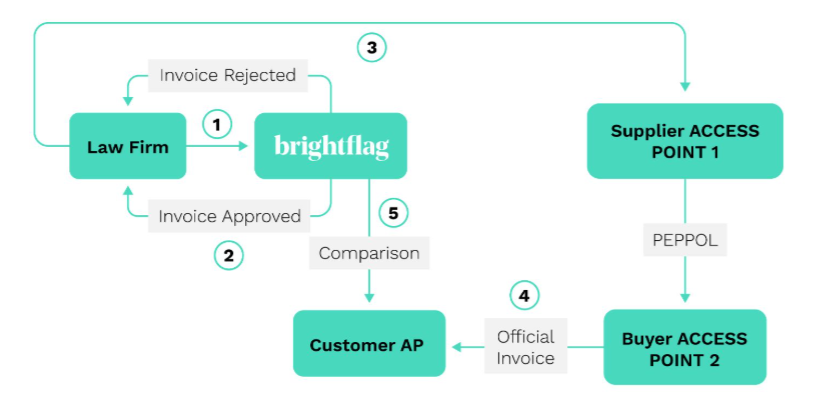
The step-by-step breakdown:
- Law firm submits. The firm submits its invoice (PDF or LEDES) in Brightflag, as they always have.
- Legal reviews and approves. Your team reviews and approves the invoice in Brightflag, against your outside counsel billing guidelines and internal standards — before it goes anywhere near a government portal.
- Brightflag notifies. Once approved, the vendor receives a tailored notification confirming the invoice is ready to submit.
- Vendor submits to the network. The law firm uploads the approved invoice to the relevant e-invoicing network (PEPPOL, KSeF, SDI, and so on).
- Network delivers to AP. The official invoice reaches your accounts payable system for payment, with an optional reconciliation step so AP can match the network invoice against the Brightflag-approved record.
Where Pre-Invoice-First Workflows Can Be Used for Legal E-Invoicing
Pre-invoice-first can be used in any country, regardless of your specific jurisdictional e-invoicing mandates, integrating into other popular e-invoicing workflows like:
- The Post-Audit Model, where businesses exchange invoices directly (often through interoperability frameworks like PEPPOL) without a mandatory real-time government checkpoint. Tax authorities retain the right to audit those invoices retrospectively.
- The Clearance Model, where the supplier—or, in the context of legal work, the law firm— must submit the invoice to a government platform for validation before it can be delivered to the buyer (i.e., the corporate legal department). The tax authority effectively “clears” the invoice as a required step in the billing process.
- The Centralized Exchange (CE) Model, a real-time or near-real-time process where suppliers send transactional data to the tax authority, which then routes it on to the buyer. The government platform sits in the middle of every transaction rather than just auditing after the fact.
The Benefits of Pre-Invoice-First Approval for Legal E-Invoicing
Pre-invoice-first approval doesn’t eliminate the extra steps e-invoicing introduces, but it does address three important aspects of e-invoicing that typically complicate the process:
You control what gets paid.
Approving the invoice in Brightflag first ensures the invoice that eventually goes to the government network aligns with your outside counsel billing guidelines and internal standards, rather than discovering a discrepancy after it’s already been submitted.
You maintain full visibility.
Brightflag remains your system of record for legal spend and matter management, so every e-invoiced transaction is still captured in the platform you already use to track spend, even as it also has to pass through a government portal.
You stay in control of your approval requirements.
Brightflag continues to enforce your standards for invoice approval authority, even as the underlying compliance requirements vary widely from country to country.
What’s Next: Brightflag’s Legal E-Invoicing Solution Roadmap
Brightflag’s product roadmap is focused on keeping pace with new e-invoicing standards and reducing the manual work involved in the government-submission step, for both in-house teams and outside counsel:
- Native e-invoicing formats. Support for Germany’s ZUGFeRD and France’s Factur-X (PDF with embedded XML).
- Built-in validation. Beyond the formats above, Brightflag’s roadmap includes validating UBL and XML e-invoices directly, alongside traditional LEDES and PDF formats, and expanding Brightflag’s data schema to capture the additional fields e-invoicing mandates require.
- Direct network submission. Brightflag is exploring a direct connection to e-invoicing networks, so an approved invoice can be submitted to the relevant government network automatically — removing the manual submission step altogether.
The direction is consistent: your team keeps the review and approval control it has today, while Brightflag takes on more of the format and submission work required to comply with each new mandate.
FAQ: E-Invoicing for Legal Departments
What is the best e-invoicing workflow for legal departments?
Brightflag recommends the pre-invoice-first approval workflow regardless of a country’s specific e-invoicing model, since it gives your team the chance to review invoice content for accuracy and compliance before it’s submitted through any government portal.
Which e-invoicing requirements apply in my country?
It depends on where your outside counsel is billing from. As of mid-2026: Belgium uses a post-audit model; Poland uses a clearance model; Italy uses a centralized exchange model; and France uses a Y-model. Because requirements evolve, it’s worth confirming the current status for any country where you engage outside counsel.
Does e-invoicing make invoicing simpler for legal departments and law firms?
Not on its own. E-invoicing adds a new, government-facing step to the billing process — the invoice or its underlying data has to reach a tax authority or government network in a specific format — on top of whatever legal review and approval already happens today. The efficiency and cross-border scalability that e-invoicing mandates are designed to deliver are primarily benefits to tax administrations, not something legal departments or their law firms should expect from the requirement itself. What legal departments can control is how well they plan for that added step, so it doesn’t create duplicate payments, delays, or gaps in spend visibility.
Do we need a separate e-invoicing software solution, or does this fit into our existing legal spend management platform?
E-invoicing compliance is best managed as part of the platform you already use to review and approve outside counsel invoices, rather than as a separate, bolted-on system — otherwise you risk losing visibility into spend the moment an invoice moves into a government network. That’s the approach Brightflag is built on: one system of record for review and approval, with e-invoicing compliance handled alongside it rather than as a disconnected extra step.
What e-invoicing standards does Brightflag support?
Brightflag supports LEDES and PDF invoices today, with law firms able to attach UBL or XML e-invoices in the interim. Native support for structured formats — including ZUGFeRD and Factur-X — is rolling out through the second half of 2026, with additional country-specific formats to follow.
How can we tell an invoice reaching AP via a government network was already approved in Brightflag?
Brightflag can send a copy of the approved invoice to AP at the point of approval, invoice status can be checked directly in Brightflag, and a scheduled report of approved invoices can be configured for AP visibility. A reverse feed can also be set up from your AP system to confirm when an invoice has been processed and paid.
Want to see how Brightflag’s AI-powered ELM platform is streamlining how legal teams manage matters, vendors, spend, and e-invoicing? Book a Demo today.
Share: